This article contains advertising. Some of the hotel, tour, activity, flight and transfer links in it are paid links: if you book through one, we get a commission from the booking company, and your price is the same either way. It never affects what we recommend. Affiliate disclosure
Athens International Airport (ATH) has one main terminal building and one satellite building, joined by an underground link, and every flight checks in at the main building. This Athens airport terminals guide explains how the gate areas, security, passport control, lounges and services fit together, so you know where you are going before you reach the kerb at Departures.
It is written for anyone flying in or out of Athens, connecting through it, or dropping bags before a last day in the city. The caveat that matters most in 2026 is passport control: since the EU’s Entry/Exit System went live in full, non-EU travellers can face long queues, and the airport’s advice is to arrive at least 2.5 hours before departure. Details checked 8 November 2026 against Athens International Airport, OASA, ONExchange and CARE4BAG. If you are heading straight on to a ferry or an island flight, our hub on getting from Athens to the islands picks up where this page stops.
| Question | Short answer |
|---|---|
| How many terminals? | Two buildings: the Main Terminal Building (gates A1-A27 and B1-B31) and the Satellite Terminal Building (gates C15-C40) |
| Which area will my flight use? | Area A for non-Schengen flights, Area B for Schengen flights, C gates in the Satellite; check the screens, gates change |
| How early to arrive? | The airport advises at least 2.5 hours before departure |
| Wi-Fi | Free “ATH Free Wi-Fi”, 120-minute sessions, reconnect free |
| Left luggage | CARE4BAG on the Arrivals level, from €8 for up to 6 hours (small bag) |
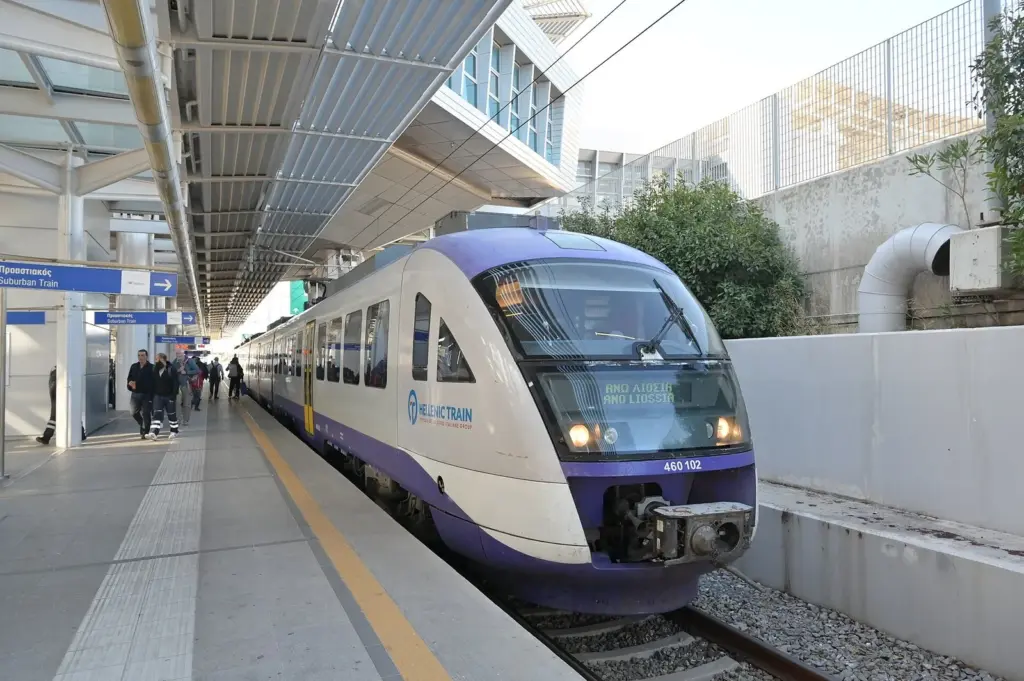
| Into the city | Metro Line 3 (€9 full fare), Airport Express buses (€5.50), taxis, suburban railway |
| Busiest time | The summer island season; give yourself more slack from June to September |
What’s changed in 2026?
Three things will catch out anyone working from an older guide, or from a trip a few years back.
Passport control is slower for non-EU passports. From 30 March 2026 the EU Entry/Exit System has been fully deployed for third-country nationals at Schengen borders, Athens included. The airport warns that passport control may be significantly affected, with long waits. Its blanket advice is 2.5 hours before departure, for check-in, security and passport control where it applies, and it adds that arriving late at the gate can mean being denied boarding. EU citizens skip the registration, but they share the halls and the queues with those who don’t.
A long building programme is under way. The airport has announced a multi-year expansion of both the main and satellite terminals, with completion expected by 2032 and the works delivered in phases; the budget and tender plans have been revised since the first announcement in December 2025. The airport itself flagged possible temporary inconvenience along the way, so expect hoardings, reshuffled walkways and the odd relocated shop for some years.
The taxi flat fare is in flux. The fixed fare between the airport and central Athens has changed several times, and a rise was reported in September 2026. Rather than quote a figure that may already be out of date, check the current day and night rates on the airport’s own taxi page before you travel; our airport to city centre transport guide compares the taxi with the metro and buses in detail.
Athens airport terminals guide: how the buildings fit together
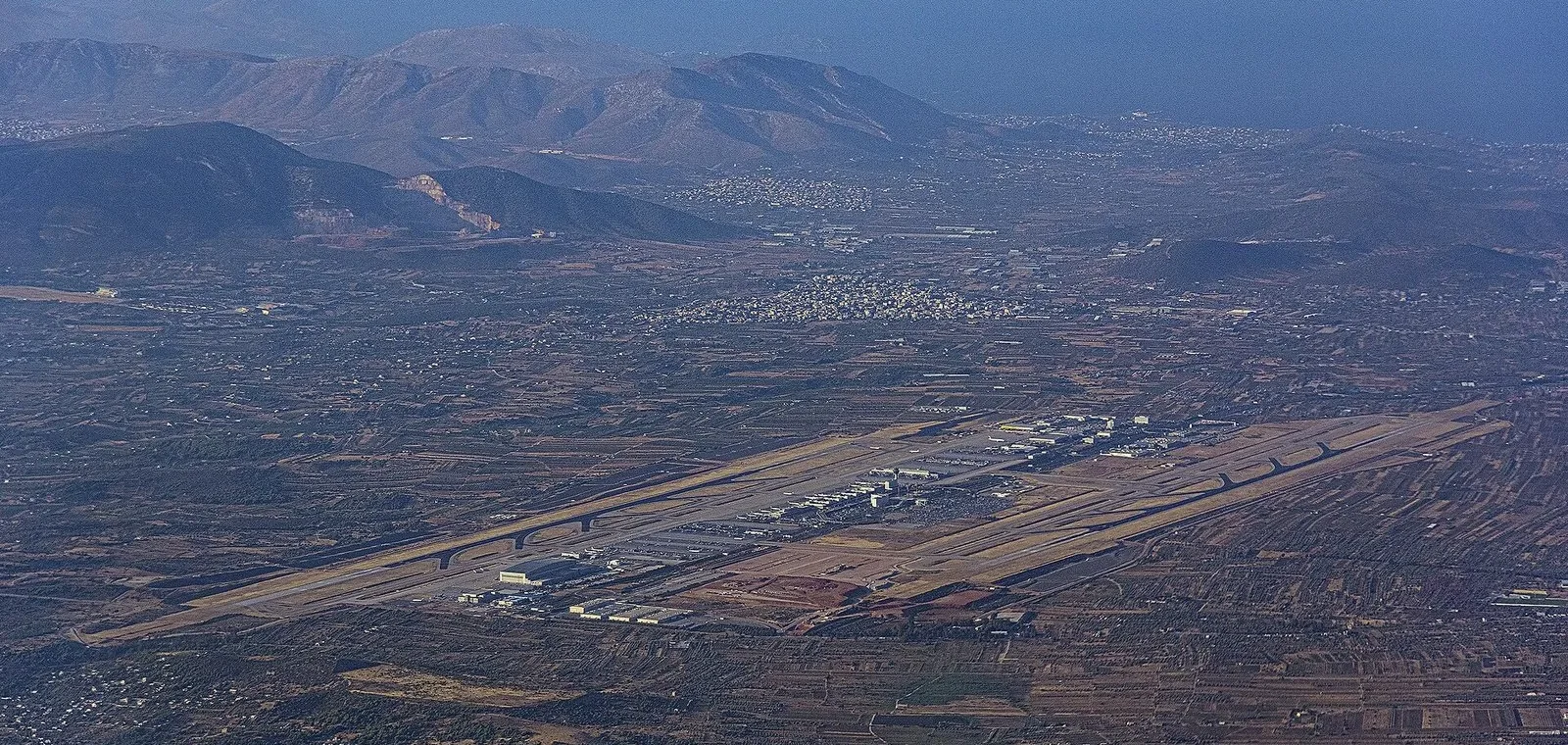
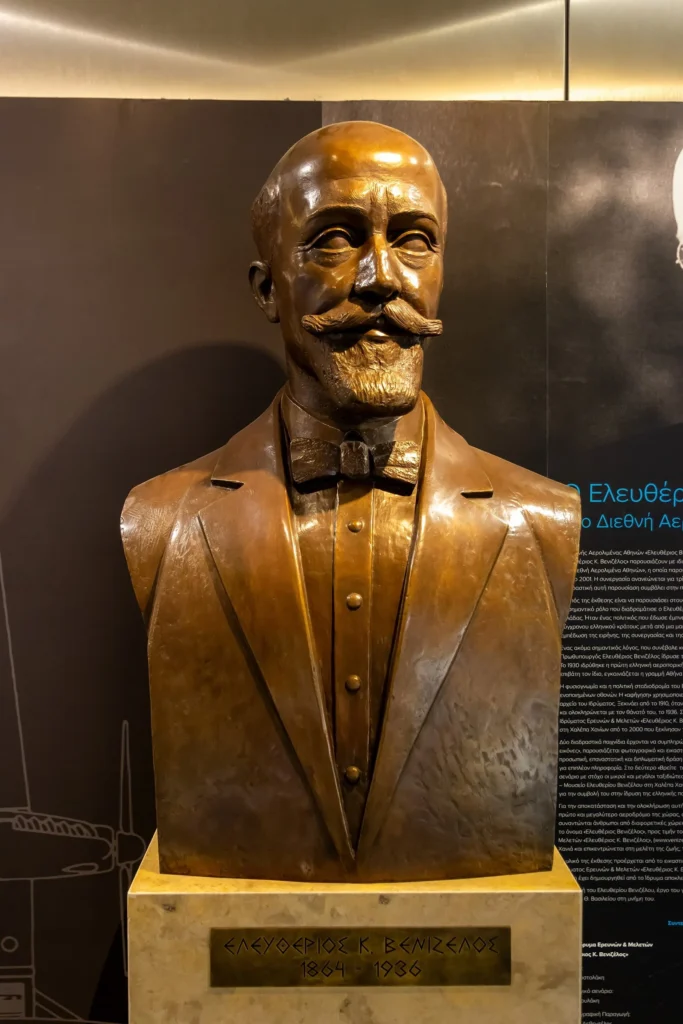
Athens International Airport, named after the statesman Eleftherios Venizelos, opened on 28 March 2001, about 20 km east of central Athens and roughly 30 km by road. It is the city’s only passenger airport, so if a ticket says Athens, this is where you land.
Search results muddle the layout. Some guides talk about “Terminal 1” and “Terminal 2”, others insist on a single terminal. The airport’s own wording is the one to learn, because it is what the signs and screens use:
- Main Terminal Building. Check-in, baggage reclaim, arrivals, and gates A1-A27 and B1-B31.
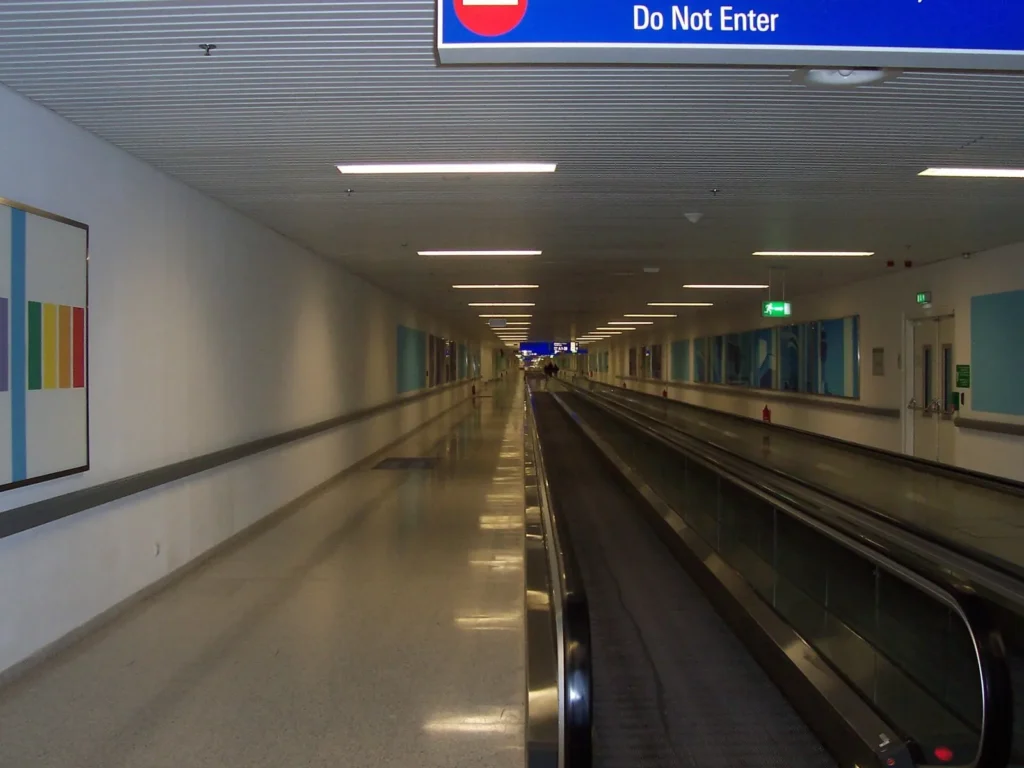
- Satellite Terminal Building. Gates C15-C40 only. There is no check-in or front door here: you reach it from the Main Terminal through an underground link.
Inside the Main Terminal, departures split into two areas after security. Area A serves non-Schengen flights: the UK, the United States, the Middle East, most of the Balkans outside the EU and the long-haul routes. Area B serves Schengen flights, which covers domestic Greek flights and most of continental Europe. Gate letters line up with the areas, so an A gate means a non-Schengen departure through passport control and a B gate means you stay inside Schengen without a passport stamp.
The Satellite is where people get caught out. You arrive at the airport, clear security in the Main Terminal, and then find your gate is C-something. The link runs underground with moving walkways, and it is a proper walk rather than a stroll to the next pier. Allow plenty of time: with a child, a bag that won’t roll straight or a slow passport queue in front of it, a C gate can take much longer to reach from the security line than you expect.
Verdict: the airport is compact by big-hub standards and the signage is straightforward. The two numbers that matter are your gate letter and the time on your boarding pass, and the screens beat any printed map, because the airport states plainly that departure gates are subject to change.
Which area will my flight leave from?
The quick test is where you are going, not which airline you fly. A flight to Rome, Paris, Berlin or Heraklion is Schengen and heads for Area B. A flight to London, Dubai, New York, Istanbul or Tirana is non-Schengen and heads for Area A, through passport control. The same airline can use both areas in a single morning.
The C gates in the Satellite are allocated flight by flight, and your boarding pass may show only a gate area, or nothing at all until boarding is close, so don’t sit at the first café you see past security on the assumption that the gate will be nearby. Find the screen, find the letter, then decide where to wait.
For a non-Schengen departure the order is check-in, security, then passport control into Area A. That last step is the one the Entry/Exit System has slowed down. The order matters for your timing: shops and lounges inside Area A are only reachable after the passport queue, so if the queue looks long, go straight through and relax on the far side.
Departing from Athens airport, step by step
The departure routine is the same whatever your destination. Here is the order, with the points where people lose time.
- Start at the Main Terminal: whether you come by metro, suburban railway, bus, taxi or car, everything begins in the Main Terminal Building.
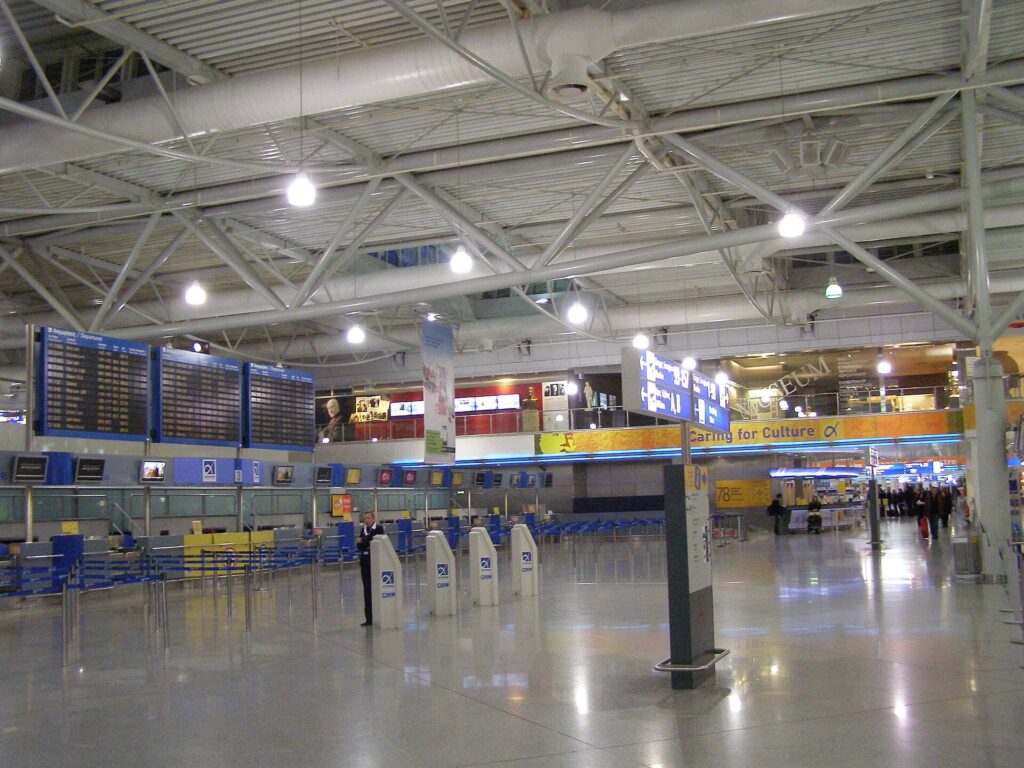
- Check in on the Departures level: the Check-In Hall is in the Main Terminal Building. Use online check-in and the airline’s bag-drop desks if you can, since the queue for the full-service desks is where most of the morning goes in summer.
- Get your VAT refund stamp first: if you are claiming a tax refund on goods in your checked bag, the airport tells you to get the customs stamp before you check in, and lists its departures customs tax-refund office as open around the clock.
- Clear security: have liquids, laptops and larger electronics ready to come out. The liquids rules have been changing across Europe, so read the airport’s security page and your airline’s guidance before you pack rather than relying on the rule you remember.
- Passport control, for non-Schengen flights: this is the step that can now run long. Non-EU passport holders go through the Entry/Exit System on leaving as well as on arriving.
- Find your gate on the screens: A and B gates are in the Main Terminal; C gates mean the walk to the Satellite.
How early is early enough? The airport says 2.5 hours, and for non-Schengen flights in summer that is not padding. For a domestic hop to Crete or Rhodes on a quiet November weekday, plenty of locals cut it finer, and the security queue at Area B is often short outside the peak. The trouble is that you can’t see the queue from your hotel. Our view: follow the airport’s 2.5 hours for any non-Schengen flight, and allow at least two hours for a domestic or Schengen flight with checked bags. You will rarely regret the extra coffee; you may very much regret the alternative.
Assistance is available for passengers who need it. The airport runs an Assisted Travel service for passengers with reduced mobility, with designated points where passengers with a disability or reduced mobility can call for help, and you should also tell your airline when you book. It also has separate pages on travelling with children and with pets, worth reading before a family trip.
Arriving at Athens airport: what happens after you land
Arrivals is simpler than departures, as long as you know which queue you are joining. All arriving passengers end up on the Arrivals level of the Main Terminal, including those who landed at a C gate and came back through the underground link.
From a Schengen flight you walk straight to baggage reclaim with no passport check. From a non-Schengen flight you pass through passport control first. For first-time non-EU arrivals since March 2026, that means the Entry/Exit System registration, and this is the queue to budget for if you have a timed onward connection such as a ferry or an afternoon tour.
After the belts and customs, you come out into the public Arrivals hall, which the airport calls the All Users Area. Here and in the public areas you find the information counters, currency exchange, banks and ATMs, the car rental desks, the CARE4BAG luggage storage desk and the exits to taxis and buses. Charging points sit at the airport’s e-lounge on the Arrivals level, opposite exit 3, which is handy if your phone died somewhere over the Alps and you need the hotel’s address.
Getting into Athens is a whole decision of its own. In short: metro Line 3, the blue line, runs from the airport station through Syntagma to Piraeus, at €9 full fare for a single; the 24-hour X95 Airport Express bus reaches Syntagma Square in around an hour depending on traffic, for €5.50; and there are taxis at a fixed fare to the centre. Our guide to transport from the airport covers every option, the night services and when each wins. Heading for a ship? The airport to Piraeus port page does the port side, and travellers bound for Mykonos, Naxos or Andros should read up on Rafina, the closer port to the airport.
Connecting flights at Athens airport
Athens is a natural hub for the Greek islands, and plenty of travellers pass through it without leaving the building. The airport’s transfer advice is worth knowing in some detail, because a few of its points surprise people.
If you already have your onward boarding pass, follow the screens to your gate. A Schengen-to-Schengen connection, say Munich to Santorini, involves no passport check. A non-Schengen-to-Schengen connection, such as London to Chania, means passport control on the way in, and potentially the Entry/Exit System if you hold a non-EU passport.
If you don’t have the boarding pass, the airport points you to the nearest transfer desk, staffed by the airlines and ground handlers. If that desk is unstaffed, you can use a self-service check-in kiosk or web check-in to get the boarding card, or go out to the Check-In Hall.
Bags to a regional Greek airport are the trap. Transfer bags are usually checked through to your final destination, but the airport warns that if your final stop is a regional Greek airport, you may have to collect the bag and clear customs at Athens even when the tag says it goes all the way. This mostly bites passengers arriving from outside the EU and connecting to an island. Ask your airline when you book and again at check-in, not when you are standing at an empty belt in Kos.
Self-made connections carry no protection. The airport’s minimum connecting times only apply to bookings that include all the flights on one reservation with bags checked through. If you have bought two separate tickets, perhaps a long-haul flight and a cheap island hop, you are on your own: you will collect your bag, re-check it, go through security again and possibly passport control too. Leave a generous gap, three hours or more for a non-Schengen arrival, and accept that you are betting against delays.
If something goes wrong, the airport’s information counters and the red courtesy phones dotted around the terminal connect to its call centre, and the general inquiries line, (+30) 210 3530000, is listed as available 24 hours.
Athens airport lounges: who runs them and how to get in
There are lounges in both departure areas and in the Satellite. The airport lists them by operator:
- Area A (non-Schengen). Aegean’s business lounge, plus lounges run by Swissport, Skyserv and Goldair Handling.
- Area B (Schengen). Aegean’s Schengen lounge, Goldair, Skyserv and the Lufthansa lounge.
- Satellite Terminal. A Goldair lounge.
Opening hours and walk-in prices are where it gets muddled. The airport’s own listing and Aegean’s page give different hours for the same Aegean lounges, and the independent lounges change their schedules with the flight programme. The airport’s own advice is to ask your airline about hours, access and pricing, and that is the right call. If you are relying on a lounge membership card, check that card’s app for the specific Athens lounge on the day you fly, since the lounge you are entitled to depends on whether you leave from Area A, Area B or a C gate.
Verdict: the Aegean lounges are the obvious choice for Aegean’s own business-class passengers. For everyone else, a lounge earns its fee on a long wait, an early departure or a summer afternoon when every seat at the gate is taken. On a short wait for a domestic flight, a coffee at the gate does the same job for a fraction of the price.
Wi-Fi, food, shops and other facilities
The basics are well covered, and most of them are free.
Wi-Fi and charging
Free, unlimited reconnections. “ATH Free Wi-Fi” covers the whole terminal around the clock. Each session lasts 120 minutes and you can simply reconnect afterwards, so there is no reason to pay for anything. Free internet points with 15 minutes of access stand at Main Terminal entrance 1, at gates B7 and B13, and at gates C33 and C37 in the Satellite. Charging points are at the e-lounge on the Arrivals level opposite exit 3. A power bank in your hand luggage saves hunting for a socket at the gate.
Shops, duty free and eating
Airport prices, with one useful exception. The airport brands its retail and dining as Airport Agora, covering duty free, Greek and international brands, cafés and restaurants. Expect airport prices on sandwiches and coffee. The exception is water: under a 2022 ministerial decision, canteens and cafés at Greek airports may not charge standing customers more than €0.60 for a 500 ml bottle or €0.90 for 750 ml, and the price list has to be displayed. Sit down at a table and the cap no longer applies, which is why the same bottle can cost more three metres away.
Money, ATMs and tax refunds
Change only what you need. Currency exchange at the airport is run by ONExchange, and there are banks and ATMs in the terminal. Airport exchange counters rarely offer the best rate anywhere in the world; paying by card and drawing a small amount of cash from a bank ATM is usually the better bet. For tax refunds, ONExchange pays Global Blue and Planet refunds in cash after customs validation, minus an administration fee, at counters in Departures Extra Schengen (listed 05:00-23:00) and Intra Schengen (listed 05:00-21:00). Remember the order: customs stamp first, before you check the bag in.
Smoking areas
Not inside, with exceptions. Smoking and e-cigarettes are banned in the terminal. The designated smoking areas are in Departures Intra Schengen opposite gates B12 and B19, Departures Extra Schengen opposite gate A8, Arrivals Intra Schengen opposite baggage belt 6, Arrivals Extra Schengen before passport control, and in the departures area of the Satellite.
Chapel and quiet space
Open to all. An Orthodox chapel and an interfaith room are on the 2nd floor of the K wing of the Main Terminal, reached by the lifts opposite the central information counters.
Left luggage and bag wrapping at the airport
If you land early and can’t check in to your room until the afternoon, or you want a final day in the city between hotel checkout and an evening flight, the airport’s own luggage desk is CARE4BAG. It sits in the Arrivals hall by Exit 1, works around the clock according to the operator, X-rays stored items and keeps them under CCTV. You pay when you collect. Food and pets are not accepted, and valuables or fragile items must be declared.
| Time stored | Small bag | Medium bag | Large bag |
|---|---|---|---|
| Up to 6 hours | €8 | €10 | €12 |
| Up to 12 hours | €10 | €12 | €14 |
| 24 hours | €12 | €15 | €18 |
| 48 hours | €15 | €19 | €23 |
| 3 x 24 hours | €18 | €23 | €28 |
| 7 x 24 hours | €30 | €39 | €48 |
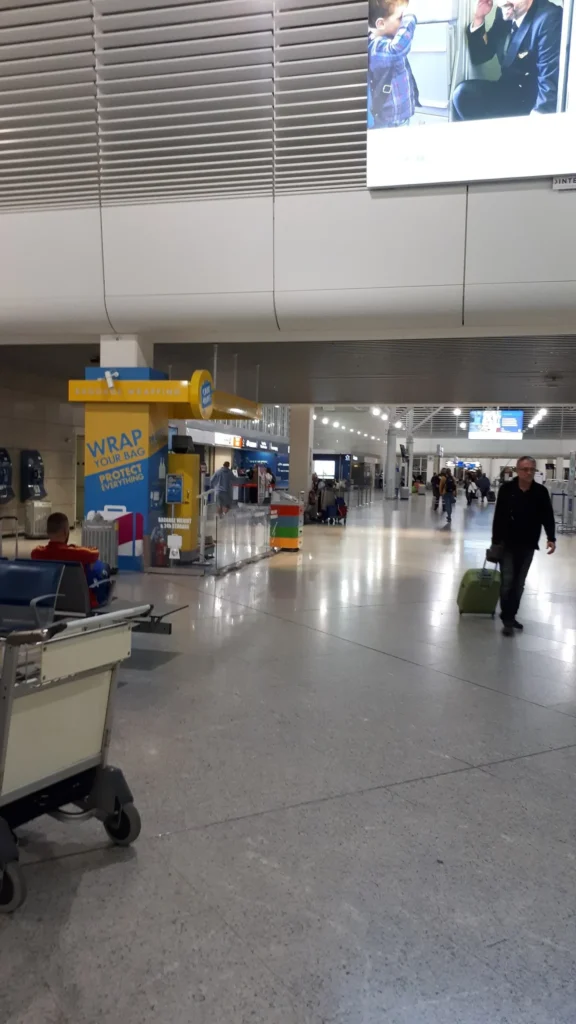
CARE4BAG defines a small bag as up to 50 x 30 x 20 cm, medium up to 65 x 50 x 25 cm and large up to 90 x 40 x 40 cm. Bicycles, surfboards and similar special items cost €20 a piece per day if there is space. Its published price list runs to 31 December 2026, so check the operator’s site for 2027 rates. Bag wrapping costs €10 per bag of any size (€8 when added to a stored bag), at stands in the Departures hall by the check-in entrances and at Arrivals.
Is it worth it? Storing a medium case for 24 hours costs €15, a euro less than one person’s €16 metro return to the centre, which makes the airport the right place for bags if your last day is out on the coast or near the airport. If you are spending the day in central Athens, you will usually do better leaving bags at your hotel or at a storage point near Syntagma, rather than hauling them back and forth on the metro. Our onward travel hub has more on timing a last day before a ferry or flight.
How busy is Athens airport, and when should you avoid it?
Very, and getting busier. The airport handled a record total of about 34 million passengers in 2025, according to its own year-end announcement, and the halls feel it most in the island season, when holiday flights pile on top of the year-round business and domestic traffic.
Judgement helps more than numbers here. An early-morning departure in August, when every island-bound traveller has the same idea, can mean queues at bag drop, security and passport control all at once. A mid-week flight in November is often a different airport entirely. If your dates are flexible, a weekday departure outside the peak months buys you the calmest version of the terminal.
What to skip and what not to believe
Skip the “Terminal 1 / Terminal 2” advice. Older guides and airline confirmations sometimes use those labels. On the ground you will see Main Terminal Building, Satellite Terminal Building and gate letters, nothing else.
Don’t rely on an old lounge or taxi price. Both have changed, and the honest place to check is the source: your airline or the lounge operator for lounges, the airport’s taxi page for the flat fare.
Don’t underestimate the trek to a C gate on a busy day. The underground link is long, and queues at security or passport control come before it. Add slack.
Don’t treat the airport as a day out. It is efficient, but there is no reason to arrive four hours early for a domestic flight. If you have a long gap, Athens itself is close enough to fill it; our airport transport guide sets out how long the trip takes.
Verdict: Athens airport is easy if you read your gate letter early, respect the 2.5-hour advice for non-Schengen flights and check the moving parts (lounges, liquids, taxi fares) at the source. Most of the bad experiences people report come from the queues, not the building.
Athens Airport FAQ
How many terminals does Athens airport have?
Two buildings: the Main Terminal Building, with gates A1-A27 and B1-B31, and the Satellite Terminal Building, with gates C15-C40. All check-in and arrivals happen in the Main Terminal, and the Satellite is reached through an underground link after security. You will not see “Terminal 1” or “Terminal 2” on the signs, only the building names and gate letters.
Which terminal do I need at Athens airport?
Go to the Main Terminal for every flight: that is where you check in and clear security. After security, follow the gate letter on the screens. Area A serves non-Schengen flights through passport control, Area B serves Schengen and domestic flights, and C gates mean the walk to the Satellite. Gates change, so watch the departure screens rather than the boarding pass alone.
How early should I arrive at Athens airport for a domestic flight?
The airport’s general advice is at least 2.5 hours before departure, chiefly because of passport control queues on non-Schengen flights. Domestic flights skip passport control, so many travellers allow around two hours with checked bags. In summer, with long bag-drop queues and the walk to a C gate, keeping to the airport’s advice is the safer choice.
Is there free Wi-Fi at Athens airport?
Yes. “ATH Free Wi-Fi” covers the whole terminal 24 hours a day. Each session lasts 120 minutes and you can reconnect for free when it ends, so there is no cap in practice. There are also free internet points with 15-minute sessions at Main Terminal entrance 1, gates B7 and B13, and Satellite gates C33 and C37.
Can I leave luggage at Athens airport?
Yes, at the CARE4BAG desk in the Arrivals hall by Exit 1, which operates 24/7 according to the operator. Prices in its 2026 list start at €8 for a small bag for up to 6 hours, and €12-€18 for 24 hours depending on size. You pay on collection, and food and pets are not accepted.
How long does it take to walk to the C gates at Athens airport?
Longer than most people expect. The C gates are in the Satellite Terminal, reached through an underground link with moving walkways, and you only start that walk after security and, for non-Schengen flights, passport control. Allow plenty of time, more with children, heavy hand luggage or summer crowds, and head to a C gate before settling down for coffee.
Where can I smoke at Athens airport?
Not inside the terminal: smoking and e-cigarettes are banned. Designated smoking areas are in Departures Intra Schengen opposite gates B12 and B19, Departures Extra Schengen opposite gate A8, Arrivals Intra Schengen opposite baggage belt 6, Arrivals Extra Schengen before passport control, and in the Satellite departures area.
Related Athens Guides
- Athens Airport to City Centre Transport: metro, buses, taxis and night options compared
- Athens Onward Travel: the hub for ports, ferries and island connections
- Athens Airport to Piraeus Port: straight from landing to the ferry or cruise ship
- Athens to Santorini: ferry or flight, and how long each takes
- Athens to Mykonos: Piraeus or Rafina, and which ferries to pick
Sources and How We Checked
Details were checked on 8 November 2026 against the official sources below; this guide is compiled from them rather than from other travel lists, and no first-hand visit is claimed.
- Athens International Airport: Connecting flights, Services and facilities, Wi-Fi and internet kiosks, Business lounges
- OASA: Airport Express bus lines and ticket prices
- ONExchange: Tax refund at Athens airport
- CARE4BAG: Airport luggage storage and prices
- Aegean Airlines: Lounges information
Athens Tourism Guide is an independent publication. We are not affiliated with the Hellenic Ministry of Culture, OASA, the Greek National Tourism Organisation or any business named here, and no business paid to be included.
Photo Credits
- Check-in hall at Athens airport: photo by Andrzej Otrębski, via Wikimedia Commons (CC BY-SA 3.0)
- Underground link to the Satellite Terminal: photo by Křžut, via Wikimedia Commons (Public domain)
- Baggage wrapping stand in the Main Terminal: photo by Rakoon, via Wikimedia Commons (CC0)
- Suburban train at the airport station: photo by Diganagata, via Wikimedia Commons (CC BY-SA 4.0)
- Eleftherios Venizelos bust at the airport: photo by Photograph by Mike Peel (www.mikepeel.net)., via Wikimedia Commons (CC BY-SA 4.0)
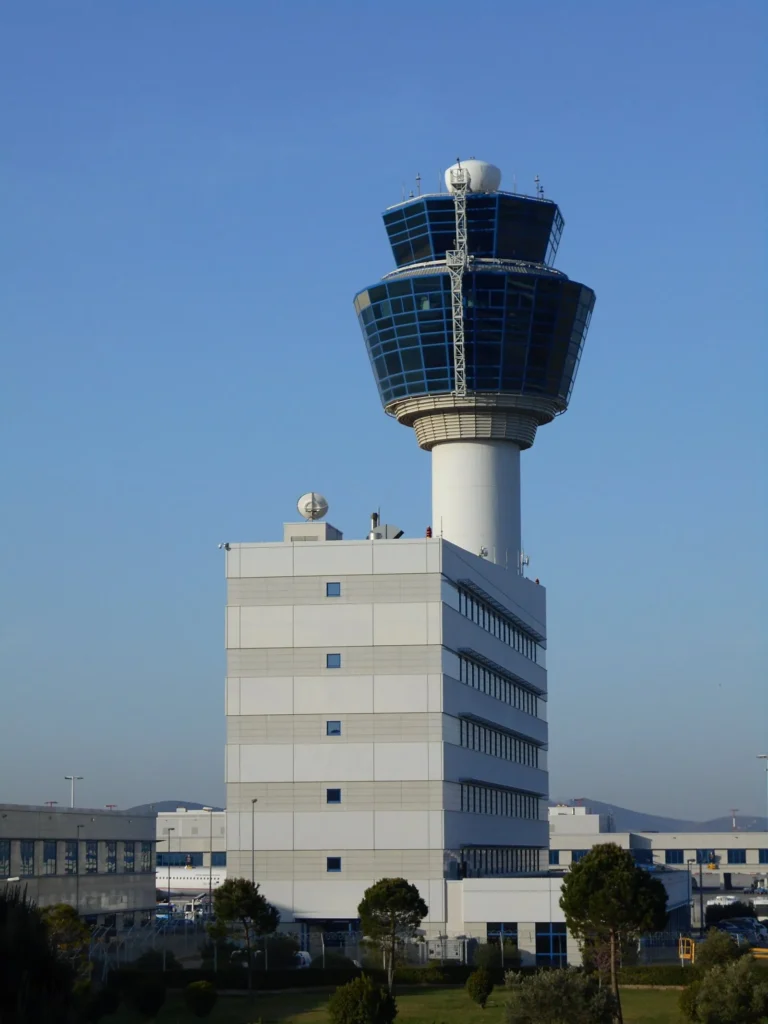
- Athens airport control tower: photo by SV1XV, via Wikimedia Commons (CC BY-SA 2.0)
- Athens International Airport from the air (featured image): photo by Apaleutos25, via Wikimedia Commons (CC BY-SA 4.0)