This article contains advertising. Some of the hotel, flight and transfer links in it are paid links: if you book through one, we get a commission from the booking company, and your price is the same either way. It never affects what we recommend. Affiliate disclosure
Every hour, on the hour, two Evzones of the Presidential Guard hand over their post at the Tomb of the Unknown Soldier, below the Hellenic Parliament, in a slow, high-stepping drill that is over within minutes and costs nothing to watch. That is the changing of the guard in Athens: it runs day and night in any weather, and every Sunday at 11:00 it grows into a full ceremony, with a large contingent of Evzones marching in with a military band. Most people catch it by accident on the way from the metro to the Plaka. It repays a little planning: the right minute, the right patch of forecourt, and a clear idea of when the Sunday crowd stops being worth it.
This page is for first-time visitors who want to see the ceremony properly rather than over a wall of raised phones, and for anyone deciding whether the Sunday version deserves a morning. The one caveat: this is a military honour guard at a war memorial, not a show put on for tourists. Nothing is ticketed or reserved, there’s no official running time, and on demonstration or parade days the forecourt can be cordoned off or simply not worth the effort. It sits within our wider guide to Athens historical sites and museums. Details checked 26 September 2026 against the Presidency of the Hellenic Republic, the City of Athens, the Hellenic Parliament and the UK Foreign Office.
| At a glance | Changing of the guard |
|---|---|
| Cost | Free: no tickets, no booking, no reserved places |
| Hourly change | Every hour on the hour, 24 hours a day, in all weather |
| Sunday ceremony | 11:00, with a large contingent of Evzones and a military band marching from the Presidential Guard camp |
| Where | Tomb of the Unknown Soldier, in front of the Hellenic Parliament, across Vasilissis Amalias Avenue from Syntagma Square |
| Getting there | Syntagma metro (Line 2 red, Line 3 blue), then about 3 minutes on foot |
| Time needed | 15 minutes for an hourly change; about an hour on Sunday, including finding a spot |
| Book ahead? | No |
| Best time | Sunday 11:00 for the full ceremony; a weekday evening change for space |
| Second location | Evzones also guard the Presidential Mansion entrance on Irodou Attikou Street, about 10 minutes’ walk away |
When is the changing of the guard in Athens?
Two timetables matter, and both come from the Presidency of the Hellenic Republic, which the Presidential Guard answers to.
Every hour, on the hour, around the clock
The Evzones guard the tomb 24 hours a day, in all weather, and the pair on duty changes every hour on the hour. That means 03:00 in January and 15:00 in a July heatwave, not just the civilised hours. The relief pair and their escort appear a little before the hour and the handover is done within minutes, so make ten to the hour your habit. Turn up at five past and you’ll mostly be watching two men stand very still, which is impressive in its way but not what you came for.
Sunday at 11:00: the full ceremony
Once a week the routine becomes a parade. Every Sunday at 11:00 a large contingent of Evzones, accompanied by a military band, marches from the Presidential Guard camp to the tomb, where the official changing of the guard takes place. This is the version in most photographs: white kilts, embroidered waistcoats and a crowd several rows deep.
National holidays and state occasions
The guard’s diary fills up on national days. The Presidency singles out the Independence Day celebrations on 25 March as the unit’s big outing, and on Sundays and official holidays Evzones also raise and lower the flag on the Acropolis. They form honour guards for the President, for visiting heads of state and for ambassadors presenting their credentials, too. If your only free morning falls on 25 March or 28 October (Ochi Day, the other great national holiday), expect crowds, security cordons and a different programme around Syntagma, and check the local news the evening before.
What happens at the hourly change?
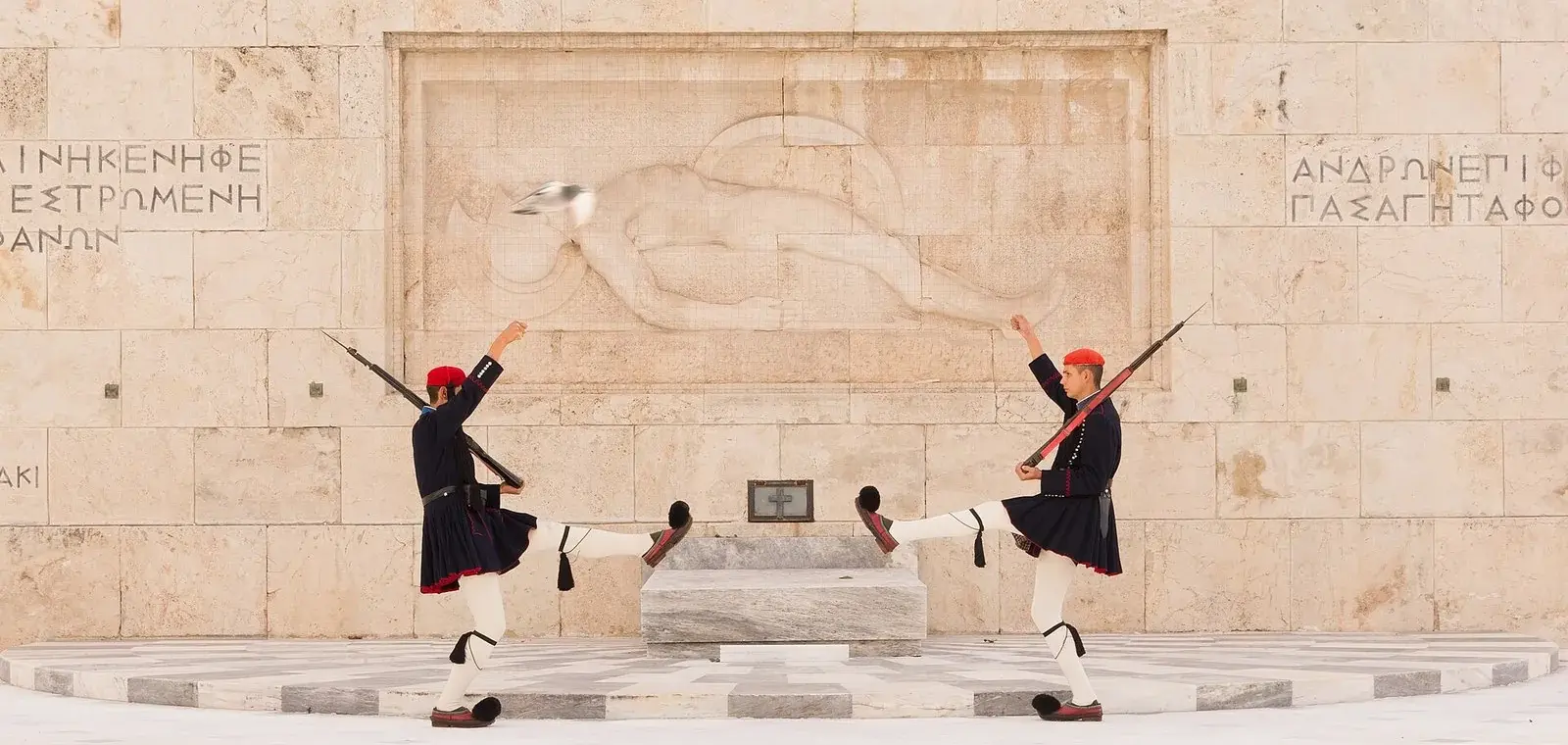
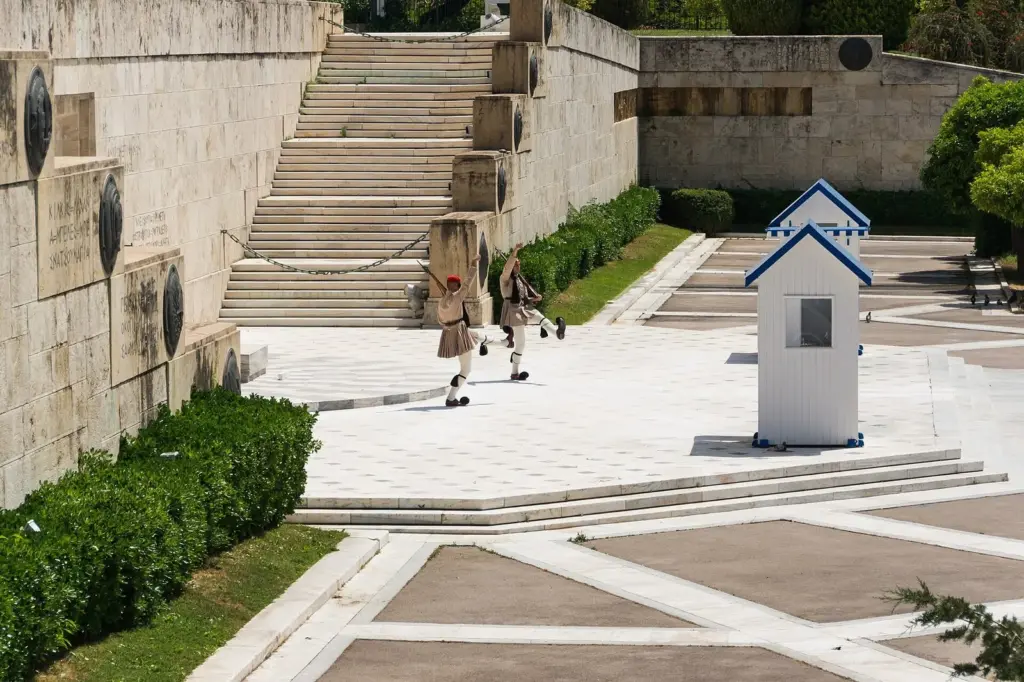
Between changes, two Evzones stand at the tomb, one on each side, in front of blue-and-white sentry boxes. They don’t speak, don’t react to the crowd and barely seem to blink. Then, shortly before the hour, the relief pair march across the forecourt with a soldier in ordinary army fatigues alongside.
Watch that soldier as closely as the Evzones. The escort sets them in place, tidies a tassel or a fold of the uniform when it needs it, and is the one who will wave you back if you drift into their path. The Evzones themselves move in a deliberately slow, exaggerated step: the leg rises high, hangs for a beat, and the nailed shoe comes down on the marble with a crack that carries right across the forecourt. The two pairs mirror each other, trade places, and the outgoing guards march off the way the new ones came.
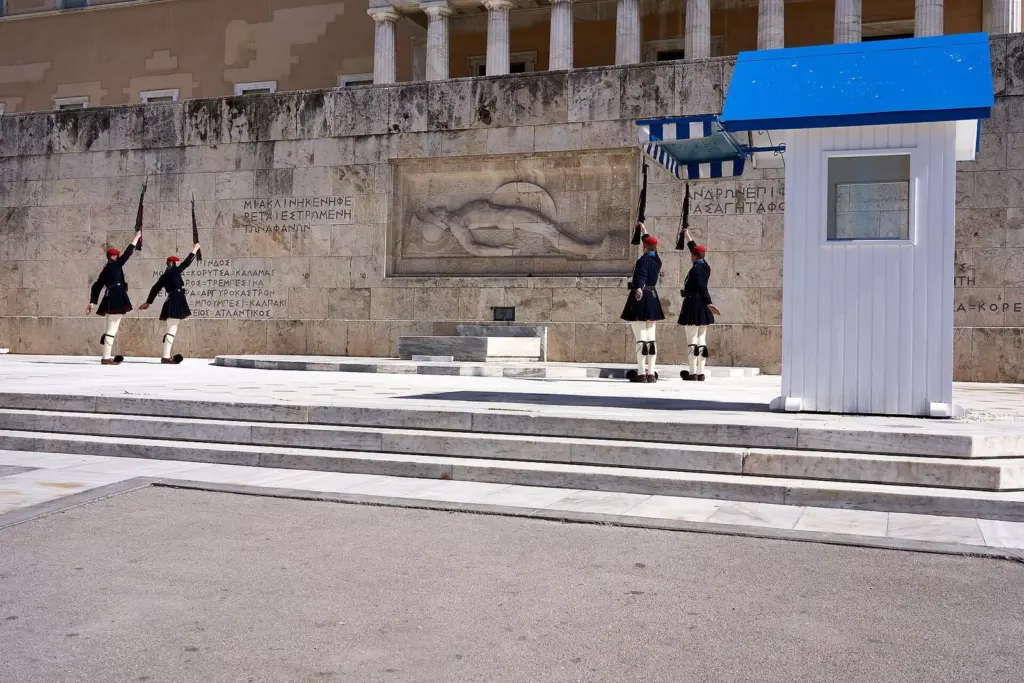
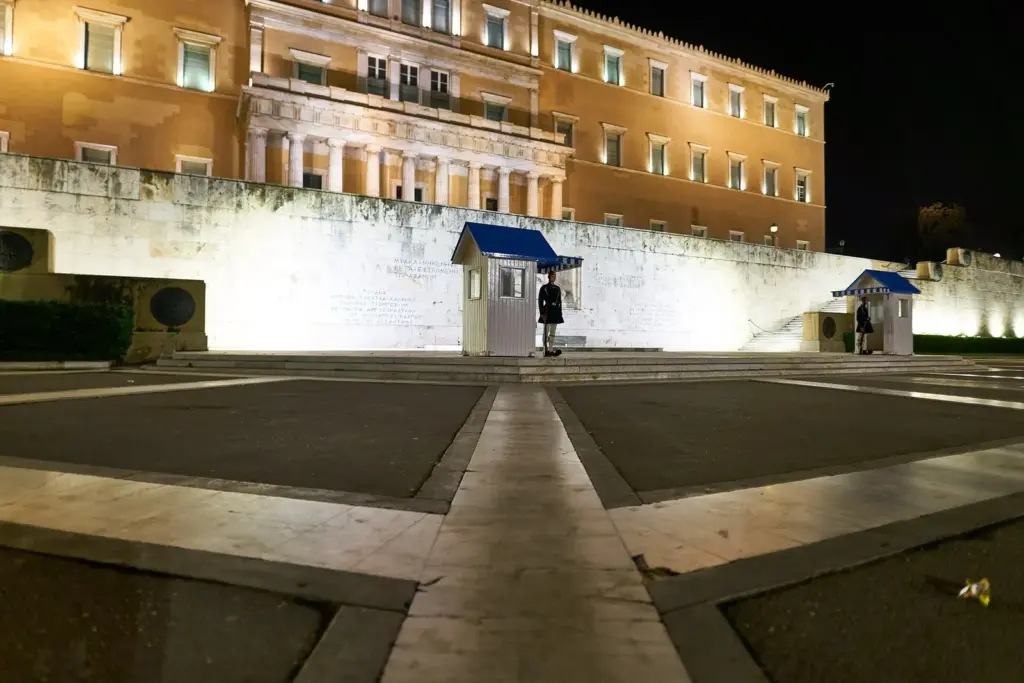
It’s short, and it’s the same drill at 09:00 as at 02:00. What changes is the audience. Late-morning and early-afternoon changes on busy days draw tour groups, while the late-evening ones, with the tomb floodlit and the traffic on Amalias thinning, are the calmest and, to our mind, the most affecting.
The everyday uniform isn’t the white kilt of the postcards, by the way: it’s the doulamas, a belted, knee-length coat, navy in winter and khaki in summer.
Plan it: every hour on the hour, day and night; free; Syntagma metro (Lines 2 and 3), then about 3 minutes on foot; arrive at ten to the hour and allow 15 minutes; best fitted into a walk through the centre.
Is the Sunday 11:00 ceremony worth it?
Yes, once, if you can face a crowd and you arrive early. It’s the only time you see the Presidential Guard as a unit rather than as two men and a sentry box: a column of Evzones in full dress, rifles shouldered, marching with a military band from their camp to the tomb for the official change.
The camp is on Irodou Attikou Street (Herodou Attikou on the Presidency’s English pages), on the far side of the National Garden, so the column reaches Syntagma on foot through the city. That leaves you a choice. Stand at the tomb and you see the formal change up close but only glimpse the march. Stand on the approach and you get the column, the band and the rhythm of all those nailed shoes on the tarmac, but lose any hope of a front place at the tomb. Several guides describe the column coming along Vasilissis Sofias Avenue, beside the Parliament’s north side, but the Presidency doesn’t publish a route. For a first Sunday, the tomb wins.
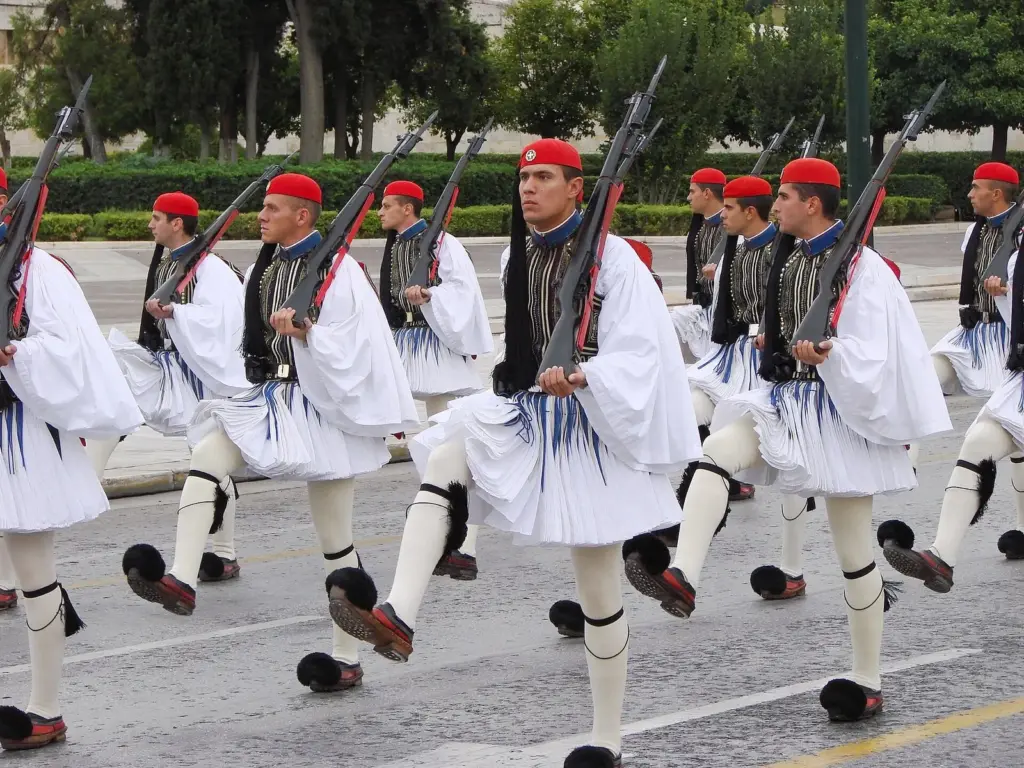
For a front-row place, be on the forecourt by about 10:30. The middle, dead opposite the tomb, fills first. A spot level with one of the sentry boxes is easier to get and arguably better, because you see each pair in profile as they step out, which is where the footwork shows.
Missed the front? Stay put. The crowd drains quickly once the column has marched off, and the ordinary 12:00 change is then yours to watch in comfort.
Verdict: worth planning one Sunday around on a first trip. Skip it if crowds make you miserable, if you’re pushing a buggy, or if 11:00 is the only slot you have for something that matters more to you: an ordinary hourly change gives you the same drill with a fraction of the crush.
Plan it: Sundays at 11:00; free; Syntagma metro (Lines 2 and 3), about 3 minutes on foot; be in place by 10:30 and allow an hour; best for first-timers who want the whole ceremony.
Where should you stand to watch?
The tomb is set into the wall below the Parliament’s front terrace and faces west, across Vasilissis Amalias Avenue towards Syntagma Square. Spectators gather on the broad paved forecourt in front of it. From the square, cross Amalias at the lights: the traffic moves faster than it looks.
For an ordinary hourly change
Front edge, slightly off-centre. Stand level with one sentry box and you see the pairs meet and turn with nobody’s head in the way. Keep out of the open strip the relief pair use to cross the forecourt; the escort will move you, politely the first time. If you arrive late and the front is full, the ends of the crowd give better sightlines than the middle.
For photographs
Afternoon light, or after dark. Because the tomb faces west, it’s backlit in the morning, with the sun behind the Parliament, and lit from the front from mid-afternoon. Late-afternoon changes put the warmest light on the marble. After dark the tomb and sentry boxes are floodlit, and the thinner crowd lets you frame the whole scene. At the Sunday ceremony, forget the tripod and hold your phone at chest height: the people behind you came for the same thing.
With children, or if standing is hard
Arrive at ten to the hour, not earlier. Take the end of the front row, where a child can see between people rather than over them. The forecourt is open paving with no real shade, but there are benches under the trees across the road in Syntagma Square for the wait. On a Sunday, consider the 12:00 change or a weekday one instead: the drill at the tomb is the same, and nobody gets squashed.
Where else can you see the Evzones?
The tomb gets the crowds, but it isn’t the only post. According to the Presidency, Evzones also stand guard at the entrance to the Presidential Mansion, the official residence of the President of the Republic, and at the gate of their own barracks. Both are on Irodou Attikou Street, the leafy road along the eastern edge of the National Garden. The barracks, at number 2, is named after George Tzavelas, a hero of the 1821 revolution. It is closed to the public, although the Presidency accepts organised visits from schools, cultural organisations and clubs by prior request.
Why bother? Because it’s the calm version. There’s no crowd ten deep, no band and no published ceremony timetable, so treat it as a chance to see Evzones close up in their sentry boxes rather than as a timed show. Walk past on the pavement, take your photo from a respectful distance, and don’t hang around the gate: this is the head of state’s working residence, not a photo stop.
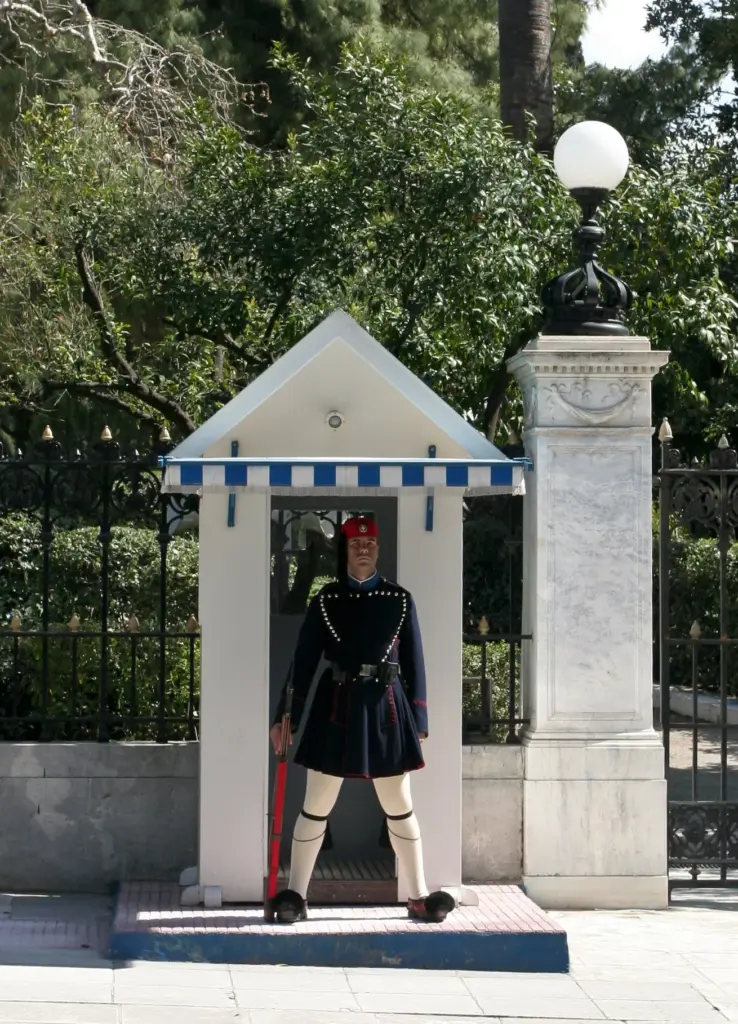
From the tomb it’s roughly a 10-minute walk. Follow Vasilissis Sofias Avenue east along the Parliament’s north side and turn right into Irodou Attikou, or cut through the National Garden and leave by its eastern side. Irodou Attikou then runs south to Vasileos Konstantinou Avenue and the Panathenaic Stadium, which makes the mansion a natural stop on the way rather than a trip of its own.
Verdict: not worth a special journey, but well worth the small detour if you’re walking from Syntagma to the stadium anyway.
Hourly, Sunday or the mansion?
| Compare | Hourly change | Sunday ceremony | Presidential Mansion |
|---|---|---|---|
| When | Every hour on the hour, day and night | Sundays at 11:00 | Sentries on duty; no published ceremony times |
| What you see | Two pairs trade places in the slow-step drill | A large contingent and a military band march in for the official change | Evzones in their sentry boxes at the gate |
| Uniform | Everyday doulamas: khaki in summer, navy in winter | Full dress with the white fustanella | Everyday doulamas |
| Crowds | Thin at night, heavy around midday in summer | The heaviest of the week | Usually none to speak of |
| Time to allow | 15 minutes | About an hour | 10 minutes in passing |
| Best for | A quick look, or night atmosphere | The full ceremony, once | A calm, close look |
What are the rules for watching?
The forecourt runs on common sense, and the escorting soldier, or the police nearby, will remind anyone who forgets it.
- Don’t touch the guards or their rifles, and don’t step into the space between the sentry boxes and the tomb.
- Keep your distance for photos. A picture near a sentry box is one thing; an arm round a guard or a phone in his face is another.
- Don’t try to make them laugh. They won’t, and everyone watching will think less of you.
- Keep the path clear when the relief pair march in, and keep children off the monument’s steps.
- Keep your voice down during the change itself. It is, after all, a tomb.
Syntagma is Athens’ main protest square. The UK Foreign Office notes that demonstrations often take place in central Athens, particularly at Syntagma, with political demonstrations likely on 1 May, 17 November and 6 December, and that police often use tear gas to disperse them. If a rally is forming, leave and come back another day: the guard will still be there.
What are the Evzones wearing?
The name starts with the belt. Evzone means roughly “well-girdled”, from the Greek for “well” and “belt”, and the uniform descends from the dress of the fighters of the 1821 revolution, later adopted as official national attire. Every uniform is made by hand, and the full-dress version you’ll see on Sundays breaks down like this.
| Piece | What it is | What it stands for |
|---|---|---|
| Fustanella | The white pleated kilt: 30 metres of fabric in 400 pleats | The years of Ottoman rule; white, like the shirt, for the purity of the independence struggle |
| Fermeli | The waistcoat, hand-embroidered in white or gilt thread and the hardest piece to make | Designs of cultural and folk value |
| Pharion | The red cap bearing the national emblem, with a long black silk tassel | Red for the blood of the fighters; the tassel for tears and mourning |
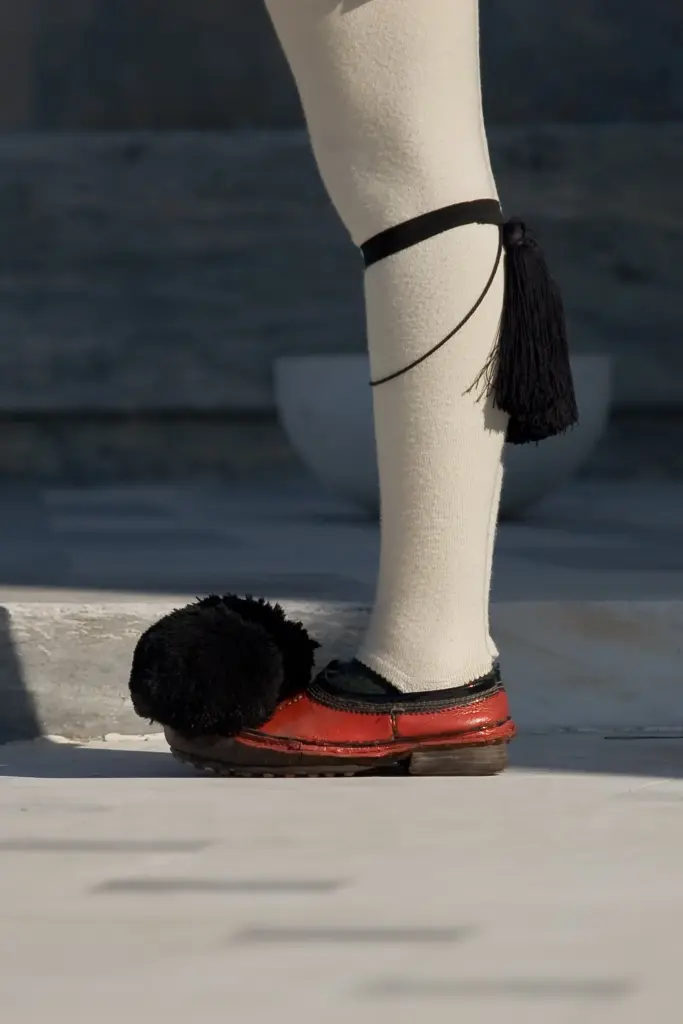
| Tsarouhi | Red leather shoes, about 3 kg a pair, with 120 nails in the soles and a large black tassel | Tradition says the tassel once hid a blade for close combat |
| Fringes | Blue-and-white silk fringes across the uniform | The Greek flag |
On ordinary days you’ll see something plainer: the doulamas. The navy-blue version, worn daily in winter, is the uniform of the Macedonian Struggle; the khaki one, worn daily in summer, recalls the Balkan Wars. In spring and autumn either is possible. The unit also keeps a Cretan uniform for parades and official ceremonies, and Pontian, Thracian and Aegean island costumes for memorial days and celebrations.
Who are the Evzones?
The Evzones (Εύζωνες, nicknamed tsoliades) of the Presidential Guard are volunteers from the Hellenic Army’s infantry, and the unit answers to the Military Office of the Presidency of the Republic. Its story starts in 1868, with an elite combat and ceremonial unit meant to set the standard for the rest of the army. It became the Palace Guard in 1914 and took over the Tomb of the Unknown Soldier in 1929, when work on the monument began. Since democracy was restored in 1974 it has been the Presidential Guard, with a purely ceremonial role.
Plenty of guides quote a minimum height and a gruelling selection course; treat those numbers with caution. What the Presidency does confirm is the job: around the clock, in any weather, standing still while strangers point cameras at you.
What is the Tomb of the Unknown Soldier?
The monument the Evzones guard is a cenotaph for Greek soldiers killed in war. The Hellenic Parliament’s history of its building credits the design to the architect Emmanuel Lazarides, after a decision taken in 1928, and work began in 1929. At the centre is a low relief of a fallen hoplite, an ancient Greek soldier, lying with his shield. The two carved lines either side come from Thucydides’ account of the Athenian war funeral at which Pericles spoke: one describes the empty bier carried for the missing, the other, from the speech itself, says that for famous men the whole earth is their tomb. Names of battles are cut into the walls on both sides.
Give it two minutes before or after the change: most people photograph the guards and never look at what they’re guarding. The Parliament building above it and the square across the road are covered in our guide to Syntagma Square and central Athens.
When should you skip it?
More often than most lists admit. The guard isn’t going anywhere, so there’s no need to force it.
Demonstration and strike days. If the square is filling with banners and riot police, walk away and come back another day.
Midday in a heatwave. The forecourt is open marble with no shade, and at 14:00 in July it’s a griddle. The guards stay; you don’t have to. Spend those hours indoors at the Acropolis Museum and come back for an evening change.
A paid changing-of-the-guard tour. The ceremony is free and public, with no reserved viewing area, so a tour buys you a guide’s commentary, not access or a better spot. Book one only if the rest of the walk appeals.
Verdict: an ordinary change is a good five minutes, not a destination. The Sunday ceremony is the one worth planning for.
How do you fit it into a day?
The change works best as a hinge in the day rather than its point. On a Sunday, this short walk puts the ceremony first and the guard’s quieter posting on the way to lunch:
- Tomb of the Unknown Soldier, by 10:30: take your place for the 11:00 ceremony.
- National Garden: once the column has gone, cross the garden eastwards in the shade.
- Irodou Attikou Street: pass the Evzones at the Presidential Mansion entrance.
- Panathenaic Stadium: carry on south to the marble stadium of the 1896 Olympics.
- Temple of Olympian Zeus: a short walk west to the Temple of Olympian Zeus, then into the Plaka for lunch.
On a weekday, an hourly change fits anywhere: between the metro and the Plaka, before dinner, or at midnight on the walk back. If you only have one day, our one day in Athens itinerary plans the rest of it. And for everything else within walking distance, from the Acropolis to the museums, start with our overview of the city’s ancient sites and museums.
Changing of the Guard FAQ
What time is the changing of the guard in Athens?
Every hour on the hour, 24 hours a day, at the Tomb of the Unknown Soldier in front of the Hellenic Parliament. The big ceremony is on Sundays at 11:00, when a large contingent of Evzones marches in with a military band. Arrive about ten minutes before any change, and on Sunday be on the forecourt by 10:30 if you want to stand at the front.
How long does the changing of the guard take?
There’s no official running time. The hourly handover is a short drill, over within minutes, so allow a quarter of an hour including finding a place. The Sunday ceremony takes much longer because the whole contingent marches in, performs the change and marches away again; allow about an hour, including the wait for a good spot.
Is the changing of the guard free to watch?
Yes. It takes place on an open public forecourt in front of the Parliament, with no ticket, booking or reserved area. Paid walking tours often include it, but they buy you a guide’s commentary rather than access or a better position. Just turn up a few minutes before the hour, or by 10:30 for the Sunday ceremony.
Does the changing of the guard happen at night and in the rain?
Yes. The Evzones guard the tomb around the clock and in all weather, and the pair changes every hour through the night. Late-evening changes are the quietest of the day, with the tomb and sentry boxes floodlit, which makes them a good choice if you want to watch without a crowd or take photographs.
Where else do the Evzones stand guard?
At the entrance to the Presidential Mansion and the gate of their own barracks, both on Irodou Attikou Street along the eastern edge of the National Garden, about 10 minutes’ walk from Syntagma. There’s no crowd and no published ceremony timetable there, so treat it as a quiet, close look at the guard rather than a timed show.
Related Athens Guides
- Athens Historical Sites and Museums: the hub for every major site and museum in the city.
- Syntagma and Central Athens Guide: the square, the Parliament building and the streets around them.
- One Day in Athens: a single-day plan for the centre.
- Acropolis Guide and Tickets: timed tickets, prices and the best hours for the rock.
Sources and How We Checked
We checked these details on 26 September 2026 against the official sources below; the page is compiled from them rather than from other travel lists, and no first-hand visit is claimed.
- Presidency of the Hellenic Republic: The Presidential Guard (history, duties, schedules, uniform, barracks and visits; read from a 1 September 2026 capture)
- City of Athens, This is Athens: Tomb of the Unknown Soldier
- Hellenic Parliament: Historical background of the Parliament building
- OASA (Athens Urban Transport Organisation): metro and bus information
- UK Foreign, Commonwealth and Development Office: Greece travel advice: safety and security
Athens Tourism Guide is an independent publication. We are not affiliated with the Hellenic Ministry of Culture, OASA, the Greek National Tourism Organisation or any business named here, and no business paid to be included.
Photo Credits
- Evzones changing the guard in winter uniform: photo by George E. Koronaios, via Wikimedia Commons (CC BY-SA 4.0)
- Evzones marching in full dress, 2010: photo by Marshallhenrie, via Wikimedia Commons (CC BY-SA 4.0)
- Evzones crossing the forecourt in summer uniform: photo by Jebulon, via Wikimedia Commons (CC0)
- Evzone at the Presidential Mansion gate: photo by Sharon Mollerus, via Wikimedia Commons (CC BY 2.0)
- Evzone tsarouhi: photo by Thermos, via Wikimedia Commons (CC BY 3.0)
- The Tomb of the Unknown Soldier at night: photo by George E. Koronaios, via Wikimedia Commons (CC BY-SA 4.0)
- Evzones at the Tomb of the Unknown Soldier (featured image): photo by Jebulon, via Wikimedia Commons (CC0)