This article contains advertising. Some of the hotel, flight and transfer links in it are paid links: if you book through one, we get a commission from the booking company, and your price is the same either way. It never affects what we recommend. Affiliate disclosure
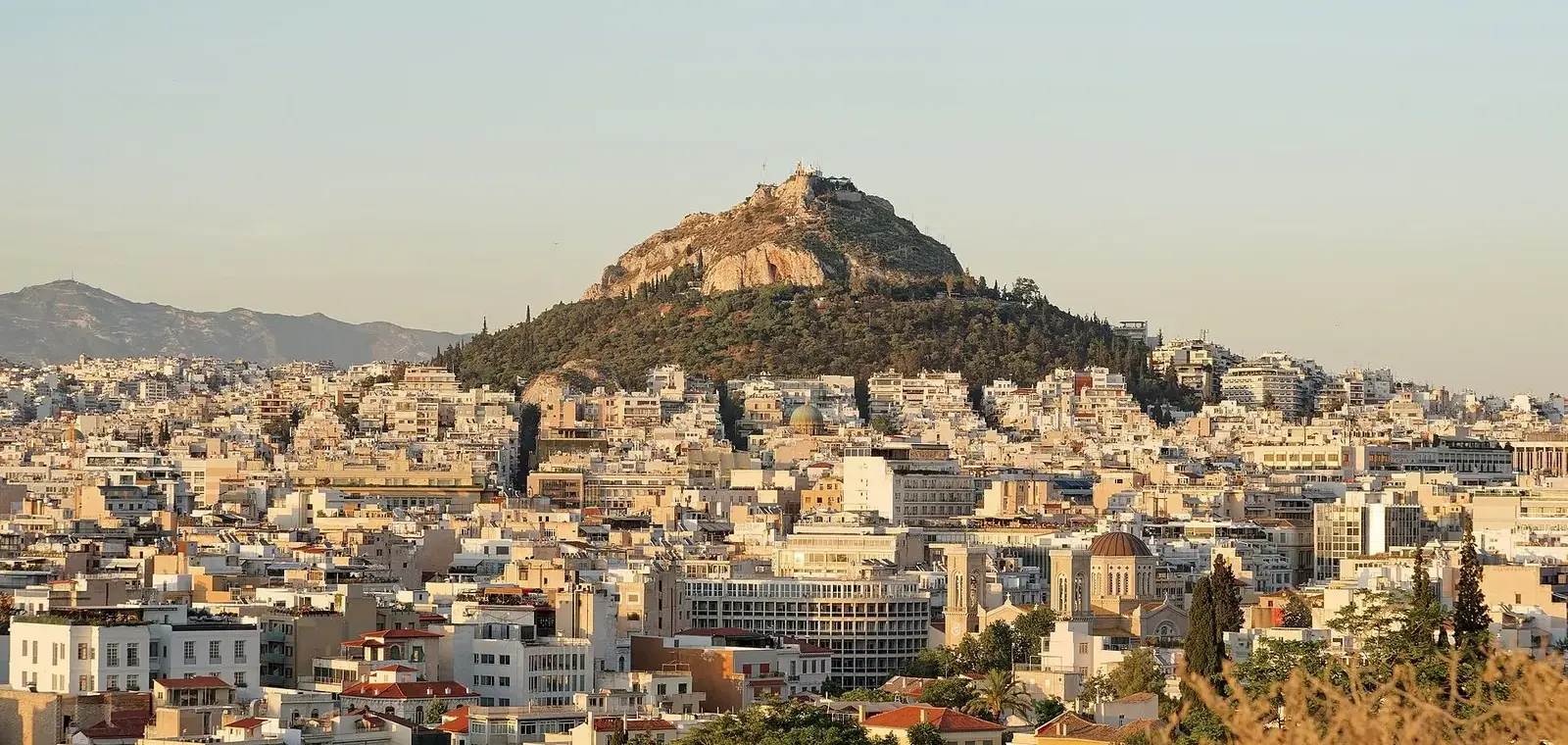
Lycabettus Hill is the pine-covered peak in the middle of Athens, and the easiest way to its 277-metre summit for sunset is the funicular from the top of Aristippou Street in Kolonaki: a three-minute ride that runs from 09:00 until 02:30, so getting down after dark is never a problem. Taking the Lycabettus Hill funicular at sunset means reaching the lower station about an hour before the sun goes down, around 17:45 in mid-October 2026, because the terrace at the top fills early. The footpath from Kolonaki is free and takes 30 to 45 minutes, and a taxi can get you most of the way up.
It’s written for first-time visitors who want the view without the guesswork: which way up, what it costs, what’s at the top, and when and where the sun goes down in each month of the year. The one caveat is the fare: the prices below are a guide, so confirm them on the operator’s site or at the station. Details checked 26 September 2026 against Orizontes Lycabettus (the summit restaurant, whose site carries the funicular information), the City of Athens, the Hellenic Ministry of Culture and NOAA’s solar calculator. If you’re still building a shortlist, our guide to things to do in Athens puts Lycabettus alongside the city’s other big experiences.
| Lycabettus at a glance | The short answer |
|---|---|
| Cost | The hill is free. The funicular was listed at about €10 single and €13 return in 2026; check the board at the window |
| Time needed | 1.5 to 2 hours for a sunset visit, about 3 hours with dinner at the top |
| Getting there | Metro to Evangelismos (Line 3, blue), then about 15 minutes uphill to the lower station at the end of Aristippou Street |
| Funicular | 09:00 to 02:30 daily, every 30 minutes and every 10 at busy times; about 3 minutes, all of it in a tunnel |
| Walking | 30 to 45 minutes from Kolonaki Square on a stepped path; free |
| Book ahead? | Not for the funicular. Yes for a sunset table at the restaurant, and for any concert at the theatre |
| Best time | Be at the top 45 minutes before sunset; on foot, early morning from June to September |
| Sunset on the 15th | October 18:48, November 17:13, December 17:07, June 20:49 |
What’s changed in 2026?
The theatre is back. The open-air Lycabettus Theatre, set into the rock below the summit on the hill’s eastern side, spent years closed. The City of Athens has reopened it after restoration, and its 2026 season opened on 15 May, billed as more than 50 nights of music and theatre running into October. Guides that still describe it as abandoned are out of date.
The Acropolis closes before sunset. Until the clocks go back, the site shuts at 18:30 up to 15 October and at 18:00 from 16 October, with last entry 30 minutes earlier, while the sun sets between about 18:35 and 19:10. From 1 November it closes at 17:00, before sunset all winter. A sunset with the Parthenon in it has to be watched from a hill, and Lycabettus is the highest.
The clocks go back on 25 October 2026. Sunset from the summit jumps from 18:36 on the 24th to 17:34 on the 25th, so late-October visitors need to be up an hour earlier than they would have been the week before. The clocks go forward again on 28 March 2027, when sunset leaps from 18:43 to 19:44.
What is Lycabettus Hill?
A limestone peak that rises straight out of the city, wooded with pines on its lower slopes and bare rock at the top. At 277 metres it’s the highest hill in central Athens and stands well above the Acropolis, which is why the view from it takes in the whole basin rather than a single monument. In English the name is usually said LY-ka-BET-us; in Greek it’s Lykavittos (lee-ka-vee-TOSS), the spelling you’ll meet on some signs and maps. Legend has it that Athena dropped it here while carrying a mountain to build up the Acropolis, after a crow brought her bad news.
How do you get up Lycabettus Hill?
There are three ways up, and the right one depends on the time of day more than on your fitness. The funicular is quick and runs late, but it shows you nothing on the way because it travels inside the hill. The footpath is free and gives you the view as you climb, though it faces west, so on a summer afternoon you walk straight into the sun. A taxi takes the road up the eastern side and leaves you with a short climb on steps to the chapel.
| Route | Time up | Cost | Effort | Best for |
|---|---|---|---|---|
| Funicular from Aristippou Street | About 3 minutes, plus any queue | About €10 single, €13 return (2026 listings) | Easy once you reach the lower station | Sunset, late evenings, the ride down |
| Footpath from Kolonaki | 30 to 45 minutes from Kolonaki Square | Free | A steady climb on uneven steps | Mornings, golden hour, anyone happy to sweat |
| Taxi up the eastern road | Depends on traffic | Metered fare | A short final climb on steps | Concert nights, tired legs |
The funicular and the footpath both start on the upper edge of Kolonaki, the well-heeled neighbourhood on the hill’s south-western slopes. The nearest metro station is Evangelismos (Line 3, blue), roughly 15 minutes’ walk from the lower funicular station and uphill most of the way. From Syntagma (Lines 2 and 3) allow about 20 minutes on foot through Kolonaki’s grid of shopping streets. Our Kolonaki neighbourhood guide covers the cafés, galleries and museums you pass on the way.
From most central bases, the metro gets you to Evangelismos with one change at most:
| Starting from | Metro to Evangelismos |
|---|---|
| Syntagma | Line 3, one stop, or walk the whole way in about 20 minutes |
| Monastiraki | Line 3, two stops |
| Plaka, the Acropolis or Koukaki | Line 2 from Akropoli or Syngrou-Fix to Syntagma, then Line 3 for one stop |
| Piraeus port | Line 3 direct, no change |
The Lycabettus funicular: hours, fares and the ride
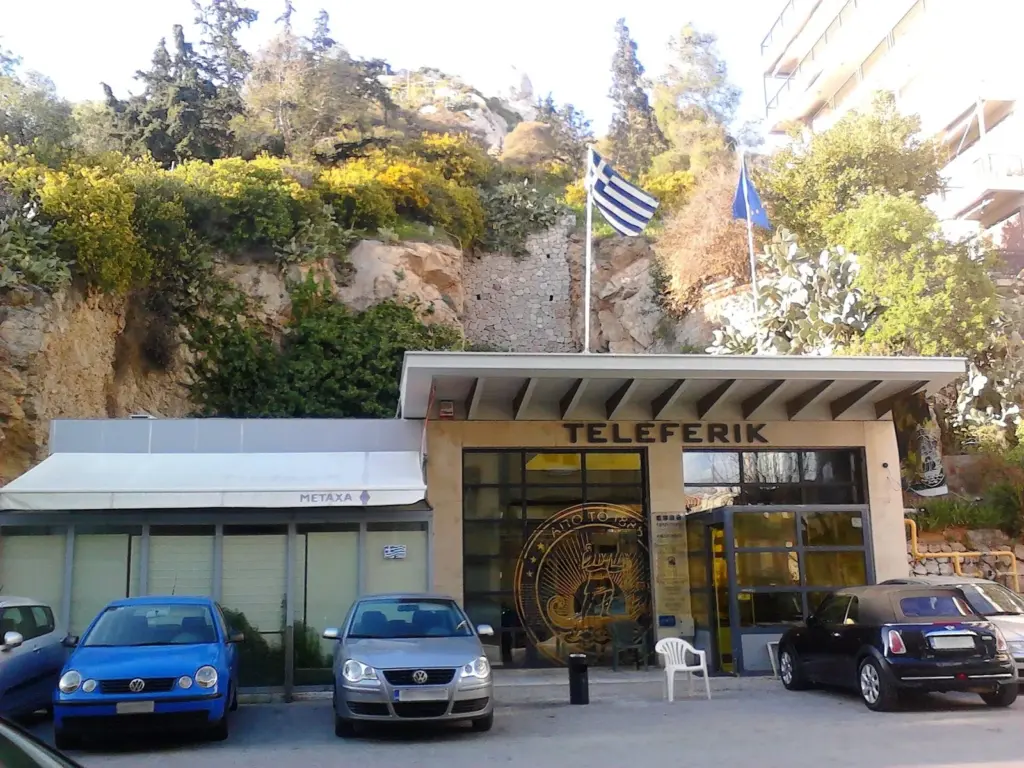
Athenians call it the teleferik, though it isn’t a cable car: two cabins run on rails, hauled up and down a tunnel inside the hill, one rising as the other descends. The lower station stands at the end of Aristippou Street in Kolonaki. The top station lets you out beside the restaurant just under the summit, and a few more steps take you up to the chapel.
When does the funicular run?
09:00 to 02:30, every day. The operator’s site gives departures every 30 minutes, stepping up to every 10 minutes at busy times. Each of the two cabins carries up to 34 people, so at the ten-minute frequency the line lifts roughly 200 passengers an hour. That sum matters on a summer evening: if 100 people are queuing ahead of you, you’ll wait three departures, up to half an hour, before you see the view. The ride itself lasts about three minutes.
How much does the funicular cost?
About €10 single and €13 return. Those are the fares 2026 listings give, so read the board at the window before you pay. Unless you’re riding both ways, buy a single. Walking up in daylight and riding down after dark gets you the best of both, and on a scorching afternoon the reverse works too: ride up, then stroll down once the heat has gone out of the day.
What’s the ride like?
Short and blind. The whole run is underground, through roughly 210 metres of tunnel, so there’s nothing to see until you step out at the top. That’s the honest case against paying for it on a mild morning: the funicular saves your legs, not your view. After dark it earns its fare, because riding down beats picking your way down a stepped path by phone light.
Plan it: daily 09:00-02:30; about €13 return, checked at the window; Evangelismos (Line 3), then about 15 minutes uphill; allow 20 minutes from the station door to the terrace, and 30 or more before a summer sunset.
Can you walk up Lycabettus Hill?
Yes, and on a cool morning it’s the better way up. The main path climbs the western face from Kolonaki in a long series of zigzags through pine woods, and the city opens out a little more at every bend. It’s a made path with steps rather than a rough trail, but the steps are uneven and can be slippery, so trainers with grip beat sandals.
- Kolonaki Square: start at the square (officially Plateia Filikis Etaireias) and head uphill to the north-east. The top of Ploutarchou Street is a long flight of steps that brings you out on Aristippou Street, about 10 minutes from the square.
- Aristippou Street: by the funicular’s lower station, the footpath leaves the street and climbs into the pines.
- The zigzags: the longest stretch, 15 to 20 minutes of steady climbing with the city spreading out below. The little chapel of Agioi Isidoroi, built into a cave, sits on this western slope.
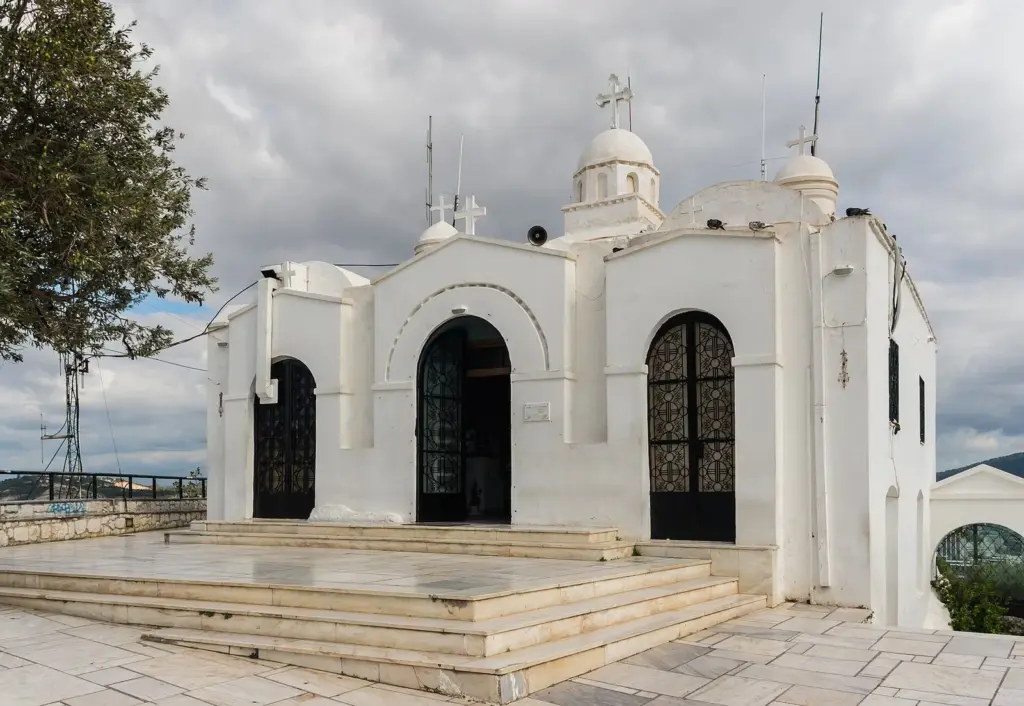
- The last steps: the path steepens over bare rock to the summit terrace and the whitewashed chapel of St George at the very top.
Free, 30 to 45 minutes from Kolonaki Square. Most people take 20 to 30 minutes from Aristippou Street and about 20 minutes to come back down. That’s a steady pace with a couple of stops to look back; runners do it much faster, and a first-timer in July heat will take longer.
Two timing rules make the walk far more pleasant. From June to September, climb before about 10:00: the path faces west, takes the full afternoon sun and has only patchy shade under the pines. The pre-sunset climb is doable, but you’ll arrive sweaty. And come down by funicular after dark, or at least with a torch, because the path is quiet at night and the steps are uneven.
Other paths climb from the Neapoli side to the north-west and from the ring road around the base of the hill. They’re quieter and less obvious to follow; on a first visit, the Kolonaki path is the one to use. For longer walks and other ways to spend a day outside, see our guide to outdoor activities in Athens.
Verdict: walk up, ride down. You watch the view grow on the climb and skip the stepped descent in the dark.
Can you take a taxi to the top?
Nearly. A road winds up the eastern side of the hill to the theatre and a parking area below the summit, and a taxi will take you that far; the last stretch to the chapel is on foot, up steps. It’s the sensible option on a concert night, or for anyone who can manage some steps but not the full climb. A taxi can also drop you at the door of the lower funicular station on Aristippou Street, which saves you the Ploutarchou steps from Kolonaki Square.
Metered, and worth being specific. Tell the driver whether you want the theatre road or the funicular station, since they’re on opposite sides of the hill and “Lycabettus” alone can land you at either. Coming down after a busy sunset or a concert, expect to wait for a free cab.
What’s at the top of Lycabettus?
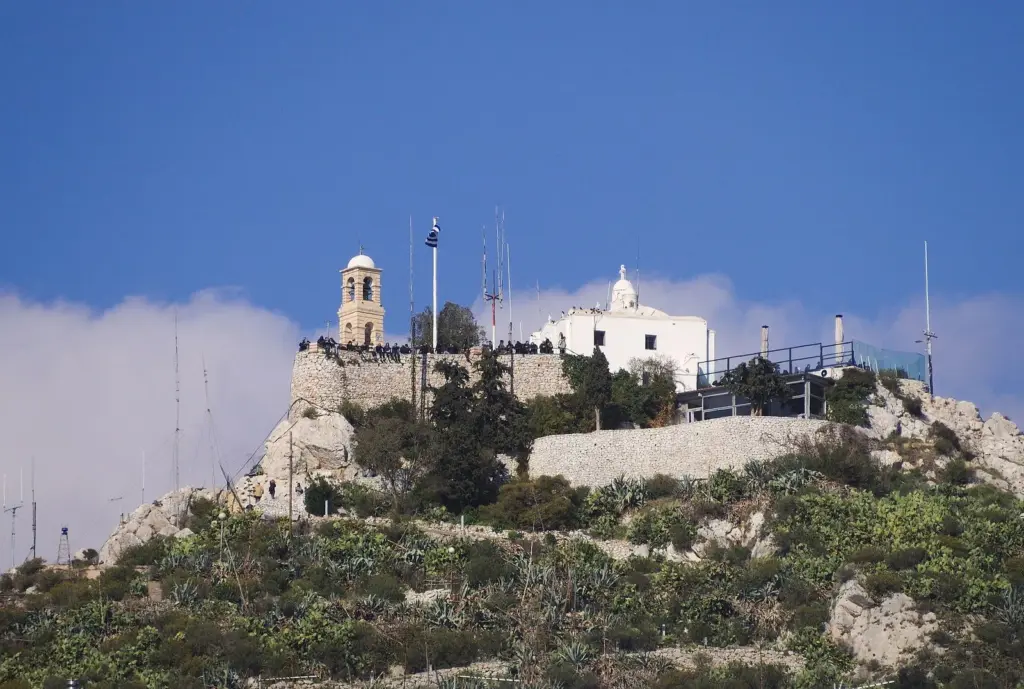
Less than you might expect, which is part of the appeal. The summit is a small platform of rock with the white chapel of Agios Georgios (St George) at its tip, a bell tower, a flagpole and railed terraces wrapped around the top. Just below sit the restaurant, a bar and the funicular’s top station. There’s no ticket and no museum: the view is the whole point.
What can you see from the summit?
Nearly all of Athens, laid out like a map with mountains around its rim. The directions below are measured from the chapel, so you can find things without guessing:
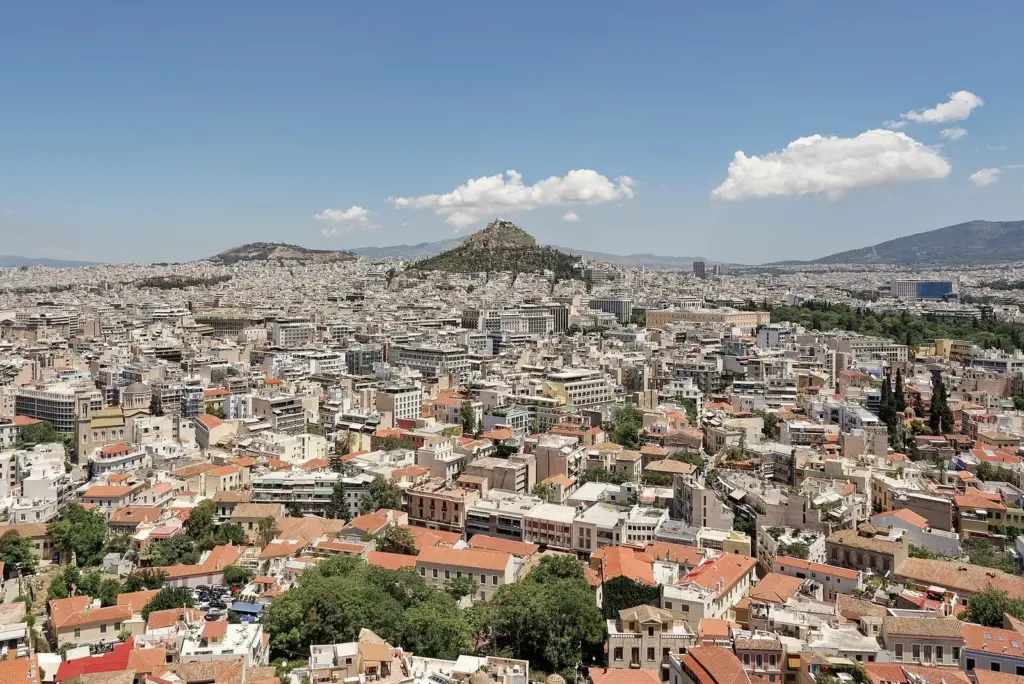
- The Acropolis: 1.85 km to the south-west. You see the Parthenon from the north-east, its long side towards you, and after dark the whole rock is floodlit.
- Syntagma Square: 1 km away, just left of the line to the Acropolis, with the Parliament at its head.
- The Panathenaic Stadium: 1.5 km due south, a white marble horseshoe.
- The Temple of Olympian Zeus: 1.7 km to the south-south-west, beyond the green of the National Garden.
- Piraeus and the Saronic Gulf: about 10 km to the west-south-west, with the islands beyond on a clear day.
- Mount Hymettus (Ymittos): the long ridge to the east, behind which the sun rises in winter.
How long to stay. Twenty minutes covers the chapel and a slow lap of the terraces. The reason to stay longer is the light: in the hour around sunset the city shifts from white to gold to blue, and after dark the grid of streetlights shows you just how far Athens spreads towards the mountains.
Where should you stand for photos?
The Acropolis is far enough away that a wide phone shot shrinks it to a pale smudge. At 1.85 km the rock spans about 9 degrees of your view, so a phone’s 3x lens fits it with the city around it and a 5x lens fills about half the frame with it; on a full-frame camera, a 200mm lens fills most of the frame with the rock alone. Stand on the south-west side of the terrace for the Acropolis, and move round to the west side for summer sunsets, which happen far to its right. Our Athens photography spots guide has more viewpoints and framing ideas across the city.
The Lycabettus Theatre: concerts under the summit
Look east from the summit and you’ll see it: an open-air theatre set into a bowl of bare rock on the hill’s eastern shoulder. It was long one of the city’s best-loved summer stages, then it sat closed for years. The City of Athens has now reopened it after restoration, and it runs a summer programme of concerts and theatre again. The 2026 season opened on 15 May and, according to reports when it launched, was billed at more than 50 nights running into October.
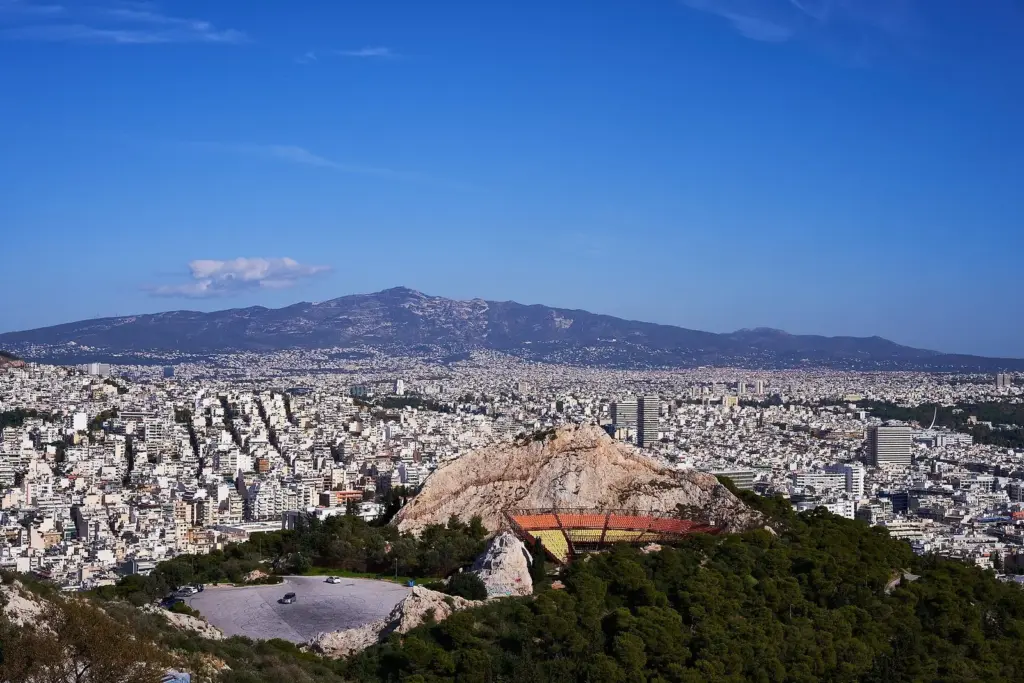
Buy through the listing, and plan the way home. Buy tickets only through the seller named on each event’s official listing, and read its access notes. The funicular doesn’t stop at the theatre: its two stations are the one in Kolonaki and the one by the summit restaurant, so a taxi up the eastern road is the simplest way in. A full house leaves all at once, so expect a slow walk down or a wait for a cab.
By mid-October the 2026 season is at or near its end; check the theatre’s programme for 2027 dates before you plan around a show. Our Athens festivals and events calendar tracks the big summer programmes as they’re announced.
Is dinner at the top worth booking?
Orizontes Lycabettus, the restaurant beside the funicular’s top station, has some of the best-placed tables in Athens and prices to match. Its website, which also carries the funicular information, lists its menus and a bar, Skybar Lycabettus, so you can go up for a drink without committing to dinner.
Book for sunset, not for the food alone. If the meal is an occasion, reserve directly with the restaurant a few days ahead and ask for a table facing west or south-west; sunset is the sitting everyone wants. If the food matters more than the setting, have a drink at the top and eat in Kolonaki or Exarchia afterwards, where the same money goes much further.
Verdict: worth it for an anniversary or a last night in Athens, less so on a budget. The view from the free terrace above is just as good; what you’re paying for is a chair and a glass while you look at it.
Lycabettus Hill funicular at sunset: times month by month
Sunset is when everyone comes, and it’s worth doing once for that reason alone. The table gives computed sunset times for the summit on the 1st and 15th of each month from October 2026 to September 2027, plus civil dusk on the 15th, when the sky turns deep blue and the city lights take over. Times are accurate to a couple of minutes and move by a minute or so from year to year. They’re in Greek summer time (EEST) until 24 October 2026 and again from 28 March 2027, and in winter time (EET) in between.
| Month | Sunset on the 1st | Sunset on the 15th | Civil dusk on the 15th | Where the sun goes down |
|---|---|---|---|---|
| October 2026 | 19:08 | 18:48 | 19:14 | Just south of west, to the right of Piraeus |
| November 2026 | 17:26 | 17:13 | 17:41 | South-west, just right of Piraeus |
| December 2026 | 17:06 | 17:07 | 17:36 | Over Piraeus, a little right of the Acropolis |
| January 2027 | 17:16 | 17:29 | 17:58 | Over Piraeus, a little right of the Acropolis |
| February 2027 | 17:48 | 18:03 | 18:30 | South-west, just right of Piraeus |
| March 2027 | 18:18 | 18:32 | 18:58 | Almost due west, behind Mount Aigaleo |
| April 2027 | 19:48 | 20:01 | 20:28 | West-north-west, behind Aigaleo |
| May 2027 | 20:15 | 20:28 | 20:58 | West-north-west, behind Aigaleo |
| June 2027 | 20:42 | 20:49 | 21:21 | Furthest north of the year |
| July 2027 | 20:52 | 20:47 | 21:18 | West-north-west, the latest sunsets |
| August 2027 | 20:35 | 20:19 | 20:47 | West-north-west, swinging back south |
| September 2027 | 19:55 | 19:34 | 20:00 | Almost due west, behind Aigaleo |
Where does the sun set from Lycabettus?
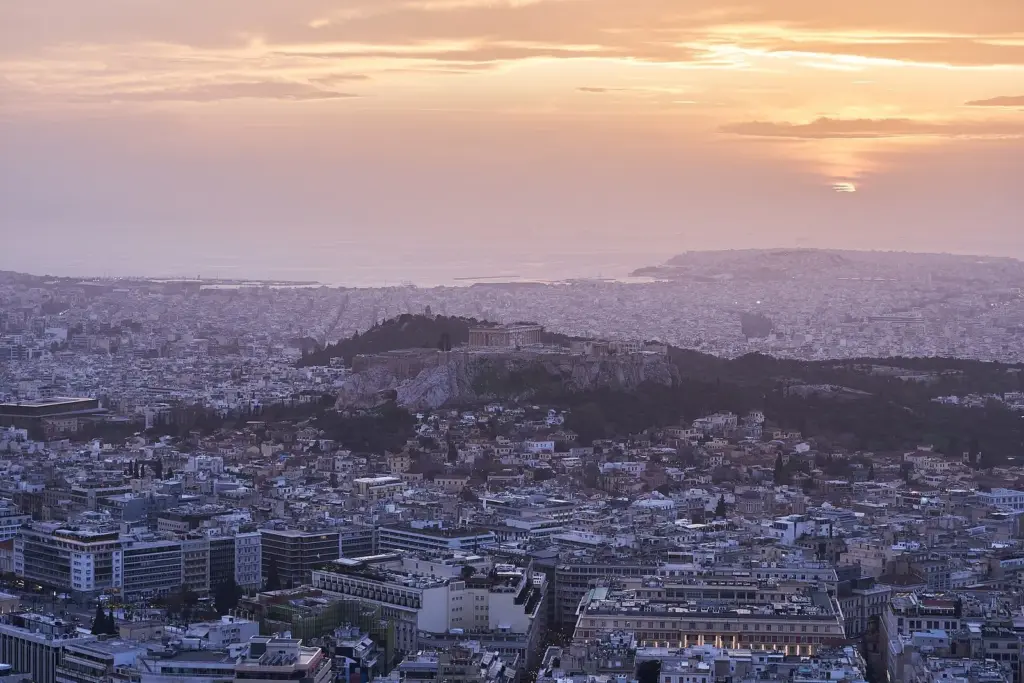
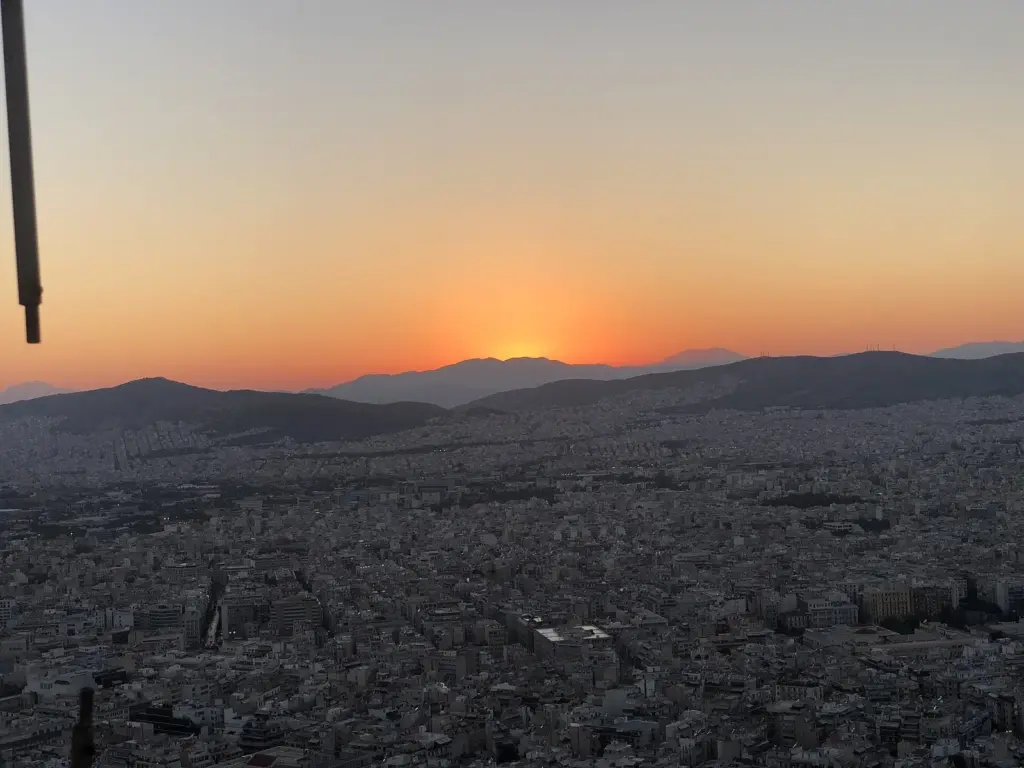
It depends on the month, and it changes the picture completely. From the chapel, the Acropolis lies at a bearing of about 231 degrees and Piraeus at about 244. In December and early January the sun sets at around 240 degrees, between the two, so the Parthenon shares the frame with the sunset as a dark outline against the glow. By the equinoxes the sunset has swung round to due west, behind Mount Aigaleo, and in June and July it goes down at about 300 degrees, far to the right of the Acropolis, which then catches the last light from the side instead of sitting in silhouette.
Winter is the season for the classic shot. From November to February the sun sets between 17:06 and 18:03, the climb is cooler, the air is often clearer after a spell of north wind, and the sun drops close to the Acropolis. Summer sunsets come later, draw bigger crowds and sink behind the mountains rather than towards the sea.
Why does the sun disappear early?
Sunset times assume a flat horizon. From March to September the sun sets behind Mount Aigaleo, whose ridge stands higher than the summit you’re on, so it slips out of sight a few minutes before the time in the table. In winter, when it heads for the sea, what you see is closer to the table. Either way the best colour often comes after the sun has gone, so don’t pack up the moment it disappears.
The sun stands about 6 degrees above the horizon 35 to 40 minutes before sunset, which is when the golden light begins, and civil dusk comes 26 to 31 minutes after it. Arrive 45 minutes early, stay 30 minutes after, and you get both, with the floodlit Acropolis to finish.
Is sunrise better?
For photographers, often. The funicular doesn’t start until 09:00, so a sunrise visit means walking up in the half-light with a torch. In December the sun rises between about 07:20 and 07:40 over Mount Hymettus, to the east-south-east, and you see it some minutes later because it has to clear the mountain first; in June it’s up by about 06:05. The reward is morning light on the east end of the Parthenon, the end that faces you, and a summit with a fraction of the evening crowd.
How should you plan a Lycabettus evening?
Work backwards from the sunset time in the table. On 15 October 2026, for example, the sun sets at 18:48, so you’d leave Kolonaki Square at about 17:30 to walk up, or be at the funicular by 17:45.
- Sunset minus 80 minutes, Kolonaki Square: coffee, then uphill; the Ploutarchou steps are the warm-up.
- Minus 70 minutes, Aristippou Street: take the footpath, or, on a summer evening, join the funicular queue no later than an hour before sunset.
- Minus 40 minutes, the summit: pick your side of the terrace, south-west for the Acropolis in winter and west for summer sunsets, and hold your place.
- Sunset: watch the sun go, then stay put; the sky often saves its best colour for afterwards.
- Plus 30 minutes, civil dusk: the city lights come up around the floodlit Acropolis, the best moment for photos.
- Plus 45 minutes, down: ride the funicular to Kolonaki for dinner, or stay on for a booked table at the top.
It pairs naturally with a morning at the Acropolis: go when the site opens at 08:00, sit out the afternoon heat, and finish on Lycabettus looking back at where you started.
With the rest of the evening free, our guide to Athens at night picks up where the funicular leaves you.
What should you skip, and when shouldn’t you go?
Skip the midday climb from June to September. The path faces west, the summit has little shade, and by early afternoon in August the rock throws the heat straight back at you. Go before 10:00, or ride up.
Skip paying for the funicular both ways in daylight. It’s a three-minute tunnel. If your knees allow it, walk one way.
Don’t expect the Acropolis close up. From 1.85 km it’s one feature in a cityscape, not the subject. If you want the Parthenon large in the frame, Philopappos Hill (Filopappou), facing the Acropolis from the south-west, is lower, closer and a better bet.
Don’t go on a hazy day for the view alone. When heat haze or Saharan dust settles over the basin, the sea and the islands disappear and the sunset turns a flat orange.
Don’t come at a July or August sunset if crowds spoil it for you. The summit platform is small and the best places at the railings go early; sunrise or a winter evening gives you the same view with elbow room.
Verdict: Lycabettus earns its place for the view over the whole city, best at a winter sunset or on a summer morning, but it’s a viewpoint rather than a sight, and one well-timed visit is enough for most people. For where it sits among the city’s top experiences, see our main list.
Lycabettus or another hill?
Athens has several free viewpoints, and each does a different job. Lycabettus is the highest and gives you the whole basin with the Acropolis as one landmark in it. Philopappos Hill gives you the Acropolis close and side-on, with Lycabettus rising behind it; choose it when the Parthenon itself is the subject. The Areopagus, the bare rock just below the Acropolis entrance, is free and minutes from the ticket gates, but it’s packed at sunset and the rock is polished slippery. Strefi Hill in Neapoli is lower and rougher around the edges, with Lycabettus itself in the view and far fewer people. For more views that cost nothing, see our list of free things to do in Athens.
Practical tips for Lycabettus
- Water and grip. Carry water on the climb and wear shoes with a decent sole; the steps can be slippery, especially after rain.
- A layer after dark. The summit is exposed, and on an October evening the wind makes it feel cooler than the streets below.
- A torch. If you walk down after sunset, a phone light will do, but the funicular is the better idea.
- Steps at the top. Even from the funicular or a taxi, expect steps up to the chapel terrace.
- Small children. Ride up rather than walk, and hold hands on the steps at the top.
- The chapel. Cover shoulders and knees if you step inside, and keep your voice down if a service is on.
Lycabettus Hill FAQ
How high is Lycabettus Hill?
Lycabettus rises to 277 metres above sea level, which makes it the highest hill in central Athens and the reason its summit sees the whole basin, from the mountains to the sea. From Kolonaki Square the walk up takes 30 to 45 minutes at a steady pace, or about three minutes by funicular from the lower station at the end of Aristippou Street.
How much is the Lycabettus funicular?
Listings in 2026 put the fare at about €10 single and €13 return. Treat those figures as a guide and check the board at the lower station before you pay. The hill itself is free, and walking up costs nothing at all.
What time does the Lycabettus funicular open and close?
The operator lists departures from 09:00 until 02:30 every day, every 30 minutes at quiet times and every 10 minutes when it’s busy. That means you can stay for sunset and dinner and still ride down. Check the times posted at the station in winter, as hours can change with the seasons.
How long does it take to walk up Lycabettus Hill?
Allow 30 to 45 minutes from Kolonaki Square, or 20 to 30 minutes from the start of the path on Aristippou Street, at a steady pace with a few stops. Coming down takes about 20 minutes. The path is paved and stepped but steep in places, so wear shoes with grip and avoid the midday heat in summer.
How far is Lycabettus Hill from the Acropolis?
The summit is 1.85 km from the Parthenon in a straight line. On foot, the Acropolis to the lower funicular station is roughly 3 km through Plaka, Syntagma and Kolonaki, about 40 to 45 minutes with the uphill end. By metro, ride Line 2 from Akropoli to Syntagma, change to Line 3 for one stop to Evangelismos, then walk about 15 minutes uphill.
Is Lycabettus Hill free?
Yes. There’s no ticket for the hill, the paths, the summit terraces or the chapel; you pay only if you take the funicular, a taxi or a table at the restaurant. That makes walking up one of the best free things to do in Athens, especially early on a summer morning or at a winter sunset.
What time should I go up Lycabettus for sunset?
Be at the summit about 45 minutes before sunset to get a place on the terrace and catch the golden light, then stay 30 minutes after for dusk. On 15 October 2026 the sun sets at 18:48; after the clocks go back on 25 October it drops to about 17:35, and it’s around 17:07 in mid-December.
Can you drive or take a taxi up Lycabettus?
Yes, most of the way. A road climbs the eastern side to the open-air theatre and a parking area below the summit, and taxis will take you there; you finish on foot up steps. It’s the practical choice for concerts at the theatre, or for anyone who can manage the last steps but not the full climb.
Related Athens Guides
- Things to Do in Athens: where Lycabettus fits among the city’s best experiences.
- Kolonaki Neighbourhood Guide: cafés, shops and dinner at the foot of the hill.
- Athens Photography Spots: more viewpoints and framing ideas across the city.
- Athens at Night: what to do once you’re back down.
- Free Things to Do in Athens: more views and sights that cost nothing.
Sources and How We Checked
We checked these details on 26 September 2026 against the official sources below; the guide is compiled from them rather than from other travel lists, and we don’t claim a first-hand visit.
- Orizontes Lycabettus (summit restaurant and funicular information): orizonteslycabettus.gr, for funicular times, cabins and the lower-station location.
- City of Athens, This is Athens: Lycabettus open-air theatre reopens.
- Hellenic Ministry of Culture, Odysseus: Acropolis opening hours.
- NOAA Global Monitoring Laboratory: Solar Calculator, the equations behind our sunset, dusk and direction figures for the summit.
- European Union, EUR-Lex: Directive 2000/84/EC on summer-time arrangements, for the 25 October 2026 and 28 March 2027 clock changes.
Athens Tourism Guide is an independent publication. We are not affiliated with the Hellenic Ministry of Culture, OASA, the Greek National Tourism Organisation or any business named here, and no business paid to be included.
Photo Credits
- Lycabettus from the Acropolis: photo by Jakub Hałun, via Wikimedia Commons (CC BY 4.0)
- The funicular's lower station: photo by Ανώνυμος Βικιπαιδιστής, via Wikimedia Commons (CC BY 3.0)
- St George's chapel on the summit: photo by Jebulon, via Wikimedia Commons (CC0)
- The Lycabettus Theatre: photo by George E. Koronaios, via Wikimedia Commons (CC BY-SA 4.0)
- Midwinter sunset over the Acropolis: photo by George E. Koronaios, via Wikimedia Commons (CC BY-SA 4.0)
- Summer sunset from the summit: photo by Nina1009, via Wikimedia Commons (CC BY-SA 4.0)
- The summit platform: photo by C messier, via Wikimedia Commons (CC BY-SA 4.0)
- Lycabettus Hill from the Areopagus (featured image): photo by Jakub Hałun, via Wikimedia Commons (CC BY 4.0)