This article contains advertising. Some of the hotel, tour, activity, flight and transfer links in it are paid links: if you book through one, we get a commission from the booking company, and your price is the same either way. It never affects what we recommend. Affiliate disclosure
The Athens Metro is the fastest, most reliable, and most modern way to get around the Greek capital. The 3-line, 66-station network covers central Athens, Athens International Airport, the major museums, and the Piraeus port, with a flat €1.20 fare for any 90-minute journey outside the airport section. Some stations double as underground archaeological museums (Syntagma, Akropoli, and Monastiraki preserve ancient finds discovered during construction). This is the complete Athens metro guide for 2026 with line-by-line breakdown, ticket prices, contactless payment, the 3-day tourist pass, and clear tips on which stations to use for each major attraction.

The Three Athens Metro Lines
Line 1 (Green) – Kifissia to Piraeus
Athens’s oldest metro line. Originally opened in 1869 as a steam railway, electrified in 1904, now fully integrated. 24 stations over 25.7 km running north-south. The line connects the northern suburb of Kifissia through the city centre (Omonia, Monastiraki, Thissio) to Piraeus port. Key tourist stations: Monastiraki, Thissio (Ancient Agora), and Piraeus (ferry departures).
Line 2 (Red) – Anthoupoli to Elliniko
Opened in 2000 ahead of the 2004 Olympics. 20 stations running broadly north-south through central Athens. Key tourist stations: Akropoli (Acropolis, Acropolis Museum), Syntagma (Parliament, central square, transfer to Line 3), Omonia (central transport hub, transfer to Line 1), and Larissa (railway station).
Line 3 (Blue) – Athens Airport to Dimotiko Theatro (Piraeus)
Opened in January 2000, with the airport extension following in summer 2004. The most internationally important line for visitors. Connects the airport directly to central Athens and onwards to Piraeus port. Key stations: Athens Airport, Doukissis Plakentias, Halandri, Ethniki Amyna, Megaro Mousikis (Megaron concert hall), Evangelismos (Byzantine and Christian Museum, Conrad Athens The Ilisian, War Museum), Syntagma (central transfer), Monastiraki (transfer to Line 1), Kerameikos (archaeological cemetery), and Piraeus port.
For broader context, see our Getting Around Athens pillar, our Airport transport guide, and our things to do guide.
2026 Ticket Prices & Tap-to-Ride
Single Ticket (Flat Fare)
€1.20 for a 90-minute journey on metro, bus, tram, and trolleybus combined (transfers included within the 90-minute window).
Day Pass
€4.10 for 24 hours unlimited travel on urban OASA transport (metro + bus + tram + trolleybus), including the X80, but not the Airport Express buses or the Koropi-Airport section of the metro. Excellent value if you take 4+ rides in a day.
5-Day Pass
€8.20 for 5 days (120 hours from first validation) of unlimited urban travel; airport services and the X80 are not included.
Tap-to-Ride (Contactless)
Use a contactless Visa or Mastercard credit/debit card or smartphone (Apple Pay, Google Pay) at the yellow readers. €1.20 charged per 90-minute journey; daily cap automatically applied at €4.10. The most convenient option for visitors with contactless cards.
3-Day Tourist Ticket
€20. Includes 3 days of unlimited travel on all OASA transport PLUS one round trip to/from the airport (the €9 standard airport fare each way is included). Excellent value for visitors landing at the airport. Available at major metro stations: Syntagma, Omonia, Monastiraki, Thissio, Acropolis, and Piraeus.
Airport Express Ticket
€9 single / €16 return. Required for journeys to/from the airport on Metro Line 3. NOT included in the standard €1.20 fare or the standard day pass. The X95 and X96 Airport Express buses take their own ticket: €5.50 single (€2.70 reduced). The reduced metro single is €4.50 for eligible passengers, including ages 7-18, people over 65 and eligible students, with proof of entitlement.
Operating Hours
Lines 2 and 3: from 05:30, with last departures from Syntagma at 00:23 Sunday-Thursday and 02:00 on Friday. Saturday: Lines 2 and 3 run all night, apart from the airport section. Line 1 and the airport trains: separate timetables, published on stasy.gr.
Trains run every few minutes at peak times and less often late in the evening.
Which Station for Each Major Attraction
- Acropolis: Akropoli (Line 2 red)
- Acropolis Museum: Akropoli (Line 2 red)
- Ancient Agora: Thissio (Line 1 green) or Monastiraki (Lines 1 & 3)
- Plaka: Monastiraki (Lines 1 & 3) or Syntagma (Lines 2 & 3)
- Monastiraki Flea Market: Monastiraki (Lines 1 & 3)
- Syntagma Square & Parliament: Syntagma (Lines 2 & 3)
- National Archaeological Museum: Viktoria (Line 1) or Omonia (Lines 1 & 2)
- Benaki Museum: Syntagma (Lines 2 & 3) or Evangelismos (Line 3)
- Byzantine & Christian Museum: Evangelismos (Line 3)
- Kerameikos Cemetery: Kerameikos (Line 3) or Thissio (Line 1)
- Temple of Olympian Zeus: Akropoli (Line 2)
- Panathenaic Stadium: Akropoli (Line 2), Syntagma (Lines 2 & 3) or Evangelismos (Line 3), each roughly a kilometre’s walk
- Piraeus Port (ferries to islands): Piraeus (Lines 1 & 3)
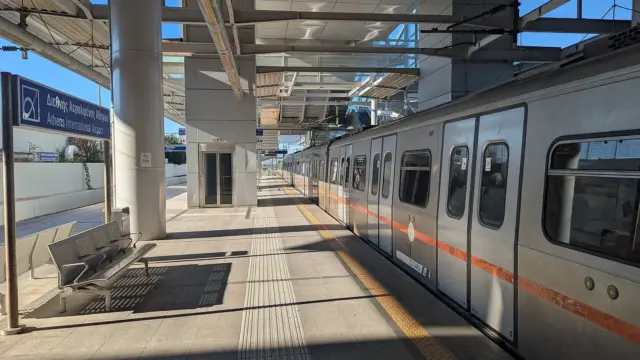
- Athens Airport: Athens International Airport (Line 3)
How to Use the Metro
Step 1: Buy or Activate Your Ticket
Three options: buy a paper ticket from a station machine (€1.20 single), buy a day pass from a machine or kiosk (€4.10), or use contactless tap-to-ride with your bank card or phone.
Step 2: Validate (Critical)
Tap your paper ticket or contactless card at the yellow validators at the station entrance BEFORE going to the platform. An unvalidated ticket counts as no ticket; inspectors check regularly and the fine is €100 if caught (€50 for passengers eligible for reduced fares).
Step 3: Find Your Line and Platform
Signs are bilingual (Greek/English) throughout the network. Line colours: green (1), red (2), blue (3).
Step 4: Board and Ride
At peak times a train comes along every few minutes. Doors close automatically; stand back from the platform edge.
Step 5: Exit
Pass through the gate at your destination station; tap your contactless card again at exit gates if you used tap-to-ride.
The Metro’s Archaeological Stations
Building Lines 2 and 3, which began in 1992, uncovered significant archaeological finds. Several stations display the discoveries in situ:
- Syntagma Station: stratigraphic sections of soil layers from ancient through modern Athens, plus ancient pottery, bronze, and architectural fragments displayed in the main concourse.
- Monastiraki Station: the preserved 5th-century-BC Eridanos River that ran through ancient Athens, plus the foundations of an 8th-century-AD Byzantine workshop. Free to view through glass floors.
- Athens Airport Station: exhibits on the history of Athens transport from antiquity.
Accessibility
Metro stations have lifts, but any one of them can be out of service, so check STASY’s lift-status information before you travel. OASA publishes access and boarding guidance for wheelchair users on Lines 1, 2 and 3. Accessible toilets at all major interchange stations (Omonia, Syntagma, Monastiraki).
Common Metro Mistakes to Avoid
Not validating your ticket (€100 fine, €50 at the reduced rate). Buying tickets on the train (not allowed; only at stations). Trying to use a standard €1.20 ticket for the airport (you need the €9 airport-specific ticket). Using contactless then losing the card you tapped in with (each journey must be tapped in and out with the same card). Staying on a Line 3 (blue) train past Piraeus: Line 1 (green) ends there, but Line 3 shares the same Piraeus station and continues one stop to Dimotiko Theatro.
The Athens Metro During Major Events
Service can differ from the usual timetable on event days, so check OASA before you travel:
New Year’s Eve: the exception. On 31 December 2025 the metro finished by 23:00, so check OASA for this year’s arrangements.
Football matches at the Olympic Stadium: check OASA for any event-day service changes.
Athens Marathon (November): several stations have crowd-control measures; arrive early.
Major concerts at OAKA Olympic Stadium: check OASA for any event-day service changes before you go.
Metro Safety & Pickpocketing Reality
The Athens Metro is generally safe at all hours. The main practical concern is pickpocketing on busy trains and at crowded stations. Practical mitigation: keep wallets in front pockets; use crossbody bags worn across the body (not over a shoulder); be alert in crowded carriages; never put bags down between your feet (use lap or shoulder).
Late-night travel (the last trains on Fridays, and the all-night Saturday service on Lines 2 and 3): the Metro remains safe but cars get less-populated. Solo travellers may prefer the front-of-train carriage where the driver is visible. Most Athens neighbourhoods served by the Metro are safe at all hours.
Frequently Asked Questions
How much does the Athens metro cost?
€1.20 single 90-minute ticket on Lines 1, 2, and 3 (excluding airport). €4.10 day pass. €9 single airport ticket (Line 3 to/from airport). €20 for the 3-day tourist ticket including airport round trip.
What are the Athens metro operating hours?
Lines 2 and 3 start at 05:30; the last trains leave Syntagma at 00:23 from Sunday to Thursday and at 02:00 on Friday, and on Saturday they run through the night (not on the airport section). Line 1 and the airport trains have their own timetables.
Can I use contactless cards on the Athens metro?
Yes. Tap a contactless Visa or Mastercard credit/debit card or smartphone (Apple Pay, Google Pay) at the yellow readers. €1.20 per 90-minute journey; daily cap of €4.10.
How do I get to the Acropolis by metro?
Take Line 2 (red) to Akropoli station. The Acropolis Museum is close to the station, and the walk uphill to the Acropolis takes about 12 minutes, depending on which entrance you use.
How many lines does the Athens metro have?
Three lines: Line 1 (green, Piraeus to Kifissia), Line 2 (red, Anthoupoli to Elliniko), and Line 3 (blue, Athens Airport to Dimotiko Theatro via central Athens and Piraeus).
Is the Athens metro safe?
Yes. Modern, well-lit, and heavily used by Athenians at all hours. Pickpockets work busy trains, so take the usual big-city precautions.
How do I get from Athens airport to the city by metro?
Take Line 3 (blue) from Athens International Airport station to Syntagma (about 39 minutes) or Monastiraki (about 41 minutes). €9 single ticket; €16 return.
Plan the Rest of Your Athens Trip
For more transport content, see our pillar guide to Getting Around Athens, our airport transport guide, and our things to do guide. The Athens bus and tram guide, taxis and ride-sharing guide, walking guide, ferry guide, and Piraeus port guide are also in this cluster.