This article contains advertising. Some of the hotel, tour, activity, flight and transfer links in it are paid links: if you book through one, we get a commission from the booking company, and your price is the same either way. It never affects what we recommend. Affiliate disclosure
Six hours is the line. Below it, the best Athens layover things to do are almost all inside the airport; from about six hours on a Schengen connection you can reach the Acropolis or the Acropolis Museum and get back with a sane buffer, and with twelve hours you get a proper day in the old centre. The deciding numbers are not the sights at all: they are passport control, an hour each way on the metro or bus, and how early you need to be back for your next flight.
This page is for travellers changing planes at Athens International Airport (ATH) who want to know, honestly, whether the city is within reach. The one caveat that matters: leaving the airport means entering Greece, so passport control, your visa position and your checked bags decide if you can go at all, before any itinerary does. For longer stays the parent guide to Athens itineraries for every trip length takes over. Details checked 9 November 2026 against OASA, Hellenic Heritage (the Ministry of Culture’s site and ticket service), the Acropolis Museum, the Hellenic Civil Aviation Authority and the Government Gazette’s airport taxi decision.
| Time between flights | Realistic time in the city | What fits | Our call |
|---|---|---|---|
| Under 4 hours | None | The airport only | Stay airside |
| 4 hours | 0-20 minutes, at best | Not enough for the trip in and out | Stay |
| 5 hours, Schengen both ways, no checked bag | About 1 hour | Syntagma Square, the guard, a coffee in Plaka | Only if you enjoy cutting it close |
| 6 hours, Schengen both ways | About 2 hours | The Acropolis or the Acropolis Museum | Go, with one sight only |
| 6 hours, arriving or leaving outside Schengen | Under 1 hour | Syntagma at a push | Usually stay |
| 8-9 hours | 3-4 hours | Acropolis plus museum, or Acropolis plus a long lunch in Plaka | Go |
| 12 hours | 6-7 hours | Acropolis, museum, Plaka, the Ancient Agora, Monastiraki | Go: it is a short day trip |
| Overnight | An evening and an early start | Dinner in Plaka, the Acropolis lit up, an early bus back | Go, and book a bed |
The middle column is the one that matters, and it already has the buffers taken out. The sections below show the arithmetic, so you can redo it for your own flight times.
What’s changed in 2026?
Four things move the layover maths in 2026, and older layover guides miss most of them.
- The airport taxi flat fare went up. A ministerial decision published in the Government Gazette on 18 September 2026 set the fixed fare between the airport and the city centre at €50 under tariff 1 and €65 under tariff 2, replacing the lower flat fares that most guides still quote. The flat fare covers the city-centre run only.
- Border checks now include EES. Since 10 April 2026 the EU’s Entry/Exit System has been fully in use at every Greek airport border point. Non-EU travellers on short stays have their face and fingerprints registered instead of getting a passport stamp, and the first registration can take extra time. That is time you spend in a queue on the way out, and again on the way back if your next flight leaves the Schengen area.
- Winter hours are short. From 1 November to 31 March the Acropolis is open 08:00-17:00, with last admission 20 minutes before closing. A layover that lands in the city at 15:30 in December has missed it.
- Free Sundays are back in winter. The Acropolis and the other state sites are free on the first and third Sundays of each month from November to March, which is lovely for your wallet and hard on the queue.
How much of an Athens layover can you actually use?
Less than the gap on your boarding pass. Every layover loses time in four places, and it is worth counting them before you pick a single sight.
| Where the time goes | Allow | Why |
|---|---|---|
| Off the plane and out of the airport | 30 minutes on a Schengen arrival with hand luggage; 45-75 minutes from outside Schengen | Passport control and, for non-EU travellers, EES registration on entry |
| Airport to the centre | 1 hour | OASA gives the X95 bus about 60 minutes to Syntagma, depending on traffic; the metro avoids traffic but runs roughly every half hour, so one missed train costs you 30 minutes |
| Centre back to the airport | 1 hour | Same again, and leave earlier in rush hour if you are on the bus |
| Back at the airport before departure | 1 hour 30 minutes for a Schengen flight with no bag to drop; 2 hours 30 minutes for a flight leaving Schengen or with a bag to check | Security, any exit passport check, the walk to the gate and a margin for a late train |
Those allowances are our planning rule rather than an official figure, and they lean cautious on purpose. The cost of being 30 minutes early at the gate is a coffee. The cost of being 30 minutes late is a new ticket, possibly at the walk-up fare, and if you are on separate bookings nobody owes you a seat on the next flight.
Run it for a six-hour Schengen connection: 30 minutes out, an hour in, an hour back, 90 minutes before departure. That leaves two hours in the city. The same six hours with a flight arriving from, say, London or Dubai and leaving for another Schengen city costs you an extra half hour or more at passport control on arrival, and if your onward flight is non-Schengen you need the longer departure margin too. You are now down to well under an hour in Athens, which is two coffees and a photo of the Parliament. Not worth a €16 metro return and the adrenaline.
Verdict: work out your hours in the city first. If the answer is under 90 minutes, read the airport section and stay.
When should you not leave the airport?
Some layovers look long enough on paper and still should not leave the building. Stay at the airport if any of these apply to you:
- You can’t enter Greece. Leaving the airport is an entry into Greece and the Schengen area, with the same rules as any arrival. If your passport needs a Schengen visa and you don’t hold one, your layover is airside. Check your own position on the EU’s official travel site before you fly, not at the airport.
- Your bag isn’t checked through. If you have to collect a suitcase and check it in again, add the time at baggage reclaim and at the check-in desk, plus somewhere to leave the bag in between. Most short layovers die here.
- Your tickets are separate. Self-connections give you no protection if the first flight is late. Use the layover as your safety margin rather than your sightseeing window.
- Your first flight is already late. An hour’s delay eats half of a six-hour plan. Redo the arithmetic on landing, honestly.
- You land after the sites close. Arriving into the city at 16:30 in winter gets you a walk, not the Acropolis. That can still be a good walk, but know which one you are buying.
- There’s a strike or engineering works. Transport strikes do happen in Athens, and STASY ran evening engineering closures on Line 3 during 2026. Check STASY and OASA on the day; if the metro is out, the bus is in traffic and the taxi rank is long.
- It’s a heatwave day. In heatwaves the Ministry of Culture closes the Acropolis through the hottest part of the day; on 8 July 2025 it stayed shut until 17:00. A summer layover built around a midday visit can collapse with a day’s notice.
None of these is a reason to panic. They are reasons to make the decision at the gate on arrival, with real information, rather than the night before.
Athens layover things to do in 4 hours
Here is the honest answer: with four hours between flights, stay at the airport. Run the numbers and the trip into Athens and back uses two of your hours, the arrival and departure margins use the rest, and the time left in the city rounds to nothing. Even in the best case, a Schengen arrival with hand luggage and a Schengen departure, you would reach Syntagma with almost no time before you needed to turn round.
That makes the 4-hour Athens layover an airport layover, and the airport is a reasonable place to spend it. Our guide to Athens airport, its terminals and facilities covers where to eat, sit, sleep and shower on both sides of security, so we won’t repeat it here.
What about five hours? The Syntagma sprint
Five hours, Schengen in and out, no checked bag, daylight: now there is a sliver. You will have something like an hour in the city, and the right place to spend it is Syntagma, because the airport metro and the X95 bus both stop there and you lose no time getting to anything.
- The station itself: Syntagma metro station, where Lines 2 and 3 meet, has a permanent archaeological exhibition on its first basement level. You walk past it anyway. Give it five minutes.
- The Parliament and the guard: two Evzones of the Presidential Guard stand at the Monument of the Unknown Soldier, below the Hellenic Parliament, and change every hour. On Sundays there is a larger ceremony with a band, which is worth timing a layover around if you can; check the Presidency’s site for the time. Watching is free.
- A coffee towards Plaka: walk south off the square into the edge of Plaka for a coffee or a koulouri, the sesame bread ring sold from street carts, with an eye on the time.
- Back down to the platform: leave yourself the full hour for the return, more if you are on the bus.
Verdict: fun if you like the feeling of having technically been to Athens. If you’d be watching the clock the whole time, the airport is the better hour.
Six hours: the Acropolis or the museum, not both
This is the layover most people are really asking about, and the answer is yes, provided both flights are Schengen and nothing has gone wrong yet. You get about two hours in the centre. Spend them on one thing done properly, not two things done at a run.
Take an example. You land at 10:00 from Rome and leave for Mykonos at 16:00. You’re on the airport train by about 10:30, at Syntagma around 11:30, and you need to be back on a train by 13:30 to be at the airport for 14:30. Two hours, and the walk from Syntagma to the Acropolis gate comes out of them.
Option 1: the Acropolis
€30, about 75-90 minutes on the rock. The Acropolis costs €30 (reduced €15) whatever the season, and entry is by timed slot. Buy your ticket online from the Ministry of Culture’s own Hellenic Heritage ticket service, which you reach from hh.gr; there is no official skip-the-line product, so any site selling one is a reseller. Pick the first slot that falls at least 45 minutes after you expect to reach Syntagma, which gives you room for a slow train.
From Syntagma, either walk through Plaka towards the west slope, where the main entrance is, or change to Line 2 for one stop to Akropoli and walk up the pedestrian Dionysiou Areopagitou. The walk is the better use of the time if your legs are fresh: you see a slice of the old town on the way, and you are not waiting on a platform.
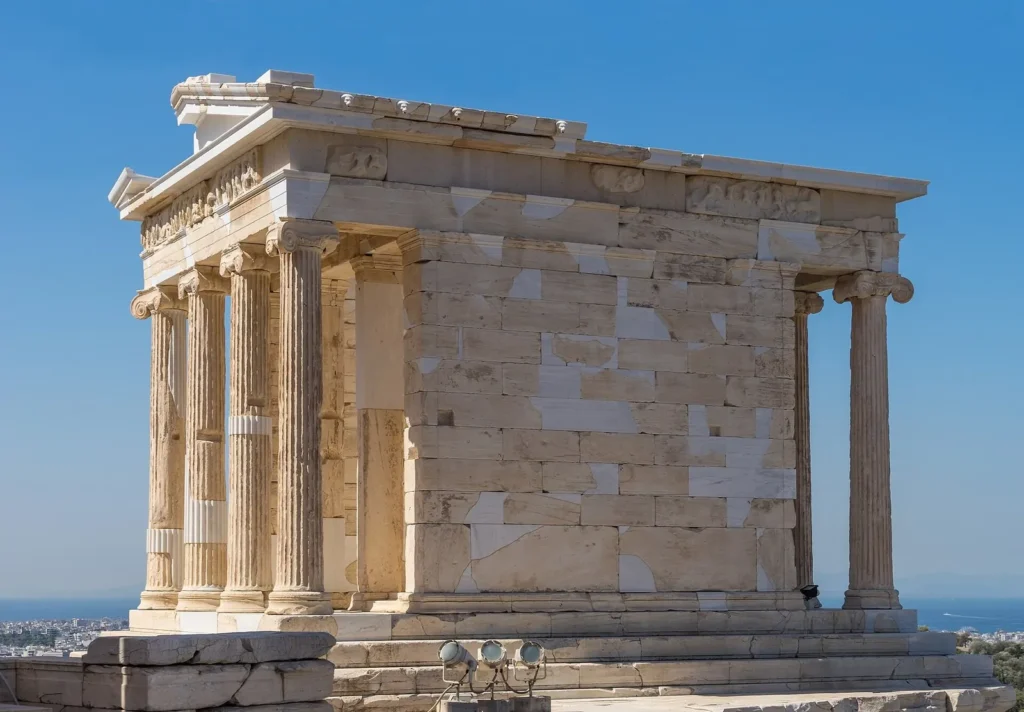
Once inside, don’t try to see every corner. The Propylaea, the Temple of Athena Nike, the Parthenon and the Erechtheion with its porch of maidens are the core of it, and they sit close together on the summit. The views over the city to the sea are half the point. In winter, with the site open 08:00-17:00 and last admission 20 minutes before closing, a late-morning visit is easy. In summer the problem is heat and crowds, not hours.
Option 2: the Acropolis Museum
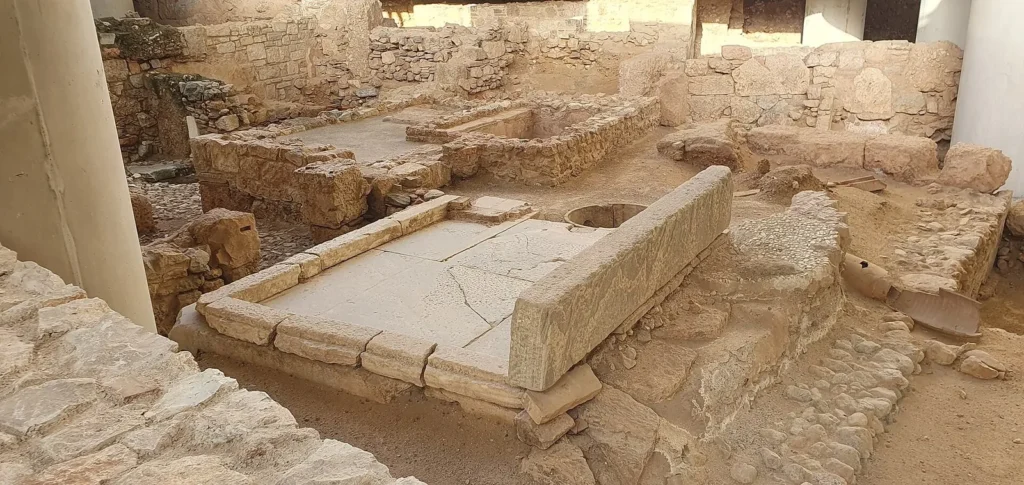
€20, about 90 minutes, flat ground. The museum charges €20 (reduced €10) all year. It suits a layover better than people expect: the entrance is beside Akropoli metro station on Dionysiou Areopagitou, there is no climb, and it is indoors, which counts for a lot in July. The top-floor Parthenon Gallery looks straight across at the temple itself, and the excavated neighbourhood under the glass floors is worth a slow look on the way in.
Check the day before you commit. The museum’s winter timetable (1 November to 31 March) has it open 09:00-17:00 Monday to Thursday, with last entry at 16:30, and later on Fridays and at weekends, but confirm the current hours on its own site. It X-rays bags at the door and asks visitors not to bring large bags or backpacks, which matters if you have come straight from the plane.
Which one? First time in Athens, decent weather: the Acropolis, because standing on the rock is the thing you came for. Rain, heat, bad knees or a slightly later arrival: the museum, which is calmer and closer to the train. Trying to squeeze both into two hours means rushing both and enjoying neither.
Plan it: Schengen in and out only; €30 Acropolis or €20 museum, plus €16 for the metro return; Syntagma (Lines 2 and 3), then walk or one stop to Akropoli (Line 2); back on a train two and a half hours before departure at the latest.
Eight or nine hours: the comfortable middle
Add two or three hours to the six-hour plan and the trip relaxes. You can do the Acropolis and the museum together, which is the natural pairing: rock first while you are fresh, then down to the museum, where the sculpture that once stood on the buildings you have just walked round is shown at eye level. Or do the Acropolis and then sit down to a long lunch in Plaka, which is a perfectly defensible choice after an early flight.
This is also the length at which a non-Schengen connection starts to work. If you need the longer arrival and departure margins, an eight-hour gap gives you roughly the two hours a Schengen traveller gets from six. Treat it as a six-hour plan and keep one sight.
Twelve hours: a real day in the old centre
With twelve hours you are no longer squeezing anything. Take off the margins and you have six or seven hours on foot in the historic centre, which is about what a well-paced first day in Athens looks like anyway. The difference is that you have to end it on a train rather than in a hotel bar.
Say you land at 07:00 and leave at 19:00. A morning arrival is the best kind: the sites open early, the light is soft, and you are back at the airport before the evening rush.
- Acropolis, from about 09:00: you’re out of the airport by around 07:45 and in the centre an hour later. In winter the gates open at 08:00, so a 09:00 slot works with time to spare. Give it a full two hours this time, including a slow circuit of the summit and the views towards the sea.
- Acropolis Museum, late morning: walk down to the museum and allow 90 minutes. It has a café if you need to refuel before lunch.
- Plaka and Anafiotika, lunch: Plaka is the old neighbourhood at the foot of the Acropolis. Eat there, then climb into Anafiotika, the hamlet of small whitewashed houses that, by the Greek National Tourism Organisation’s account, craftsmen from the island of Anafi built in the 1860s. Its lanes are all steps, so it is not a route for a wheeled case.
- Ancient Agora, early afternoon: the marketplace of the ancient city, with its museum in the Stoa of Attalos. It costs €20 (reduced €10) and keeps the same winter hours as the Acropolis, 08:00-17:00. While the main Adrianou Street entrance is being redeveloped, visitors have been entering by the gate on the Thiseio side; check hh.gr for the current entrance before you walk round.
- Monastiraki, mid-afternoon: finish at Monastiraki Square, where the flea-market streets start. Monastiraki station is on Line 3, the airport line, so you can board here without going back to Syntagma.
Board at Monastiraki by about 16:00 and you’re at the airport by 17:00 with two hours before a Schengen departure. For a non-Schengen flight, leave the Agora for another trip and head back an hour earlier.

The summer version
In summer, flip the order. The Acropolis stays open until 20:00 from April to August, so take the museum and Plaka in the heat of the day and the rock in the late afternoon, when the stone has started to cool and the cruise groups have gone back to Piraeus. That only works if your flight leaves late enough to let you be on a train by the early evening, and only on a day without a heatwave closure. If the forecast says 40°C, do the museum and skip the hilltop altogether.
What to leave out on a 12-hour layover
Cape Sounion. The Temple of Poseidon at sunset is beautiful and on half the day-trip lists, but it is far down the coast from the centre and further still from the airport. Doing it on a layover means spending most of your day in a vehicle with your flight time ticking. Verdict: save it for a trip with a hotel.
The National Archaeological Museum. It is one of the great collections of ancient art, but it is north of the old centre, its winter hours are short (last winter 08:30-15:30 most days and 13:00 on Tuesdays; check namuseum.gr for this winter’s timetable), and on a first visit the Acropolis pair is the stronger use of the day. Verdict: second visit.
Lycabettus Hill. A fine viewpoint, but it is in the opposite direction from everything else on this route, and the view from the Acropolis or Philopappos Hill does the same job without the detour. Verdict: skip on a layover.
If you finish early and want one more view, Philopappos Hill, across from the Acropolis, is free to visit, though the hills can be closed on high wildfire-risk days, so check before you go.
Overnight and late-evening layovers
An overnight layover changes the shape of the trip completely. The sites are shut when you land, so you are buying an evening in the city and, if your flight is late enough, a morning at the Acropolis before you fly.
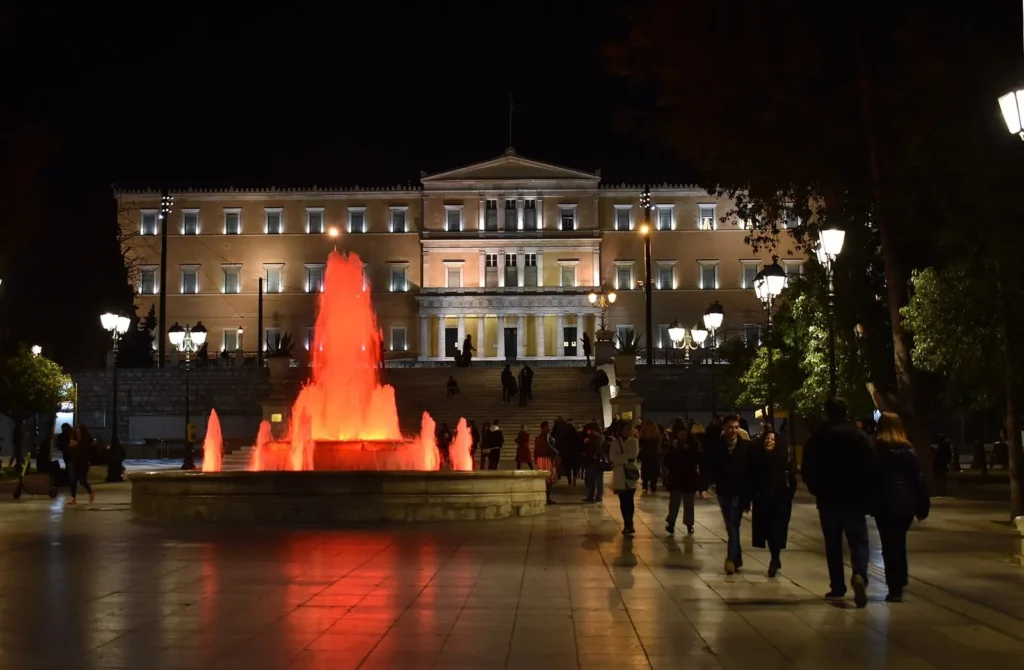
For the evening, Syntagma and Plaka are the natural pair again. The guard changes on the hour at the Monument of the Unknown Soldier, the Parliament is floodlit, and Plaka’s tavernas run late, with the lit Acropolis above the rooftops. In winter the Acropolis Museum stays open until 22:00 on Fridays, which makes a Friday evening layover unusually good.
Getting back is where people come unstuck. The X95 airport bus runs 24 hours, which makes it the safe late-night and early-morning link between Syntagma and the airport. The metro keeps shorter hours, and its first and last airport trains are set by STASY’s timetable, so check that before you plan around it.
Book a bed. Either take a hotel near Syntagma and the X95 stop, or sleep at the airport’s own Sofitel across from Arrivals and come into the city in the morning. Sleeping on terminal seating is possible but you will not enjoy the Acropolis on three hours of it.
Metro, bus or taxi: which is best on a layover?
The metro, in most cases. It doesn’t sit in traffic, it stops at both Syntagma and Monastiraki, and a return ticket covers your whole layover. The bus is the cheap and 24-hour option; the taxi wins for two or more people on a tight timetable, or when the metro isn’t running.
| Option | Fare | Frequency and time | Best for |
|---|---|---|---|
| Metro Line 3 (blue) | €9 single, €4.50 reduced; €16 return, valid 30 days | Roughly every half hour; check STASY’s timetable for first and last trains | Daytime layovers, Syntagma and Monastiraki |
| X95 Airport Express bus | €5.50, €2.70 reduced; contactless bank cards accepted at the full fare | 24 hours; OASA estimates about 60 minutes to Syntagma, depending on traffic | Nights, early mornings, tight budgets |
| Taxi | Flat fare to the city centre: €50 (tariff 1) or €65 (tariff 2) | Door to door, traffic permitting | Groups of two or more, strikes, very tight timings |
A few details trip up first-timers. The ordinary €1.20 ticket is not valid on the airport stretch of the metro, so you need the airport ticket. The single airport ticket is valid for 90 minutes on other OASA services, including all three metro lines, but not on the airport buses. The €20 three-day tourist ticket includes an airport trip each way, but on a layover the €16 metro return is cheaper. On the X95, you can only board on the way to the airport and only get off on the way in, so it is not a hop-on city bus.
The sums shift with group size. A taxi there and back costs €100 at tariff 1 however many of you there are, against €16 a head for metro returns: €32 for two, €64 for four. Alone or as a couple, the metro wins easily. For a family of four on a tight timetable, the taxi’s extra €36 buys you door-to-door travel and no 30-minute wait for a missed train. The flat fare only covers the city centre: to Piraeus or anywhere outside the centre, the meter runs. Ask for the flat fare before you get in.
The full comparison, with where each option leaves from, is in our guide to getting from the airport to the city centre.
What do you do with your bags?
If your suitcase is checked through to your final destination, you only have your cabin bag to think about. If not, leave it at the airport rather than dragging it into the city.
Care4Bag runs a 24-hour left-luggage desk in the Arrivals hall next to Gate 1. Its price list, valid to the end of 2026, runs from €8 for a small bag up to six hours, €10 medium and €12 large, with longer periods priced in steps, and you pay when you collect. Dropping the bag on the way out and picking it up on the way back costs you a few minutes each way, which beats hauling it up the Acropolis steps.
Your cabin bag is a different question. The Acropolis Museum X-rays bags and asks visitors not to bring large bags or backpacks, and the steps of Anafiotika and the Acropolis are no place for wheels. If you want to leave even a small bag, there are lockers beside Syntagma and Monastiraki stations; the City of Athens visitor guide lists Leave Your Luggage there, 07:00-21:00 daily. Our guide to left luggage in Athens compares the options and what they cost.
Can you leave Athens airport during a layover?
Yes, if you are allowed to enter Greece. Greece is in the Schengen area, so leaving the airport is a full border entry: passport control on the way out, and on the way back too if your next flight leaves Schengen. Non-EU travellers on short stays also go through EES registration, with face and fingerprints, and the first time is the slow one.
We are not going to tell you if you need a visa, because it depends on your passport and the rules are set by the EU. Check the EU’s official travel site (travel-europe.europa.eu) or the Greek consulate for your country before you book a long layover with city plans. If you need a visa you don’t have, you stay airside, however long the gap.
Your bags matter as much as your passport. A suitcase checked through to your final destination lets you walk out with just a cabin bag. A suitcase you have to collect means baggage reclaim, somewhere to leave it, and a fresh check-in before your next flight, which turns a six-hour layover into a four-hour one.
Is a layover tour worth it?
Private layover tours of Athens exist, and they solve the two things that make a layover stressful: transport and timekeeping. A driver meets you at Arrivals, takes you to the Acropolis and back, and watches the clock so you don’t have to. For a family, or anyone who would rather not navigate the metro after a long-haul flight, that is worth money.
Doing it yourself is cheaper and nearly as easy. The metro runs straight to the centre, the Acropolis sells timed tickets online, and the route on this page needs nothing more complicated than one change of line. Whichever you choose, check three things before you book a tour: that the meeting point is in Arrivals, that the price includes your Acropolis or museum entry or says clearly that it doesn’t, and that the operator commits to a return time in writing. A tour that leaves you at the airport two hours before a non-Schengen flight is not doing you a favour.
Winter or summer: how the season changes a layover
| Season | Acropolis hours | What it means for a layover |
|---|---|---|
| 1 November-31 March | 08:00-17:00, last admission 20 minutes before closing | Morning and midday arrivals work; afternoon ones often don’t. Free on the first and third Sundays, so expect queues then. |
| 1 April-31 August | 08:00-20:00 | Long hours, but heat and crowds; heatwave closures can shut the site in the middle of the day. |
| September and October | Closing time steps down from 19:30 to 18:00 through the two months | Good weather, shrinking evenings; check the exact closing time for your date. |
Winter is, in many ways, the better layover season. The Acropolis is calmer, walking between sights in the middle of the day is pleasant rather than punishing, and the museum’s late Friday opening gives you an evening option. The catch is the 17:00 close, which makes an afternoon arrival a walking-and-dinner layover rather than a sightseeing one.
Summer gives you long opening hours and makes you pay for them in heat. Wear a hat, carry water, wear shoes with grip for the polished marble, and keep the hilltop for the morning or the late afternoon. If your layover falls on a heatwave day, the museum is your plan A.
When your next trip has more than a layover’s worth of time, start with our one day in Athens itinerary, then see how many days to spend in Athens and the rest of our Athens trip plans.
Athens Layover FAQ
Can I leave Athens airport during a layover?
Yes, if you can legally enter Greece and the Schengen area. You go through passport control, and non-EU travellers on short stays are registered in the Entry/Exit System, which can add time on a first visit. If your bags are checked through and your layover is six hours or more on a Schengen connection, a short trip into the city is realistic.
Is a 5-hour layover in Athens enough to see the Acropolis?
Not comfortably. Once you allow for leaving the airport, an hour each way to the centre and a safe margin before your next flight, five hours leaves about an hour in the city, which is not enough to reach the Acropolis, go through the gate and see it. Use the time for Syntagma Square and the changing of the guard, or stay at the airport.
How long does it take to get from Athens airport to the city centre?
OASA estimates about 60 minutes on the X95 bus to Syntagma, depending on traffic. The metro avoids traffic, but trains run roughly every half hour, so a missed train adds half an hour. For layover planning, budget an hour each way whichever you take, and check STASY’s timetable for first and last trains.
How much is a taxi from Athens airport to the centre?
The flat fare between the airport and the city centre is €50 under tariff 1 and €65 under tariff 2, set by a decision published in September 2026. Older guides quoting lower flat fares are out of date. The flat fare covers only the city-centre route, so trips to Piraeus and elsewhere are metered. Confirm the fare with the driver before you set off.
Do I need a visa for a layover in Athens?
That depends on your passport and on leaving the airport or not. Staying airside is a different case from entering Greece, which follows the normal Schengen rules. Check the EU’s official travel site or the Greek consulate for your nationality well before you fly, and don’t rely on finding out at passport control on the day of your layover.
Can you sleep at Athens airport on a long layover?
You can wait out a night in the terminal, and the airport also has its own hotel, the Sofitel, across from Arrivals, which suits a late landing and an early departure. If you want an evening in the city instead, the X95 bus runs 24 hours, so you can stay near Syntagma and still make a dawn flight. Our airport guide covers the terminal options in detail.
Is a long layover in Athens worth it?
From about six hours on a Schengen connection, yes: the Acropolis or its museum is reachable with time to spare. With twelve hours you get most of what a first day in Athens offers. Under that, or with a non-Schengen connection and no extra hours, the airport is the wiser place to be, and you have a reason to come back.
Related Athens Guides
- Athens Itineraries: every plan we publish, from a cruise stop to four days.
- Athens Airport Guide: terminals, food, lounges and where to rest if you stay airside.
- Athens Airport to the City Centre: metro, bus and taxi compared in full.
- Luggage Storage in Athens: airport and city left-luggage options and prices.
- One Day in Athens: the full-day plan when you have a night in the city.
Sources and How We Checked
Details were checked on 9 November 2026 against the official sources below; this guide was compiled from them rather than from other travel lists, and no first-hand visit is claimed.
- OASA: ticket prices and 24-hour and airport lines
- Hellenic Heritage (Ministry of Culture): Acropolis of Athens hours, tickets and free days
- Ministry of Culture: Ancient Agora entrance and tickets
- Acropolis Museum: plan your visit
- Government Gazette B 5674/2026, decision 147620/16-09-2026 on airport taxi flat fares, as reproduced by Taxheaven
- Hellenic Civil Aviation Authority: EES in full operation from 10 April 2026; European Union: Entry/Exit System
- Care4Bag: airport baggage storage; City of Athens: luggage storage
Athens Tourism Guide is an independent publication. We are not affiliated with the Hellenic Ministry of Culture, OASA, the Greek National Tourism Organisation or any business named here, and no business paid to be included.
Photo Credits
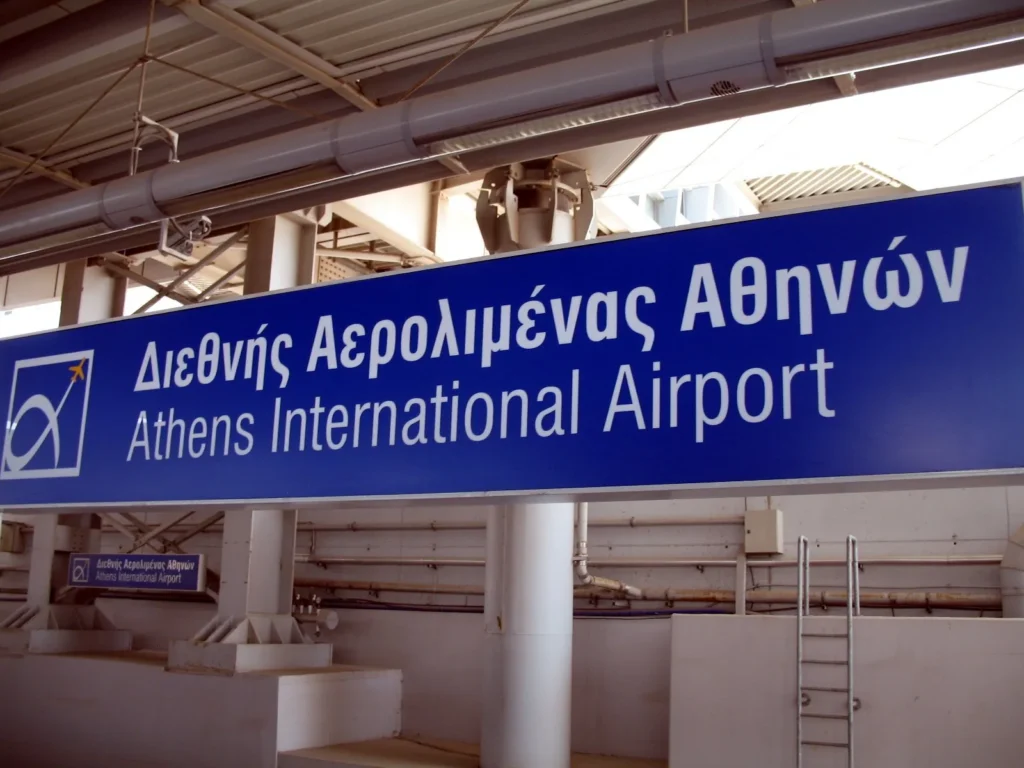
- Athens airport metro station: photo by Bobby H from Washington, DC, United States, via Wikimedia Commons (CC BY-SA 2.0)
- Temple of Athena Nike, Acropolis: photo by Jebulon, via Wikimedia Commons (CC0)
- Kolettis house, Plaka: photo by George E. Koronaios, via Wikimedia Commons (CC BY-SA 4.0)
- Hellenic Parliament and Syntagma fountain at night: photo by Annatsach, via Wikimedia Commons (CC BY-SA 4.0)
- Excavation beneath the Acropolis Museum: photo by Yair-haklai, via Wikimedia Commons (CC BY-SA 4.0)
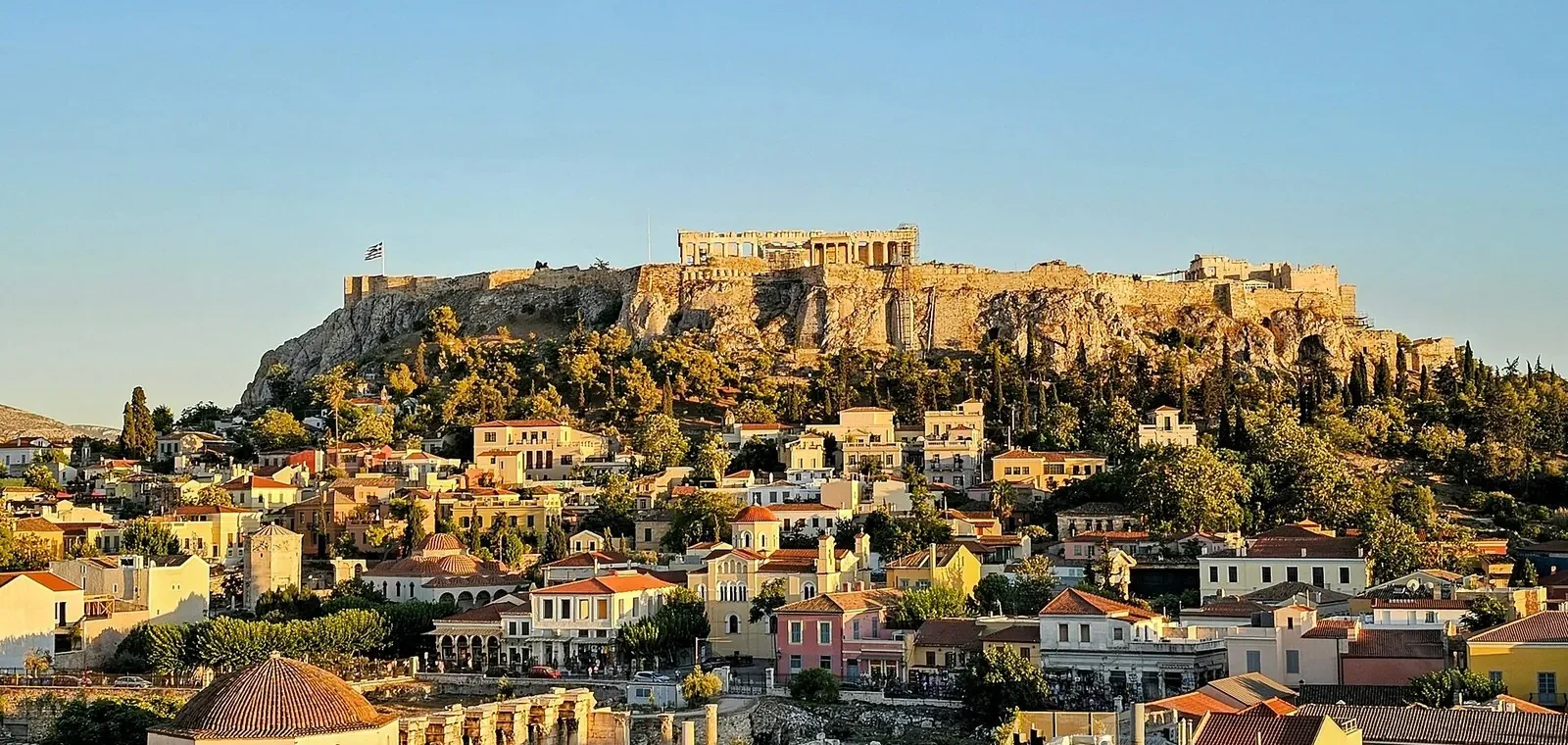
- Monastiraki Square and the Acropolis (featured image): photo by CHMunro, via Wikimedia Commons (CC BY-SA 4.0)