This article contains advertising. Some of the hotel, flight and transfer links in it are paid links: if you book through one, we get a commission from the booking company, and your price is the same either way. It never affects what we recommend. Affiliate disclosure
Spend the morning on the Acropolis and in its museum, the afternoon in the Ancient Agora and the lanes of Plaka, and the evening on a rock facing the Parthenon as the sun goes down, then eat late in Psirri. That is the whole of our one day in Athens itinerary in two sentences, and the order matters more than the list: the hill at 08:00 before the heat, indoors through the middle of the day, ruins and lanes once the light softens. Below are the timings hour by hour, the 2026 prices, what we’d skip, and two variants for days when the classic plan doesn’t fit: a museum day for heatwaves and rain, and a tighter day for a cruise call.
This plan is for a first visit with one full day, based in the centre and done on foot. The caveat that shapes it: the Acropolis is unshaded marble, and in heatwaves the Ministry of Culture has closed it for the afternoon, so the early entry is the one fixed point and everything after lunch can move. Details checked 26 September 2026 against the Ministry of Culture’s site pages, the Acropolis Museum, the National Archaeological Museum, the Panathenaic Stadium, OASA and the City of Athens visitor guide. With more than a day, our Athens itineraries for every trip length pick up where this one stops.
| At a glance | The first-timer’s day |
|---|---|
| Tickets | €70 at full price: Acropolis €30, Acropolis Museum €20, Ancient Agora €20 (€35 at reduced rates) |
| Time needed | 08:00 to dinner, with about 12 km on foot |
| Getting there | Walk from a central base; Akropoli (Line 2), Thissio (Line 1) and Monastiraki (Lines 1 and 3) stations bracket the route; a 90-minute metro ticket is €1.20 |
| Book ahead | Only the Acropolis, on the Ministry’s own ticket site, so you can walk straight to the gate at 08:00; buy the rest at the door |
| Best time | April to June and September to October; in July and August start at 08:00 and stay indoors from noon to 17:00 |
| Skip | The €20 Olympieion ticket, Lycabettus, and any restaurant with a tout at the door |
What’s changed in 2026?
Many one-day plans online predate the 2025 price overhaul. These are the details that now catch people out.
- The Acropolis costs €30 all year (reduced €15). The winter half price has gone, and first Sundays from November to March are no longer free; the free days are 6 March, 18 April, 18 May, the last weekend of September and 28 October.
- Every site sells its own ticket. The Ministry’s pages for the Acropolis, the Ancient Agora (€20) and the Olympieion (€20) list single-site tickets only. The seven-site pass that older guides describe isn’t on them, so budget site by site.
- The official ticket address has changed. The Ministry’s pages now send online buyers to tickets.hh.gr, its Hellenic Heritage Tickets platform; older guides give hhticket.gr, the same service’s earlier address. There is no official skip-the-line product, whatever resellers call their tours.
- One entry per Acropolis ticket. It covers the summit and the South Slope, but leave either and you can’t go back in on it.
- The Agora has one gate. Since 1 July 2025, while the Adrianou Street entrance is rebuilt, you enter and leave only at Thiseio Square. The Stoa of Attalos’s upper-floor exhibition and the Church of the Holy Apostles have been closed since 1 November 2025.
- The area around Hadrian’s Arch is closed. A Ministry notice of 1 April 2026 shut it for the Vasilissis Olgas Avenue works, with no reopening date.
- Heat closures have hit three summers running. On 8 July 2025 the Acropolis stayed shut until 17:00, after similar closures in 2023 and 2024.
Your one day in Athens itinerary, hour by hour
These times suit early October, when the Acropolis closes at 18:30 and the sun sets a little after 19:00. The morning holds all year; the table after the list shows how to shift the afternoon in summer and winter.
- 07:30 Breakfast near the hill: a koulouri (sesame bread ring) or a slice of bougatsa (custard pie) with a coffee, then walk up.
- 08:00 The Acropolis: in at the main west gate at opening for the Propylaea, the Parthenon, the Erechtheion and the view from the east end.
- 09:45 The South Slope: follow the signs down past the Theatre of Dionysus and out onto Dionysiou Areopagitou.
- 10:30 The Acropolis Museum: the Parthenon Gallery first, then the Caryatids and the Archaic rooms.
- 12:45 Lunch in Koukaki or Makrygianni: the streets immediately south of the museum.
- 14:15 The pedestrian avenue: Dionysiou Areopagitou and Apostolou Pavlou round the west side of the hill to Thiseio, about 25 minutes on foot.
- 14:45 The Ancient Agora: in at the Thiseio Square gate for the Temple of Hephaestus and the Stoa of Attalos.
- 16:30 Monastiraki, Plaka and Anafiotika: Hadrian’s Library and the Roman Agora over the railings, then uphill into the island-style lanes under the rock.
- 18:15 The Areopagus: the marble outcrop below the Acropolis gate, for sunset.
- 20:30 Dinner: Psirri for noise, Thiseio for the floodlit view, Koukaki for quiet.
| Stop | Allow | Ticket | On foot to the next stop |
|---|---|---|---|
| Acropolis and South Slope | 2 to 2.5 hours | €30 | 2 minutes to the Acropolis Museum |
| Acropolis Museum | 1.5 to 2 hours | €20 | 5 minutes into Koukaki |
| Lunch | 1 to 1.5 hours | Prices posted at the door | 25 minutes to the Agora’s Thiseio gate |
| Ancient Agora | 1 to 1.5 hours | €20 | 10 minutes to Monastiraki Square |
| Monastiraki, Plaka and Anafiotika | 1.5 hours | Free | 15 minutes to the Areopagus |
| The Areopagus at sunset | 30 to 45 minutes | Free | 10 minutes to Thiseio, about 15 to Psirri |
Verdict: full, not frantic. If something has to give, drop the Agora rather than the museum. The Acropolis Museum is where the sculpture from the hill actually is, and without it the Parthenon is an elegant shell.
How does the day shift with the season?
Both Ministry sites open at 08:00 all year but close earlier in steps as the days shorten, so June and December need different afternoons. September runs in two steps too: the Acropolis closes at 19:30 until the 15th, then at 19:00.
| Closes (last entry) | Summer | 1-15 October | 16-31 October | Winter |
|---|---|---|---|---|
| Acropolis | 20:00 (19:30) | 18:30 (18:00) | 18:00 (17:30) | 17:00 (16:30) |
| Ancient Agora | 19:30 (19:00) | 18:00 (17:30) | 17:30 (17:00) | 16:30 (16:10) |
| Acropolis Museum | 20:00; Monday 17:00; Friday 22:00 | As summer | As summer, to 31 October | 17:00 Monday-Thursday; 22:00 Friday; 20:00 weekends |
| Sunset, roughly | 20:50 at midsummer | 19:05, falling to 18:50 | 18:45; about 17:35 once the clocks go back on 25 October | 17:10 in December |
In summer, keep the Acropolis at 08:00, stretch the museum and lunch until 16:00, do the Agora from 16:00 and take the sunset after 20:30. In winter, go to the Agora straight after lunch, because its last entry is 16:10, and be at the sunset spot by 16:45.
Why start at the Acropolis at 08:00?
Because it is the one slot nothing can take from you. The summit has almost no shade and the marble throws the heat back up at you; on 8 July 2025, with the thermometer above 40°C, the Ministry kept the site shut until 17:00. The first hour is also the coolest of the day. At 14:00 in August the rock is a griddle.
08:00 In at the main gate, out by the South Slope
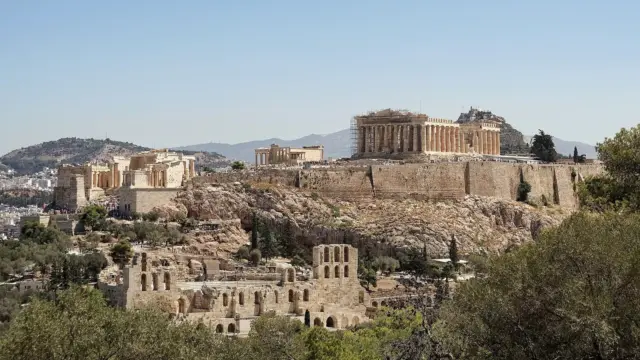
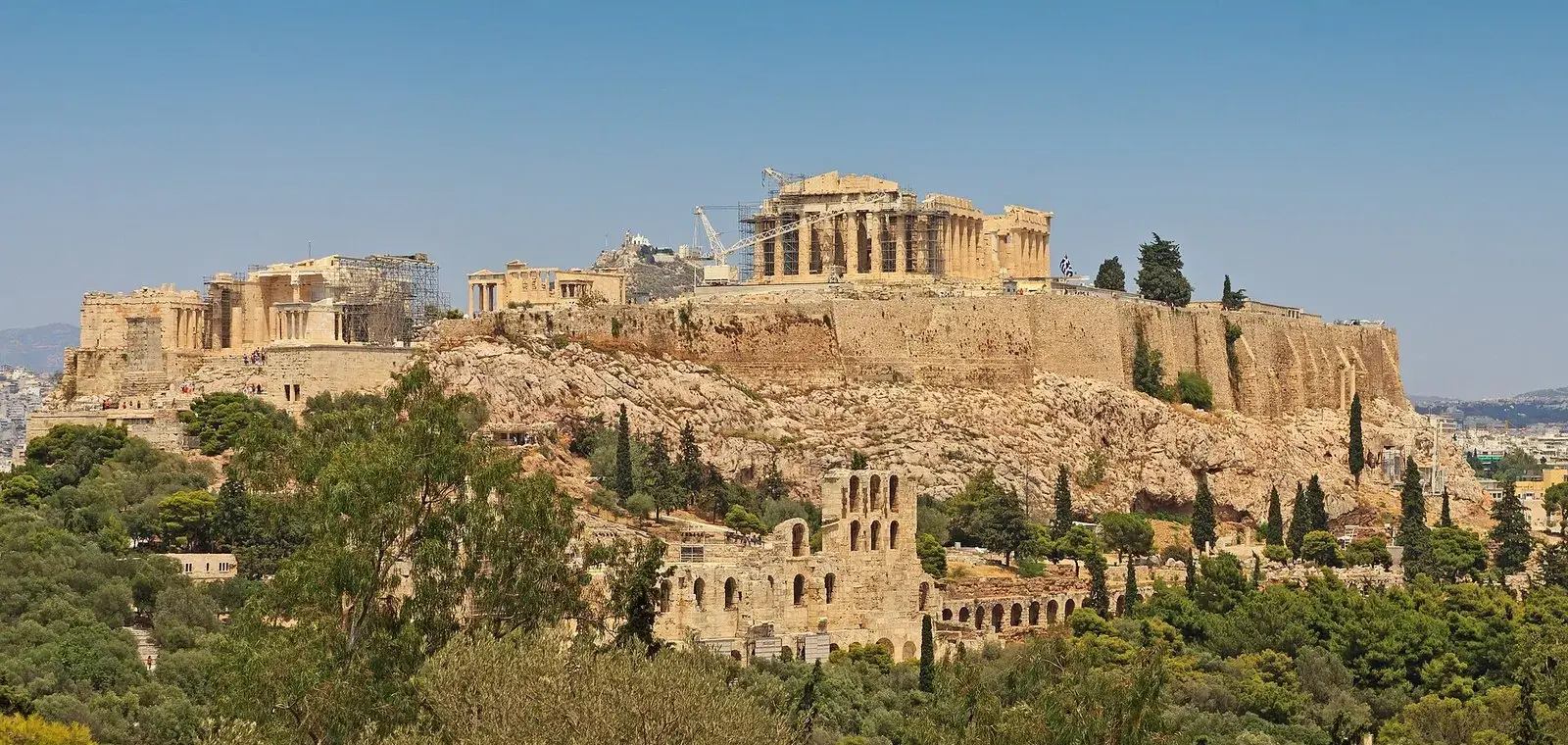
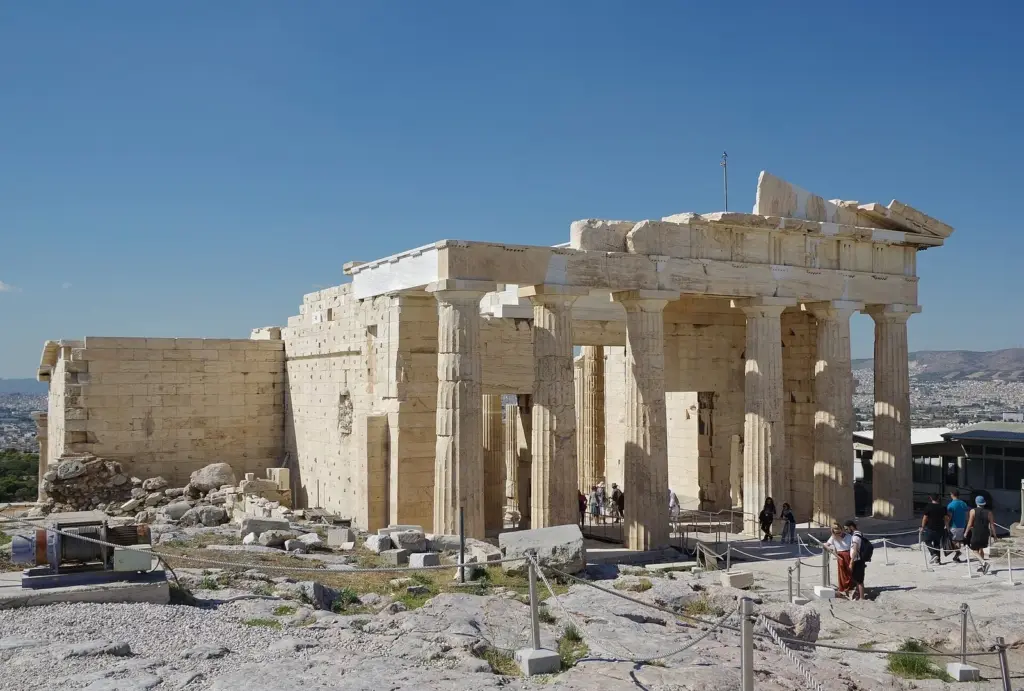
€30, 2 to 2.5 hours. Buy the ticket online from the Ministry’s platform the day before, or at the ticket office on site. Walk up through the Propylaea, the monumental gateway, with the small Temple of Athena Nike on its bastion to your right. Take the Parthenon slowly and from every side, then the Erechtheion and its Porch of the Caryatids (the six on the building are copies; five of the originals are in the museum), then the lookout at the east end, where the Greek flag flies over Plaka. Come back down through the Beulé Gate and follow the signs left, to the south, onto the path that drops to the South Slope: the Odeon of Herodes Atticus from above, the Asklepieion, the Theatre of Dionysus, and out onto Dionysiou Areopagitou a couple of minutes from the museum.
That route only works in one go, because the ticket is single-entry: step out of either area and it’s spent. If the queue at the main gate is long at opening, walk round to the South Slope entrance on Dionysiou Areopagitou and do the whole thing in reverse, finishing at the west gate beside the Areopagus. The cloakroom outside the main entrance won’t take large luggage, though small backpacks are fine on the site. Eating and drinking among the monuments is against the rules, and the City of Athens warns against heels on the slippery marble. The monuments one by one, and every ticket category, are in our complete Acropolis guide.
Plan it: 08:00-18:30 in early October (last entry 18:00), 08:00-17:00 in winter; €30, reduced €15; Akropoli (Line 2), then about 15 minutes uphill to the main gate; allow 2 to 2.5 hours with the South Slope; best first thing, in every season.
Is the Acropolis Museum worth two hours of a single day?
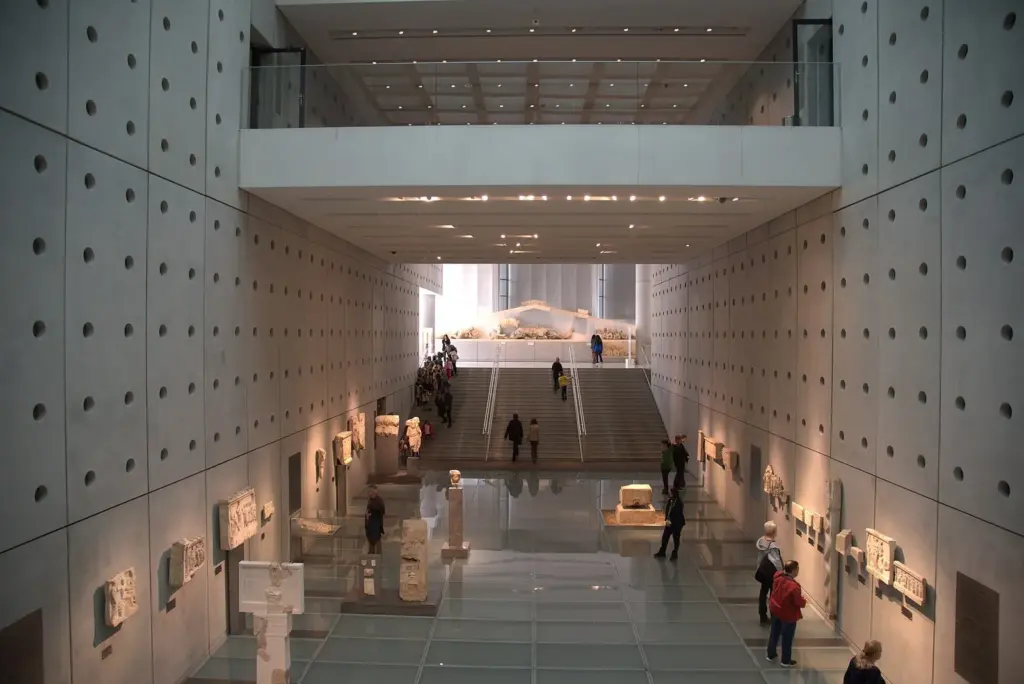
€20, 1.5 to 2 hours. Yes, and it’s the reason the plan runs in this order. The Parthenon sculpture that stayed in Athens is here, not on the hill. The glass-walled Parthenon Gallery on the top floor lays out the frieze, the metopes and the pediment figures as they sat on the temple, facing the building you walked round an hour earlier, with pale plaster casts standing in for the pieces in London. Go there first, while the real thing is still fresh in your head. Then drop to the first floor for the five Caryatids and the Archaic gallery’s painted korai, and look down through the glass floor at the entrance onto the excavated ancient neighbourhood the museum was built over.
Bags go through an X-ray at the door and backpacks go to the ground-floor cloakroom. The desk takes cash or cards, and reduced or free tickets (EU citizens under 25 among them) are issued only there, with proof. Mondays are the catch: the museum closes at 17:00 that day all year, one more reason to go in the morning.
Plan it: 09:00-20:00 Tuesday to Sunday until 31 October (Friday to 22:00, Monday to 17:00), then winter hours; €20, reduced €10; Akropoli (Line 2), next door; allow 1.5 to 2 hours; best straight after the hill.
Where should you eat lunch near the Acropolis?
Walk two or three blocks south of the museum into Koukaki and Makrygianni, residential districts with tavernas and cafés on their side streets. Avoid the terraces on the pedestrian avenue and anywhere a waiter steps into your path with a menu: the City of Athens’s own visitor guide tells visitors not to be lured in. Greek rules are on your side here. Every taverna must post its price list outside the door, a cover charge is illegal, bread or bottled water can’t be added to the bill unless you agreed to it, and you’re owed an itemised bill. A tip of 10-15% is normal for good service; our guide to tipping in Greece covers cash versus card.
In July and August, make lunch long. The two hours after it are the worst of the day to be on bare rock or open ruins, and the Agora will still be there at 16:00.
Afternoon: the Ancient Agora, then Plaka’s back lanes
From Koukaki, the pedestrianised Dionysiou Areopagitou curves round the south side of the Acropolis and becomes Apostolou Pavlou on the west: about 25 minutes of car-free walking past the Odeon’s arches and the foot of Philopappos Hill to Thiseio (Thissio on the metro map).
14:45 The Ancient Agora, in through Thiseio
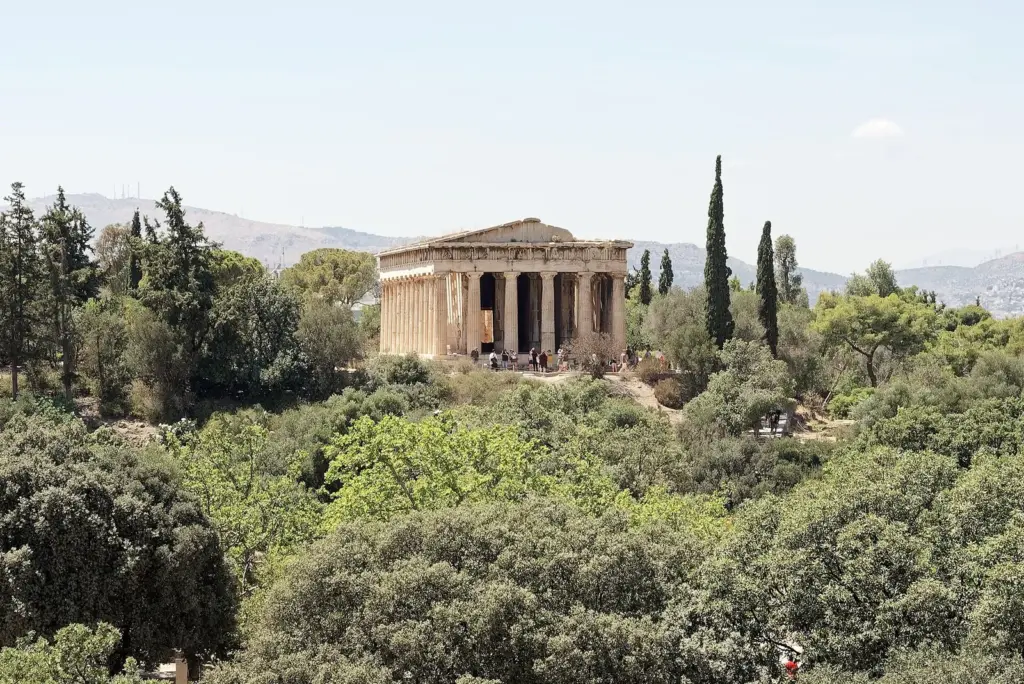
€20, 1 to 1.5 hours. This was the working heart of the ancient city, all law courts, offices and colonnades where Socrates argued, and most of it survives as foundations in long grass, which is why it divides opinion. Two buildings carry it. The Temple of Hephaestus, on the low hill at the western edge, stands almost whole because it spent centuries as a church. The Stoa of Attalos, rebuilt in the 1950s, holds the site museum, including the pottery shards Athenians scratched names on to vote a politician into exile; its upper floor has been closed since November 2025. With the Adrianou entrance shut for works, you come and go through the Thiseio Square gate, so plan to leave the way you came.
Verdict: worth €20 if you want the democracy story after the Acropolis’s temples, or simply a greener, quieter site. If another ruin sounds like homework, take the east-side loop below instead.
Plan it: 08:00-18:00 in early October (last entry 17:30), to 17:30 from 16 October, 08:00-16:30 in winter (last entry 16:10); €20, reduced €10, museum included; Thissio (Line 1), a short walk to the gate; allow 1 to 1.5 hours.
16:30 Monastiraki, Plaka and Anafiotika
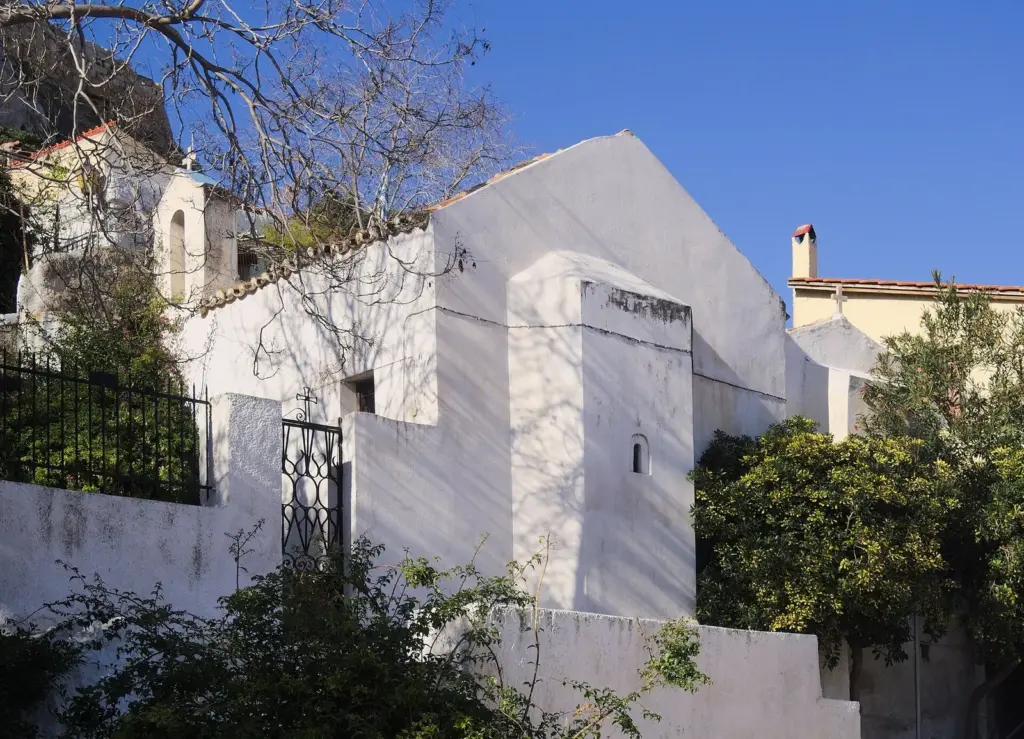
Free, 1.5 hours. From the Thiseio gate, Adrianou Street runs east beside the Agora fence to Monastiraki Square in about 10 minutes. Hadrian’s Library lines the lane beside the square, and a few minutes further on, the Roman Agora’s gateway and the octagonal Tower of the Winds sit in an enclosure you can take in almost entirely from the streets around it. Then climb. Plaka’s lanes rise towards the rock, and at the top, under the north-east cliff, is Anafiotika: whitewashed cube houses built by stonemasons from the island of Anafi in the 19th century, with steps and passages barely a shoulder wide. People live here, so keep your voice down and stay out of doorways. From Anafiotika, follow the lanes west along the north slope, signposted for the Acropolis entrance, to reach the Areopagus in about 15 minutes.
Plan it: free; Monastiraki (Lines 1 and 3); allow 1.5 hours; best in the late afternoon, on the way to the sunset.
The east-side swap: Syntagma, the National Garden and the stadium
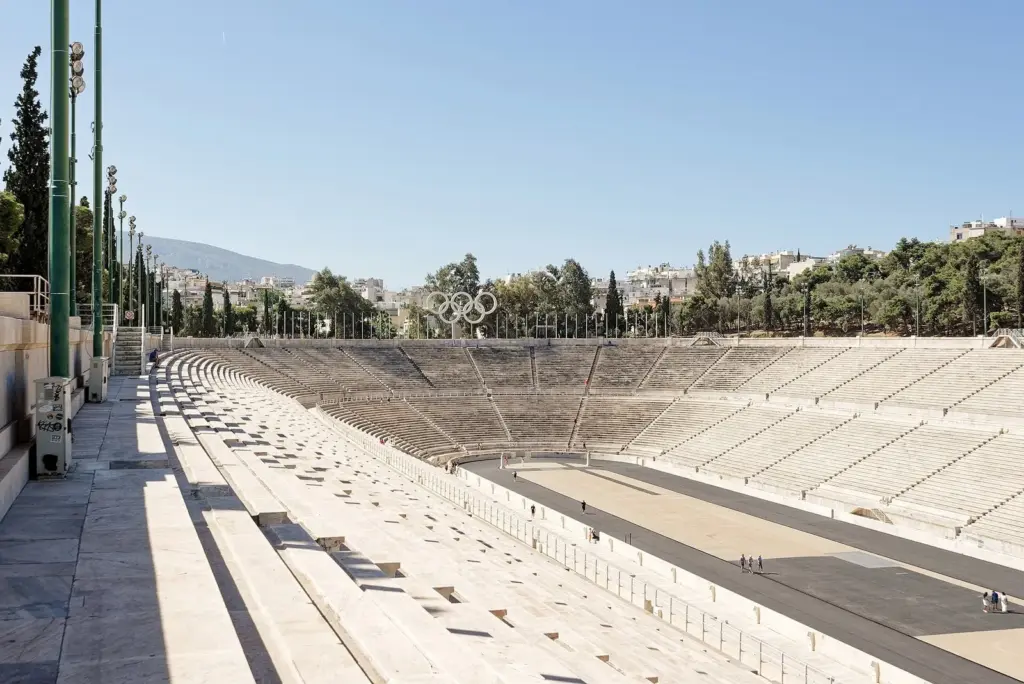
Free to look, about 2.5 hours. If you drop the Agora, spend the afternoon on the city’s 19th-century side instead. From Koukaki walk east to Amalias Avenue, where the Olympieion’s colossal columns stand behind railings you can see straight through, then cut past the Zappeion to the Panathenaic Stadium, the all-marble arena of the first modern Olympic Games in 1896. Its website gave its hours as 08:00-19:00 daily in late September, and it posts closures of the track for events, so check before you go. The view through the entrance on Vasileos Konstantinou Avenue costs nothing; a ticket gets you onto the track and the stands. Walk back through the shade of the National Garden to Syntagma Square, where two Evzones of the Presidential Guard change at the Monument of the Unknown Soldier every hour. On Sunday at 11:00 the whole guard marches in with a band. From Syntagma, Plaka and Anafiotika are 15 to 20 minutes uphill on foot.
Verdict: the guard change is worth ten minutes if you’re passing on the hour, and worth building a morning round only on a Sunday. The stadium is best seen from its gate unless you want to run a lap of the 1896 track.
Where should you watch the sunset?
Two hills west of the Acropolis, both free and both reached on foot from the day’s route. The difference is effort.
The Areopagus, the easy option
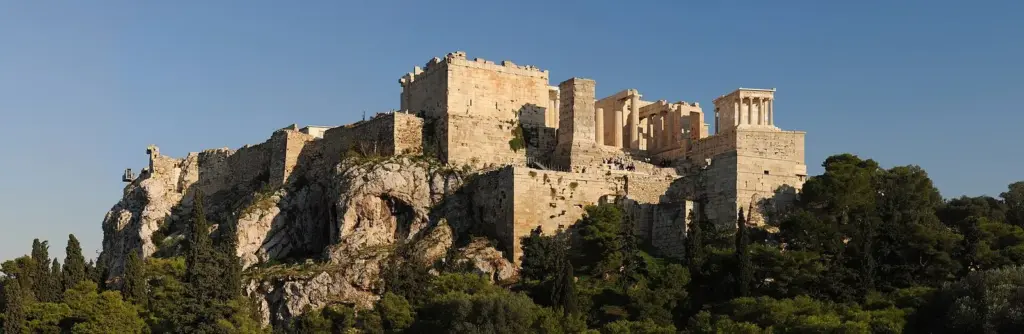
Free, 30 to 45 minutes. This is the bare rock just below the Acropolis’s west gate, where the ancient city’s council sat as a court and where, according to Acts, St Paul preached. Metal steps take you up. The top looks west over the Agora and the rooftops as the sun drops, with the Acropolis walls turning gold behind you. The rock itself has been polished smooth by centuries of feet and is slippery even when dry, so wear shoes with grip.
Philopappos Hill, the better view
Free, about an hour with the climb. Philopappos (Filopappou on local signs) is the bigger effort and the bigger reward. Paths laid out by the architect Dimitris Pikionis in the 1950s wind up through pines from the little church of Agios Dimitrios Loumbardiaris to the Philopappos Monument, a Roman-era tomb on the summit. From the top the whole Acropolis sits side-on in front of you, the classic view of the Parthenon, with the Saronic Gulf at your back. Allow 20 minutes up, and a phone torch for the stony path down after dark.
Verdict: the Areopagus if your legs are done and dinner is in Psirri or Thiseio; Philopappos if you want the photograph at the top of this page. Skip Lycabettus (Lykavittos) for sunset on a one-day trip: it’s a taxi or a long climb away, and from up there the Acropolis is a small shape in the middle distance.
Plan it: free; the Areopagus is a couple of minutes below the Acropolis main gate, and the Philopappos paths start at the west end of Dionysiou Areopagitou; arrive 30 minutes before sunset.
Dinner: Psirri, Thiseio or Koukaki?
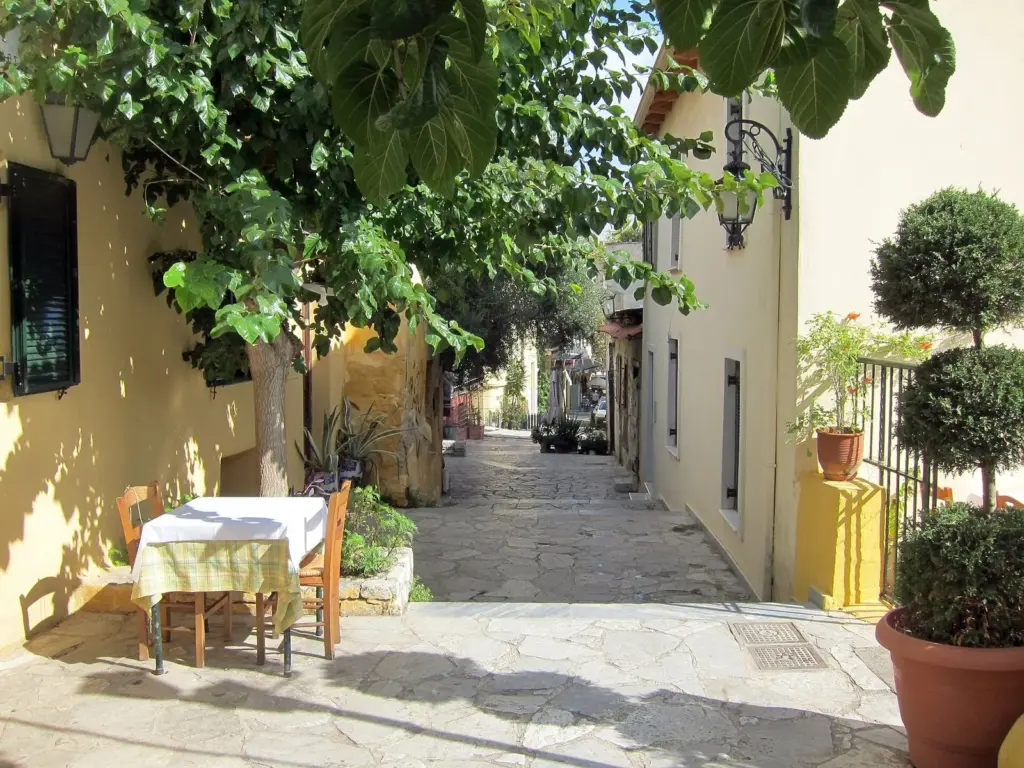
Athenians eat late, and the City of Athens notes that kitchens stay open until well after midnight, so 21:00 is early rather than late. Psirri (Psyrri), north of Monastiraki, is the loud choice: tavernas, meze places and bars round small squares, some with live music. Thiseio, along Apostolou Pavlou, sells the floodlit Acropolis from its terraces and prices the view in. Koukaki, back near the museum, is for a neighbourhood taverna without the crowd. Wherever you sit, read the price list at the door first; the law says it has to be there.
Variant 2: the museum day for heatwaves and rain
Use this when a heat warning is out, when it’s pouring, or when you’ve seen the hill before. It keeps you indoors from breakfast to late afternoon and still gets you onto the Acropolis if it reopens.
- 08:00 National Archaeological Museum: the gold Mask of Agamemnon, the Antikythera Mechanism and the bronze god from Artemision; allow 2.5 to 3 hours.
- 11:30 Metro to Monastiraki: Line 1 from Victoria or Omonia, then lunch in Psirri.
- 13:30 The Acropolis Museum: the whole middle of the day indoors, top floor first.
- 17:00 The Acropolis, or the Areopagus: the site if it’s open, the Areopagus at sunset if it isn’t.
- 20:30 Dinner in Koukaki, a few minutes from the museum.
€70 in tickets: €20 for the National Archaeological Museum, plus the Acropolis Museum and the Acropolis. The National Archaeological Museum keeps summer hours until 15 November 2026 (08:00-20:00, but Tuesdays 13:00-20:00), then short winter hours that last season ran 08:30-15:30, so in winter get there at opening. On the first and third Sundays from November to March it’s free. Two weekday tweaks: on a Tuesday flip the order, with the Acropolis Museum at 09:00 and the National Archaeological Museum from 13:00; on a Friday, when the Acropolis Museum stays open to 22:00, put the hill in the late afternoon and the museum after dark.
Verdict: the only thing this day loses is the Agora, and you won’t miss it on a 40°C afternoon.
Variant 3: the cruise-length day
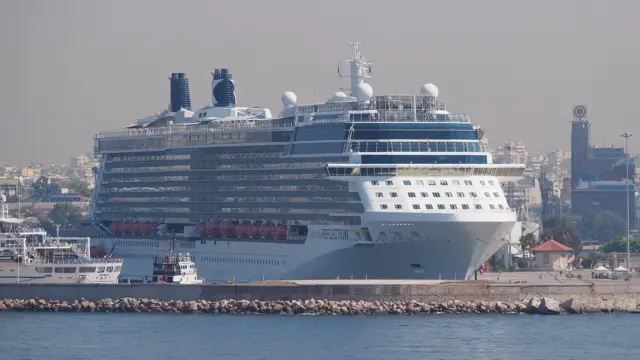
A ship’s call, or any day with a hard stop, strips the plan to its core: the hill, the museum and one walk. Say your ship is alongside at Piraeus from 07:00 with all-aboard at 17:00. Getting from the Athens cruise port to the centre (metro, taxi or shuttle, and how long each really takes) is a subject of its own; here we simply allow at least an hour each way plus an hour’s margin at the end, which leaves about six hours in the centre.
- 07:30 Off the ship, among the first ashore.
- 08:30 The Acropolis: main gate in, South Slope out, 2 hours.
- 10:30 The Acropolis Museum: the Parthenon Gallery and the Caryatids only, 75 minutes.
- 12:00 Plaka and Anafiotika: up through the lanes and down to Monastiraki, with a souvlaki on the way.
- 14:00 Start back from Monastiraki.
- 15:00-16:00 At the ship, an hour or more before all-aboard.
€50 in tickets (€25 reduced). Cut the Agora, the National Archaeological Museum and the sunset without a second thought. Don’t cut the buffer: it’s the one line in this plan that protects the rest of your holiday. If you’re flying in and boarding the same evening, our airport-to-Piraeus transfer guide covers that journey and our luggage storage guide covers the bags, since the Acropolis cloakroom won’t take a suitcase. An Athens layover runs on the same logic with a different clock: the airport metro is €9 each way, not the €1.20 city fare.
What should you skip with only one day?
With only 24 hours in Athens, every hour on a second-rank sight comes out of a first-rank one. Our cuts, in order of conviction:
The Acropolis at midday in summer
Heat and closures. No shade, reflected heat and a real chance of a Ministry closure in a heatwave. Verdict: 08:00 or late afternoon; never 13:00 in July.
The Olympieion ticket
€20 for a closer look. The Temple of Olympian Zeus is a stand of colossal columns you can see almost entirely through the railings on Vasilissis Olgas and Amalias avenues; paying gets you nearer, not a different view, and the corner by Hadrian’s Arch is closed for works anyway. Verdict: look from the pavement and keep the €20.
Lycabettus Hill
A two-hour detour. It’s the highest point in central Athens, but on the wrong side of the day’s route: a taxi or a steep walk to the funicular in Kolonaki, and at the top the Acropolis is far away. Verdict: save it for a second day.
Paying for the Roman Agora and Hadrian’s Library
Visible from the street. Both sit in fenced enclosures beside Monastiraki’s lanes and read well over the railings. With the Acropolis and the Agora already on your ticket list, that’s enough. Verdict: one for a second day, or for completists.
Hop-on hop-off buses
The centre is small. Everything in the first-timer’s plan lies within about 2 km of the Parthenon, and no bus goes up Plaka’s lanes or the paths to the hilltops. Verdict: walk, and spend the fare on lunch.
Restaurants with a tout
Plaka’s main streets and the pedestrian avenue. The City of Athens’s own guide says not to be lured in by waiters working the pavement. Verdict: go two streets further and read the posted prices.
Which day of the week works best?
| Day | What changes |
|---|---|
| Monday | The Acropolis Museum closes at 17:00 all year, so keep it in the morning, as the main plan does |
| Tuesday | The National Archaeological Museum opens only at 13:00: flip the museum day |
| Wednesday, Thursday | No catches in summer; from November the Acropolis Museum closes at 17:00 |
| Friday | The Acropolis Museum is open to 22:00 all year: the most flexible day |
| Saturday | Standard shop hours end at 15:00 |
| Sunday | The full Changing of the Guard at 11:00; almost all shops shut |
Public holidays matter more than weekdays. Ministry sites close on Easter Sunday and 1 May, and open only 12:00-17:00 on Good Friday and 08:30-15:30 on Holy Saturday; the Acropolis Museum closes on 1 January, Easter Sunday, 1 May and 25-26 December. On 28 October entry is free at the Acropolis, the Agora and the Acropolis Museum, so expect company. Verdict: Friday, if you can choose.
What does one day in Athens cost?
Tickets are the fixed part of the bill, and since 2025 they add up faster than older guides suggest.
| Variant | Tickets | Full price | Reduced |
|---|---|---|---|
| First-timer’s day | Acropolis, Acropolis Museum, Ancient Agora | €70 | €35 |
| East-side swap | Acropolis, Acropolis Museum, stadium optional | €50, plus the stadium | €25, plus the stadium |
| Museum day | National Archaeological Museum, Acropolis Museum, Acropolis | €70 | €35 if you qualify at all three |
| Cruise-length day | Acropolis, Acropolis Museum | €50 | €25 |
Add €1.20 for each 90-minute metro ticket (€0.50 reduced), or pay €4.10 for a 24-hour ticket if you’ll ride four or more times. Free entry changes the sums: EU citizens under 25 go free at the Acropolis Museum and the National Archaeological Museum, and everyone gets into the Ministry sites free on the free days listed above. Food is where you have control. The price list must hang outside every taverna, so you can compare before you sit; with no cover charge allowed and bread charged only if you asked for it, the number on the menu is close to the number on the bill, before any tip.
Where should you stay for a one-day visit?
As close to the 08:00 start as your budget allows, because the first hour is the one you can’t get back. Makrygianni and Koukaki, south of the Acropolis, put you minutes from Akropoli station, the museum and the South Slope gate, and are the quieter choice at night. Plaka is the shortest walk to the main gate, with the most tourist-facing streets. Monastiraki and Psirri stay loud until late but sit on two metro lines, handy if you’re coming in from Piraeus on Line 1. Syntagma is the transport hub, with the X95 airport bus stopping on the square around the clock, 20 to 25 minutes on foot from the Acropolis gate. We don’t quote nightly rates, which swing with the season and with city events; the cheapest rooms for an early start are usually a street or two back from the pedestrian avenue rather than on it.
Practical tips for the day
Water: EYDAP, the city’s water company, says Athens tap water meets the national drinking-water standard, so refill a bottle. Shoes: grip matters more than cushioning on polished marble. Pickpockets: the UK Foreign Office warns that thefts are common on the metro and in crowded tourist spots, so keep your phone and wallet apart. Crossings: drivers don’t always stop, a green man can still have cars turning across it, and motorbikes use the pavement. Toilets: paper goes in the bin, not the bowl, because the pipes are old. Alerts: turn on your phone’s emergency alerts, which carry heat and wildfire warnings. Syntagma: demonstrations often gather there; walk round them.
Metro tickets, money and the rest of the everyday detail are in our Athens practical guide.
One Day in Athens FAQ
Is one day in Athens enough?
For the essentials, yes. The Acropolis, its museum, the Agora and the old centre sit within a couple of kilometres of each other, and this plan covers them on foot. What one day can’t do is everything: you choose between the Agora and the east-side loop, and the National Archaeological Museum needs its own half day. Our Athens itinerary planner covers 2 days in Athens and longer.
What is the best order to see Athens in a day?
The Acropolis at 08:00, the Acropolis Museum straight after, lunch, then the Agora and Plaka, a hilltop sunset and a late dinner. The logic is heat and hours: the rock has no shade and can close in a heatwave, the museum is indoors and open until at least 17:00, and the Agora closes first, at 16:30 in winter.
How much does a day of sightseeing in Athens cost?
Tickets for the first-timer’s day come to €70 at full price: €30 for the Acropolis, €20 for the Acropolis Museum and €20 for the Ancient Agora, or €35 at reduced rates. A 90-minute metro ticket is €1.20, if you need one at all. Food is the variable, but tavernas must post their prices outside, so you can check before you sit down.
Do I need to book Acropolis tickets in advance?
Book ahead if you want to walk in at 08:00. The Ministry’s pages now point to tickets.hh.gr, its official platform, or you can queue at the ticket office. No official skip-the-line ticket exists; products sold elsewhere as priority entry are tours. One ticket covers the Acropolis and its South Slope, and it’s single-entry, so plan your route before you go in.
What if I only have an afternoon in Athens?
Start at the Acropolis Museum, then walk up for a late entry to the Acropolis: in early October the last entry is 18:00, in winter 16:30. Finish on the Areopagus for sunset and eat in Psirri or Thiseio. In summer this order also dodges the worst of the heat, as long as no heat closure is in force that day.
What happens if the Acropolis closes for heat?
The Ministry of Culture closes the site through the hottest hours in heatwaves, as on 8 July 2025, when it stayed shut until 17:00. Switch to the museum day: the National Archaeological Museum in the morning, the Acropolis Museum through the afternoon, then the hill once it reopens, or the Areopagus at sunset. Turn on your phone’s emergency alerts, which carry heat warnings.
Can I do this itinerary without the metro?
Yes, if you stay in the centre. From Plaka, Makrygianni, Koukaki or Monastiraki every stop is walkable, about 12 km over the day. Use the metro to reach the start, or for the National Archaeological Museum on the museum day: a 90-minute ticket is €1.20 and a 24-hour ticket €4.10, while the airport line needs its own €9 fare.
Related Athens Guides
- The Acropolis: complete guide and tickets: every monument on the rock, the entrances and who pays what.
- Athens practical guide: metro tickets, money, safety and the everyday details.
- Luggage storage in Athens: where to leave bags on an arrival or departure day.
- Tipping in Greece: what to leave at lunch and dinner, in cash or by card.
Sources and How We Checked
We checked every price, opening time and rule in this itinerary on 26 September 2026 against the official sources below, and compiled the plan from them rather than from other travel lists; we don’t claim a first-hand visit.
- Hellenic Ministry of Culture: visitor pages for the Acropolis, the Ancient Agora and the Olympieion (read from Web Archive captures dated 26 September 2026, as the live site refused connections), and its Hellenic Heritage Tickets platform
- Acropolis Museum: plan your visit and visitor FAQ
- National Archaeological Museum: hours and tickets
- Panathenaic Stadium: official site
- OASA (Athens Urban Transport Organisation): ticket prices
- City of Athens visitor guide: Tomb of the Unknown Soldier, dos and don’ts and holidays and opening hours
- EYDAP (Athens Water Supply and Sewerage Company): water quality checks
- UK Foreign, Commonwealth and Development Office: Greece safety and security
Athens Tourism Guide is an independent publication. We are not affiliated with the Hellenic Ministry of Culture, OASA, the Greek National Tourism Organisation or any business named here, and no business paid to be included.
Photo Credits
- The Propylaea on the Acropolis: photo by Berthold Werner, via Wikimedia Commons (CC BY-SA 3.0)
- Inside the Acropolis Museum: photo by Bandelmug, via Wikimedia Commons (CC BY 4.0)
- Temple of Hephaestus, Ancient Agora: photo by Jakub Hałun, via Wikimedia Commons (CC BY 4.0)
- Agios Georgios tou Vrachou, Anafiotika: photo by C messier, via Wikimedia Commons (CC BY-SA 4.0)
- Panathenaic Stadium: photo by Jakub Hałun, via Wikimedia Commons (CC BY 4.0)
- The Acropolis from the Areopagus: photo by Ggia, via Wikimedia Commons (CC BY-SA 3.0)
- Taverna table: photo by northernsky7007, via Wikimedia Commons (CC BY-SA 3.0)
- Acropolis from Philopappos Hill (featured image): photo by A.Savin, via Wikimedia Commons (CC BY-SA 3.0)