This article contains advertising. Some of the hotel, tour, activity, flight and transfer links in it are paid links: if you book through one, we get a commission from the booking company, and your price is the same either way. It never affects what we recommend. Affiliate disclosure
Climb Philopappos Hill in the last hour of daylight and the Acropolis sits across a valley of pines, 590 metres away and almost at eye level, for nothing. The view from Philopappos Hill in Athens is the best free look at the Parthenon in the city: a walk and a short climb from Akropoli metro, with no ticket to buy, while standing on the rock itself now costs €30.
This page is for first-time visitors who want the classic Parthenon view without a timed slot, and for anyone with a spare evening near Koukaki or Thissio. It folds in the Pnyx and the Areopagus, because the three hills make one easy walk, and it’s among the best-value things to do in Athens. The one caveat: the paths are polished stone and loose earth, so leave the flip-flops behind. Details checked 27 September 2026 against the Hellenic Ministry of Culture, the Ephorate of Antiquities of the City of Athens, OASA, OpenStreetMap and NOAA’s solar calculator.
| At a glance | Philopappos Hill, the Pnyx and the Areopagus |
|---|---|
| Cost | Free: the Western Hills have no admission charge |
| Time needed | An hour for Philopappos alone; two to two and a half hours for all three hills |
| Getting there | Akropoli (Line 2, red), then a flat walk and a short climb to the summit; Thissio (Line 1, green) for the Pnyx and Areopagus end |
| Book ahead? | No: there’s nothing to book |
| Best time | The last 90 minutes before sunset (about 18:47 in mid-October and earlier as autumn goes on, so check the time for your date), or before 10:00 for quiet |
| Height | 147 metres, almost level with the Parthenon |
| Bring | Water, shoes with grip and a phone torch if you’ll stay past dusk |
What’s changed in 2026?
The Acropolis costs more; the hills still cost nothing. The Acropolis is €30 (reduced €15) in every month now. Its free days are 6 March, 18 April, 18 May, the last weekend of September and 28 October, plus the first and third Sundays of each month from November to March. The hills are free every day of the year.
The rock shuts before the good light. The Acropolis closes at 18:30 until 15 October and at 18:00 from 16 to 31 October, with last entry 20 minutes earlier, and winter hours of 08:00 to 17:00 start on 1 November. Sunset on 16 October is about 18:46, so the evening glow on the Parthenon is something you watch from the hills. Book the rock itself for the morning with our complete Acropolis guide.
Check the Agora’s gate. Planning to finish at the Areopagus and drop into the Ancient Agora below? Its entrance arrangements have changed during works, so look up which gate is in use on the site’s hh.gr page before you walk down. Tickets are €20 (reduced €10), and from 16 to 31 October the Agora is open 08:00-18:00.
Where is Philopappos Hill, and how do you get up?
Philopappos Hill is the pine-covered ridge south-west of the Acropolis, across the pedestrian avenue of Dionysiou Areopagitou. Its ancient name is the Hill of the Muses; Greek signs and maps say Filopappou. It’s one of the three Western Hills: Philopappos to the south, the Pnyx in the middle and the Hill of the Nymphs, topped by the old Observatory, to the north. Koukaki lies below its south-eastern slopes, Ano Petralona to the west and Thissio to the north. The Areopagus is a separate outcrop just under the Acropolis entrance, about 350 metres from the church of Agios Dimitrios Loumbardiaris at the start of the path.
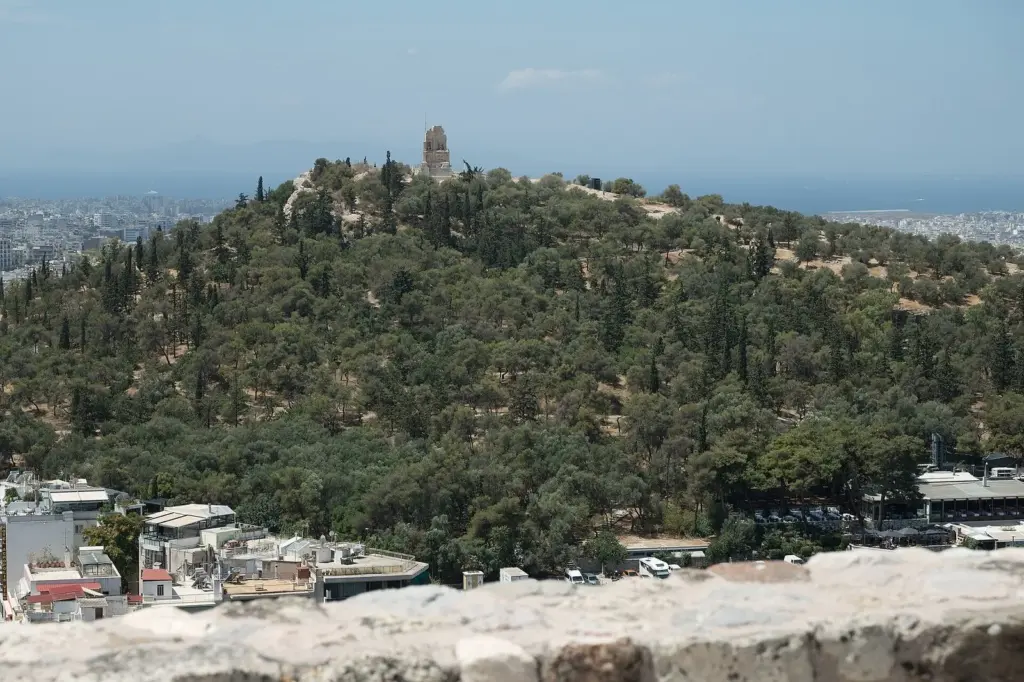
From Akropoli (Line 2, red). The easy start. Take the exit for Makrygianni and Dionysiou Areopagitou and walk west along the flat, traffic-free avenue to the little church of Agios Dimitrios Loumbardiaris. The stone path climbs from there. The summit is only 315 metres away as the crow flies, and the zigzags turn that into a short climb.
From Thissio (Line 1, green). Best for the northern end. Walk south along Apostolou Pavlou, the pedestrian street under the Hill of the Nymphs; the Areopagus is a little over 500 metres from the station and the Pnyx about 600.
From Petralona (Line 1). The locals’ back door: a short walk east through Ano Petralona to the western slope by the Dora Stratou dance theatre, then up through the woods. This side follows part of the Koile road, the ancient route from Athens to Piraeus, which survives for about 500 metres between the hills. Quieter, and better once you know the layout.
From Koukaki. Syngrou-Fix (Line 2) is just 570 metres from the monument in a straight line, and the neighbourhood’s top streets back onto the hill, but the Dionysiou Areopagitou approach is far easier to follow on a first visit. Whichever line you take, one €1.20 90-minute ticket covers the ride.
What does the view from Philopappos Hill in Athens take in?
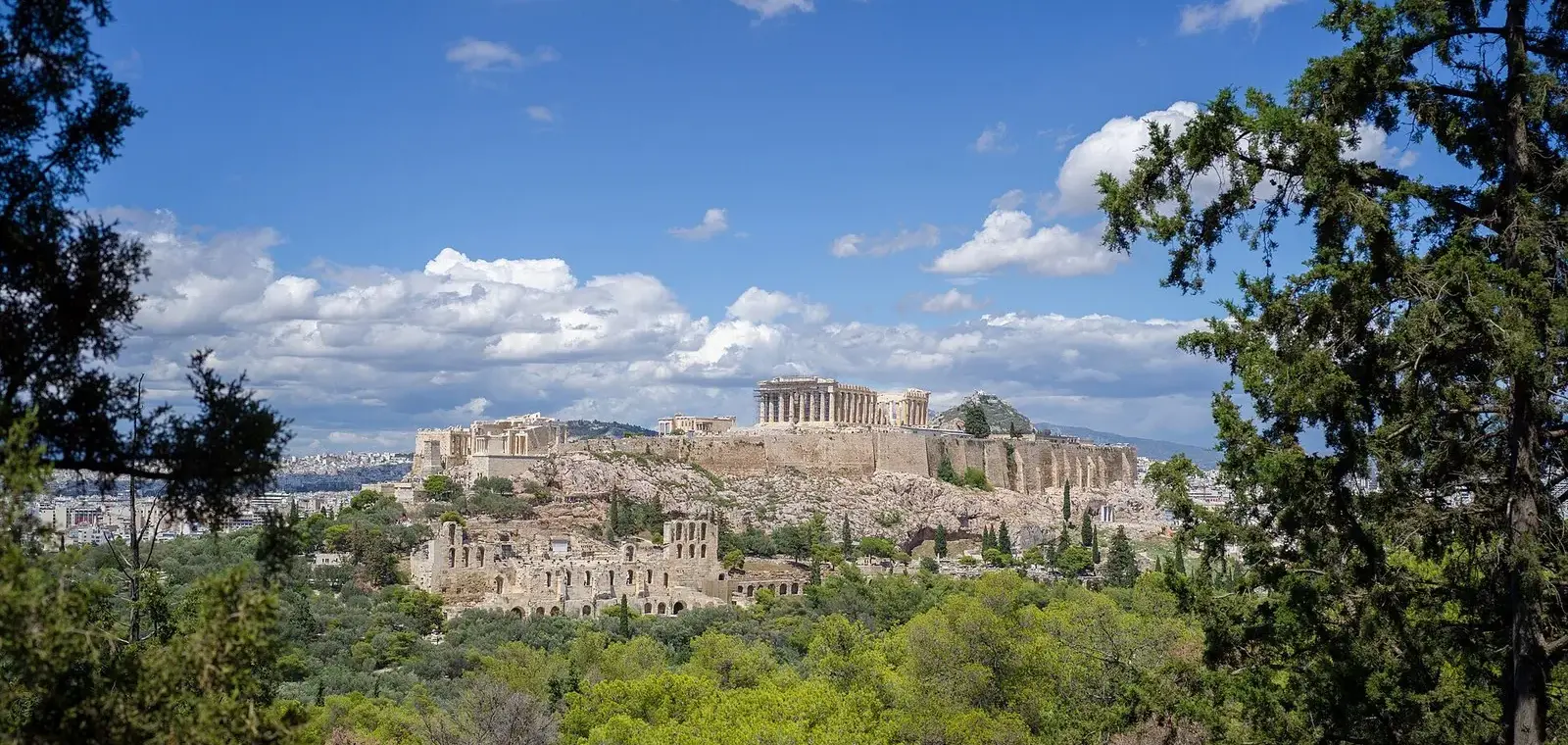
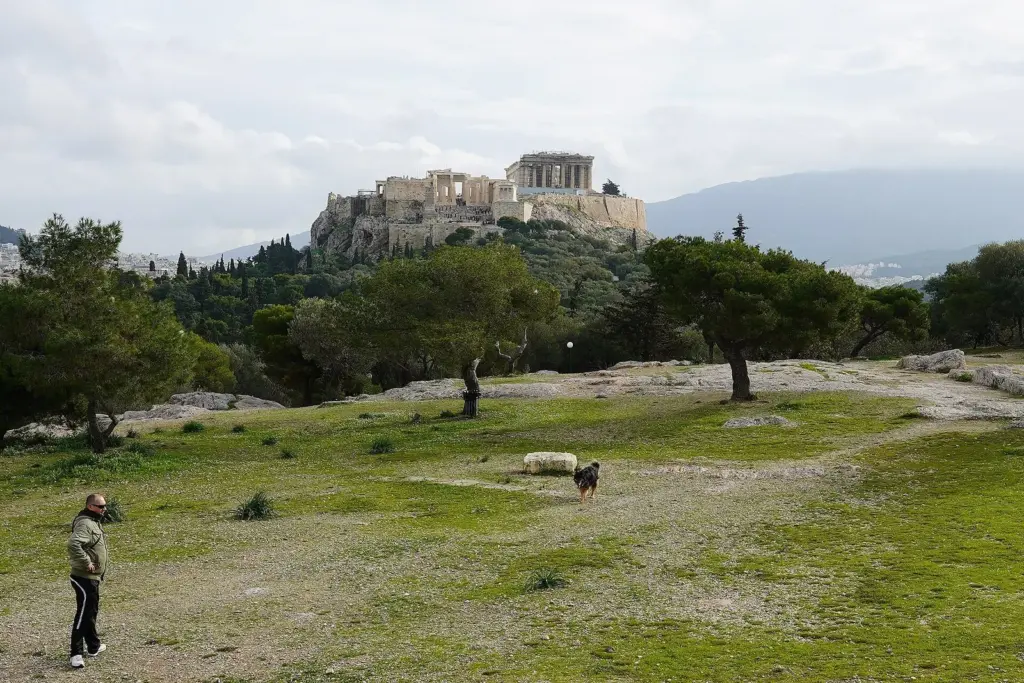
The Parthenon, first. From the summit it’s 590 metres away across the valley, and because the hill tops out at 147 metres you look across at the temple rather than up at it. The Odeon of Herodes Atticus is cut into the rock’s south-west slope below, the Propylaia sits to the left, and Lycabettus rises behind, just to the right of the Parthenon. Stand by the monument and the two line up even more tightly.
Turn round and the city runs down to the sea: Piraeus seven kilometres to the south-west with Salamis behind it, the Saronic Gulf opening to the left, Hymettus closing the view to the east and, on a clear day, Parnitha standing up to the north. Lycabettus gives you a wider sweep, but nowhere else puts this much city and this much Acropolis in the same turn of the head.
For photographs, the platform in front of the monument and the rocks just below it on the Acropolis side are the classic spots. A phone’s 3x or 5x lens, or 70 to 200mm on a camera, stacks the Parthenon against Lycabettus; a wide lens shrinks the Acropolis into the distance, which is the opposite of the point. Lower down the path, the pines make ready-made frames. For more places to point a lens, see our Athens photography spots.
When is sunset on Philopappos Hill?
Here’s what most guides leave out: at sunset the sun is behind you. The Parthenon lies north-east of the summit and the autumn sun goes down in the west-south-west, so you face the Acropolis while the low light warms its west end, then turn round for the sun itself. In mid-October it sets just right of Piraeus. In December it swings left over the open gulf, and by June it has moved round to drop behind the ridge of Mount Aigaleo.
Be on top 45 minutes early: the light on the marble warms as the sun drops, and the sky keeps some colour for a while after sunset. The times below are for central Athens; the hilltop differs by a minute or two.
| Date | Sunset (approximate) | Aim to be on the summit by |
|---|---|---|
| 16 October 2026 | 18:46 | 18:00 |
| 24 October 2026 | 18:36 | 17:50 |
| 25 October 2026 (clocks go back) | 17:35 | 16:50 |
| 15 November 2026 | 17:13 | 16:30 |
| 21 December 2026 | 17:09 | 16:25 |
| 15 February 2027 | 18:03 | 17:15 |
| 28 March 2027 (clocks go forward) | 19:43 | 19:00 |
| 1 May 2027 | 20:15 | 19:30 |
| 21 June 2027 | 20:51 | 20:05 |
| 15 August 2027 | 20:20 | 19:35 |
| 15 September 2027 | 19:35 | 18:50 |
What is there to see on the three hills?
More than a view. The Ephorate of Antiquities counts an assembly place, an ancient road, a Roman tomb, sanctuaries of Musaeus, the Nymphs, Pan and Zeus, a defensive wall called the Diateichisma, a 1950s landscape and an Observatory across these hills. These are the stops that repay the walk.
The Pikionis paths and Agios Dimitrios Loumbardiaris
Free, 10 minutes. The paths are a monument in their own right. Between 1954 and 1957 the architect Dimitris Pikionis laid out the walkways around the Acropolis and up this hill in rough-finished marble and stone, in patterns that look random until you spot the geometry. The work took in the setting of the little church of Agios Dimitrios Loumbardiaris, where the climb begins, and the small pavilion beside it. It’s easy to walk straight over it without noticing, so look down now and then. It’s a working church, so cover your shoulders if you step inside.
The so-called Prison of Socrates
Free, 5 minutes. About 90 metres up the path from the church, a row of chambers is cut into the rock. Tradition, not evidence, named them after Socrates, who was tried and put to death in 399 BC. Verdict: the name is the attraction; look in on the way past, but don’t make a special trip.
The Philopappos Monument
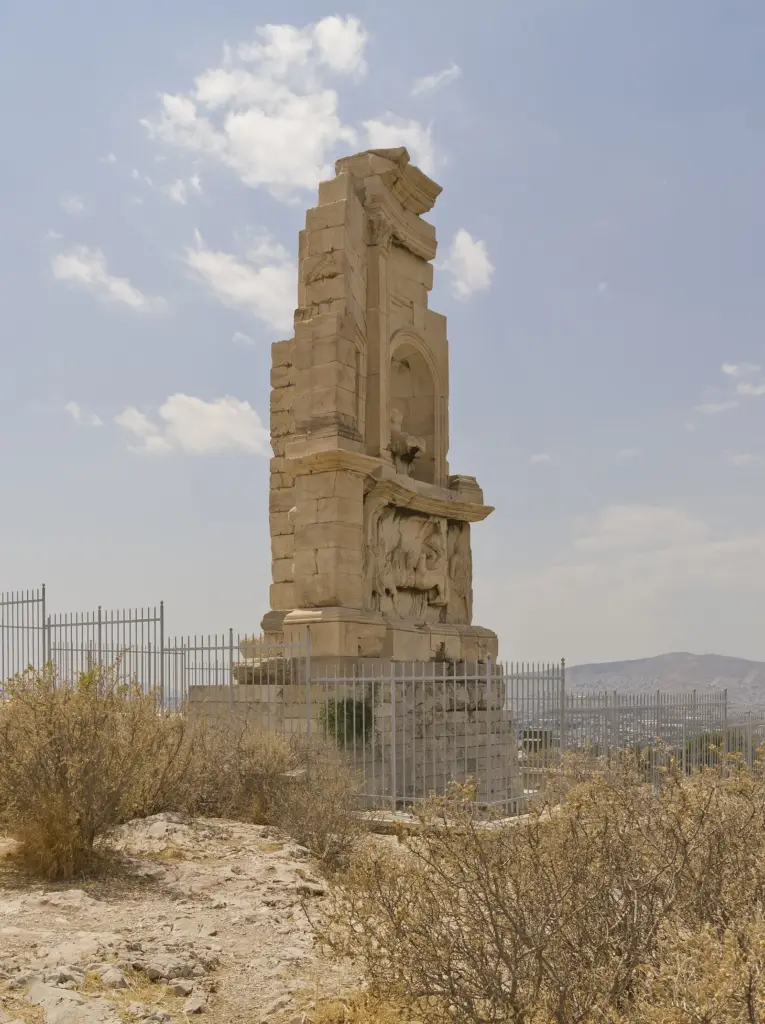
Free, 20 minutes with the view. The marble tomb on the summit belongs to Gaius Julius Antiochus Epiphanes Philopappos, grandson of Antiochus IV, the last king of Commagene in what is now south-eastern Turkey. He became a Roman consul, an Athenian citizen and a generous benefactor, and after his death in AD 116 his sister Julia Balbilla and the people of Athens raised this tomb facing the Acropolis. Pausanias, writing a few decades later, remembered the hill as the place where the poet Musaeus sang and was buried, and waved the tomb away as that of “a Syrian”.
What survives is about two-thirds of the curved front, and of the burial chamber behind it only the base. Its lower frieze shows Philopappos as consul riding in his chariot, led by lictors. The niches above held statues of his grandfather, of Philopappos himself and of Seleucus I, the Macedonian general the kings of Commagene claimed as an ancestor, whose figure is lost. A railing keeps you back from the stonework, which is as it should be.
The Pnyx
Free. This is where Athenian democracy did its arguing. From the 6th to the late 4th century BC the Assembly of the Athenians met on this slope to settle foreign policy and other public business, and Pericles, Demosthenes and Aeschines all spoke here. What you see today is the phase from the time of Lycurgus, 330 to 326 BC. From the bema, the speakers’ platform, the Parthenon is 630 metres due east. Verdict: the most underrated stop of the three, flatter and quieter than Philopappos, with room to sit and think.
The Hill of the Nymphs and the Observatory
Free to walk, 10 minutes. The northern hill carries the National Observatory of Athens, founded in 1842 and the oldest research institution in Greece; the banker Georgios Sinas paid for its first building, designed by Eduard Schaubert and Theophil Hansen. It’s a working institute, not part of the free site. Its visitor centre has run evening telescope visits, so check the Observatory’s own site for the 2026 programme before planning around one. At the hill’s northern foot, the church of Agia Marina stands beside the remains of a sanctuary of Zeus.
The Areopagus (Mars Hill)
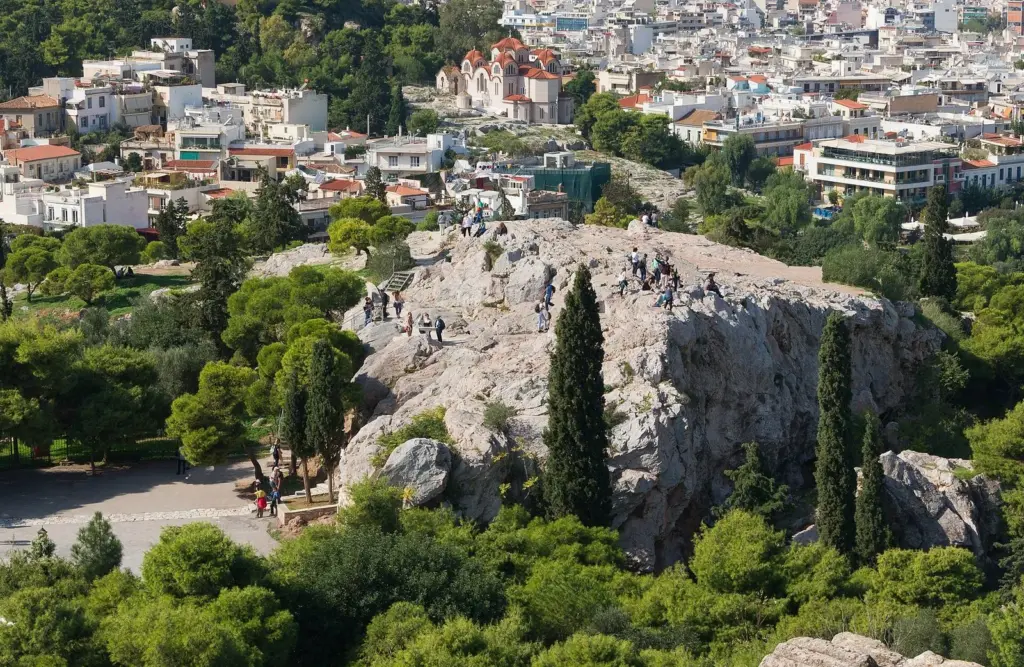
Watch your footing. The bare rock under the Acropolis entrance is the Areopagus, the Hill of Ares, sacred to Ares and to the Furies and the meeting place of the ancient council that took its name. Mars is Ares’ Roman counterpart, hence the English nickname. Acts 17 sets Paul’s sermon to the Athenians here, and an engraved plaque at the rock carries the text, though historians aren’t sure whether he spoke on the hill itself or before the council down in the Agora. One convert, Dionysius the Areopagite, became the patron saint of Athens.
The view is closer and busier than on Philopappos: the Propylaia 230 metres away, the Parthenon 325, and the Ancient Agora spread out below to the north with the Temple of Hephaestus on its far side. Use the modern metal staircase rather than the worn ancient steps, and watch your footing on top, where centuries of shoes have polished the limestone smooth. It’s treacherous after rain. Verdict: best in the morning or late afternoon; at sunset in summer, expect company.
How do you walk all three hills in one go?
Start at Thissio about two hours before sunset and finish on Philopappos, so the best view comes last and the easiest path takes you down in the dusk. Expect stone paths, steps and packed earth the whole way.
- Thissio station (Line 1): walk up Apostolou Pavlou towards the Acropolis and take the path to the Areopagus.
- Areopagus: 20 minutes on the rock, with the Propylaia at close range and the Agora below.
- Hill of the Nymphs: back down to Apostolou Pavlou and up past Agia Marina towards the Observatory, about 15 minutes.
- Pnyx: a few minutes south along the ridge; stand by the bema and look east.
- Agios Dimitrios Loumbardiaris: five minutes down to the south, where the Pikionis paving starts.
- Prison of Socrates: 90 metres up the path, a two-minute stop.
- Philopappos Monument: 10 more minutes uphill; arrive 45 minutes before sunset.
- Dionysiou Areopagitou: take the paved path back down past the church, then walk east to Akropoli station (Line 2), or turn into Koukaki for dinner.
Short on time? Do steps 5 to 8 from and back to Akropoli in about an hour and a half. For a longer day on foot, our self-guided Athens walking tour links this corner to the rest of the old city.
Is Philopappos Hill safe at night?
Broadly, yes, with some sense. After sunset, come down by the paved path to Dionysiou Areopagitou. Higher up and further west it’s a different place: a big wooded park with uneven stone underfoot and far fewer people once the light goes. Don’t count on lighting away from the main path.
So come down the way you went up, with a phone torch ready. Go with someone if you can, keep phones and wallets zipped away as you would anywhere visitors gather, and leave the western woods alone late at night. If you’d rather carry on in town, see our ideas for Athens in the evening. Verdict: fine at sunset and for the first hour of dark on the main path; no place for a solo wander at 2am.
In a summer heatwave, check the news before you set off. Wear shoes with grip and carry water, because you shouldn’t count on buying any once you’re on the paths. The site is only partly accessible for visitors with reduced mobility; the Ephorate publishes a map of its accessible route.
Philopappos, the Areopagus or Lycabettus: which view?
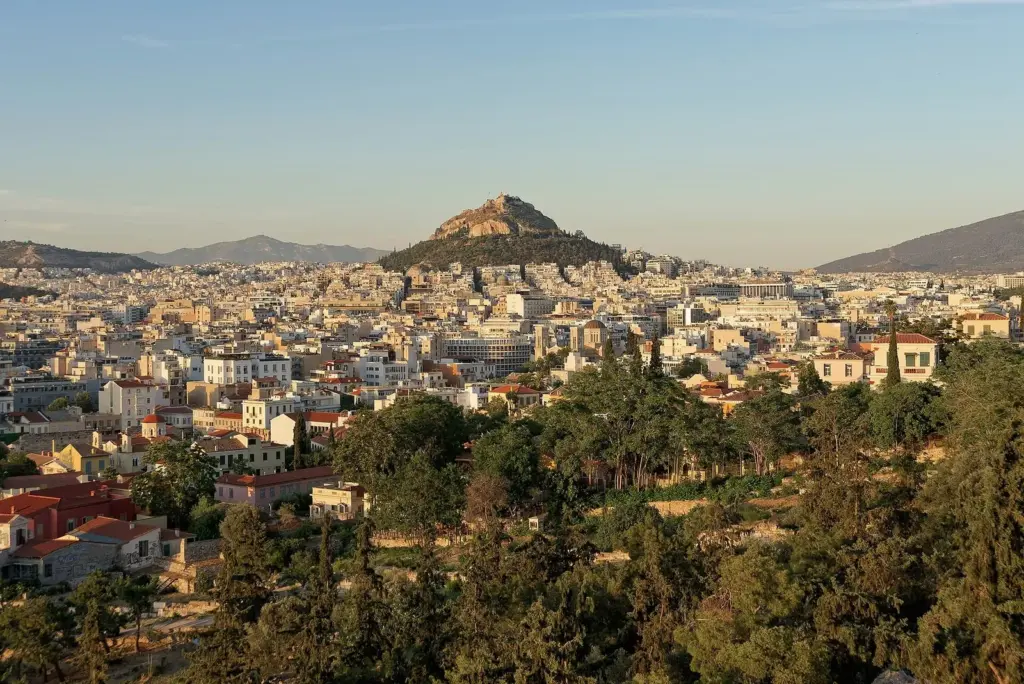
They do different jobs. Philopappos gives you the Parthenon side-on at nearly its own height, with pines in front and room to breathe. The Areopagus is closer and more dramatic, but bare, busy and slippery. Lycabettus Hill is higher and takes in the whole basin, though from 1.85 kilometres away the Parthenon looks small.
| Viewpoint | Distance to the Parthenon | Cost | Best for |
|---|---|---|---|
| Philopappos Hill | 590 to 650 metres | Free | The side-on Parthenon photo and sunset |
| Pnyx | 630 metres | Free | A quiet sit with the Acropolis due east |
| Areopagus | 325 metres | Free | The Propylaia close up and the Agora below |
| Lycabettus | 1.85 kilometres | Free on foot; the funicular costs extra | The whole city, especially after dark |
Skip: the summit at midday in July and August. There’s little shade on top, and the heatwaves that close the Acropolis in the middle of the day make this climb miserable. Come before 10:00 or after 18:00.
Philopappos fits into most days, after the Acropolis in the morning or before dinner in Koukaki or Petralona. For the rest of the city, browse our full list of Athens sights and experiences, or pair the hills with more free things to do in Athens.
Philopappos Hill FAQ
How high is Philopappos Hill?
Philopappos Hill rises to 147 metres above sea level, almost level with the Parthenon on the Acropolis opposite, which is why the view feels eye to eye rather than looking up. The climb from the church of Agios Dimitrios Loumbardiaris is a short one on stone paths: steady rather than steep, with some uneven steps near the top.
How long does it take to walk up Philopappos Hill?
From Akropoli metro it’s a flat walk along Dionysiou Areopagitou to Agios Dimitrios Loumbardiaris, then a short climb on stone paths to the monument; how long that takes depends on your pace, so leave some slack before sunset. Add 20 minutes at the top for the view. If you want the Pnyx and the Areopagus as well, set aside two to two and a half hours for the whole loop.
Is Philopappos Hill free?
Yes. The Western Hills site, which covers Philopappos, the Pnyx and the Hill of the Nymphs, is free to enter.
Is Philopappos Hill safe at night?
For most visitors, yes, with ordinary care. The paved path from Dionysiou Areopagitou is the main route down after dark, while the upper and western woods get quiet once the light goes. Come down the way you went up, carry a phone torch, keep valuables zipped away and don’t wander alone late at night.
How do you get to Philopappos Hill from the Acropolis?
After your visit, signs lead you out through the South Exit onto Dionysiou Areopagitou. Turn right and walk west along the pedestrian avenue to the church of Agios Dimitrios Loumbardiaris, then take the stone path up to the monument. The Areopagus is a 350-metre detour north-east of the church, up the path towards the Acropolis entrance.
Can you watch the sunset from Philopappos Hill?
Yes, and it’s the best reason to go. The sun sets behind you as you face the Acropolis, so you see the Parthenon in warm light first, then turn round for the sun dropping over Piraeus and the Saronic Gulf. Sunset is about 18:47 in mid-October, jumps an hour earlier when the clocks go back on 25 October and keeps creeping earlier into November, so check the time for your date. Arrive 45 minutes early.
Is the Areopagus the same as Mars Hill?
Yes. Areopagus means Hill of Ares, and Mars is his Roman counterpart, which is why older English Bibles call it Mars’ Hill in Acts 17. It’s the bare rock just below the Acropolis entrance, reached by a modern metal staircase. The polished top is slippery, especially after rain, so wear shoes with grip and keep children close.
Related Athens Guides
- The Acropolis of Athens: Complete Guide and Tickets: timed entry, prices and the exit you’ll leave by
- Free Things to Do in Athens: more sights with no ticket at all
- Athens Photography Spots: where else to point a camera
- Lycabettus Hill: the higher view and the funicular
- Athens at Night: what to do once the sun has gone down
Sources and How We Checked
We checked these details on 27 September 2026 against the official sources below and compiled them from those sources rather than from other travel lists; no first-hand visit is claimed.
- Hellenic Ministry of Culture: Acropolis Western Hills (hours, admission, access) and Philopappos Monument
- Hellenic Ministry of Culture: Acropolis of Athens (prices, hours, exits), Ancient Agora of Athens (tickets, hours, entrance) and its Areios Pagos history page
- Ephorate of Antiquities of the City of Athens: The Heart of Ancient Athens: Western Hills
- OASA: ticket prices
- NOAA Global Monitoring Laboratory: Solar Calculator, whose equations we used for sunset times and directions
- OpenStreetMap contributors: Philopappos Hill summit, for the height and the coordinates behind our distances
Athens Tourism Guide is an independent publication. We are not affiliated with the Hellenic Ministry of Culture, OASA, the Greek National Tourism Organisation or any business named here, and no business paid to be included.
Photo Credits
- Philopappos Hill from the Acropolis: photo by Zde, via Wikimedia Commons (CC BY-SA 4.0)
- The Philopappos Monument: photo by A.Savin, via Wikimedia Commons (CC BY-SA 3.0)
- The Acropolis from the Pnyx: photo by George E. Koronaios, via Wikimedia Commons (CC BY-SA 4.0)
- The Areopagus from the Acropolis: photo by Jebulon, via Wikimedia Commons (CC0)
- Lycabettus from the Areopagus: photo by Jakub Hałun, via Wikimedia Commons (CC BY 4.0)
- The Acropolis from Philopappos Hill (featured image): photo by This Photo was taken by Wolfgang Moroder. Feel free to use my photos, but please mention me as the author and send me a message. This image is not in the public domain. Please respect the copyright protection. It may only be used according to the rules mentioned here. This specifically excludes use in social media, if applicable terms of the licenses listed here not appropriate. Please do not upload an updated image here without consultation with the Author. The author would like to make corrections only at his own source. This ensures that the changes are preserved.Please if you think that any changes should be required, please inform the author.Otherwise you can upload a new image with a new name. Please use one of the templates derivative or extract., via Wikimedia Commons (CC BY-SA 3.0)