This article contains advertising. Some of the hotel, tour, activity, flight and transfer links in it are paid links: if you book through one, we get a commission from the booking company, and your price is the same either way. It never affects what we recommend. Affiliate disclosure
Greece’s railway network is small but useful, with the flagship Athens-Thessaloniki intercity service and the suburban Proastiakos network connecting Athens to the airport, Corinth, and Kiato in the northern Peloponnese. Operated by Hellenic Train (the rebranded TrainOSE since 2022), the system is more limited than in northern Europe but covers several routes where it’s genuinely competitive with buses. This is the complete Greece train Athens railway guide for 2026 with the major routes, ticket booking, the Larissa Station hub, and clear advice on when to choose the train over alternatives.
The Athens Railway System
Hellenic Train (Long-Distance Intercity)
The Greek national train operator. Operates intercity services from Athens (Larissa station) to Thessaloniki via Larissa, Volos, and other northern Greek cities. The Athens-Thessaloniki service is the flagship 4-5 hour journey.
Proastiakos (Athens Suburban Rail)
The Athens suburban rail network with three lines: Piraeus-Athens-Ano Liosia (connecting the major terminals), Ano Liosia-Athens International Airport (the airport rail link), and Ano Liosia-Corinth-Kiato (the Peloponnese suburban service).
For broader context, see our Getting Around Athens pillar, our Day Trips guide, and our airport transport guide.
Athens Larissa Railway Station
The central Athens passenger railway station, located just north of central Athens at the Larissa metro station (Line 2, red). Connections: metro to all central tourist areas; X95 airport bus stops nearby. The station building is a 1908 neoclassical structure with modern internal renovations. Facilities: ticket counters, café, small shop, ATM, accessible toilets.
Athens-Thessaloniki Train (The Flagship Route)
Journey Time & Service
5 hours by the standard Hellenic Train Intercity service. As of late 2025, the higher-speed Express services (52, 53, 54, 55) were suspended for infrastructure work; only conventional services operate during the work period. Service typically resumes after spring 2026.
Departures
4-6 daily departures from Athens Larissa station to Thessaloniki, typically at 7:30 AM, 11:30 AM, 2:30 PM, and 5:30 PM. Check hellenictrain.gr for current schedules.
Prices (2026)
Economy: €25-35 one way. Business class: €45-60. Book at hellenictrain.gr or at the station. Significant discounts for advance booking (up to 30% off if booked 14+ days ahead).
Train vs Plane to Thessaloniki
The 50-minute flight from Athens airport (€40-100 with advance booking) competes with the 4-5 hour train. The train wins for: lower total cost, no airport transit time, comfortable seats with table, sea/mountain views, eco-friendly. The plane wins for: speed, more daily departures, easier last-minute bookings.
Other Hellenic Train Routes from Athens
Athens → Larissa: 3.5 hours; €18-28. Use this if going to the Meteora area; combine with a 30-minute taxi to Kalambaka.
Athens → Volos: 4 hours; €20-30. Use for the Pelion peninsula or the Sporades islands (ferry from Volos).
Athens → Patras (via Athens Airport, Corinth, Kiato): Currently the train terminates at Kiato (90 minutes from Athens). Onward Patras travel by KTEL bus from Kiato (€8, 90 minutes). Patras is the main port for Italian ferries.
Athens → Kalamata, Sparta: No direct train service. The southern Peloponnese is bus-only from Athens.
Athens Suburban Rail (Proastiakos)
Athens Airport Rail Link
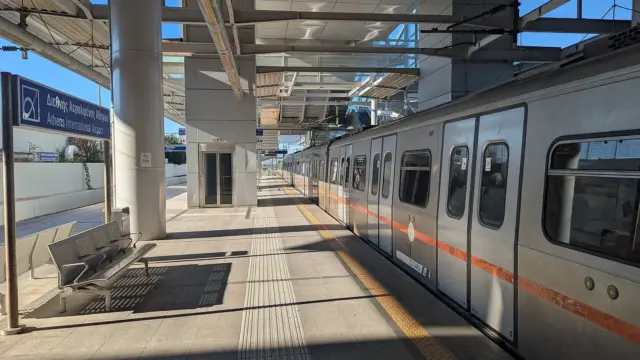
The Proastiakos line connects Athens airport to Athens Larissa station (and onwards via the suburban network). The journey takes about 40 minutes; €9 single ticket (same as metro Line 3 airport ticket). Useful for travellers going to or from the airport who want the railway alternative to metro Line 3 (which is faster and more frequent for most central destinations).
Athens to Corinth
Proastiakos line to Kiato passes through Corinth. €4-7 each way; 1 hour. The most affordable way to reach Ancient Corinth as a day trip if you don’t have a car. See our Ancient Corinth day trip guide.
Booking Greek Train Tickets
Official: hellenictrain.gr (Greek and English). Tickets become QR codes; print or save to your phone. Major credit cards accepted.
International booking platforms: Omio (formerly Goeuro), Trainline, Rail Europe all sell Hellenic Train tickets with a 5-10% markup but easier English interfaces.
At the station: Athens Larissa station ticket counter sells day-of and advance tickets; expect a small queue at peak times.
Train Travel Tips for Greece
Buy reserved seats in advance for the Thessaloniki Intercity service; unreserved seats may not be available. Bring snacks; the on-board café has limited menu. Wi-Fi is available on most modern trains; download offline content as backup. Air conditioning works well in summer; bring a light layer for the climate-controlled cars. Greek trains are punctual by Mediterranean standards (within 15-30 minutes typically); allow extra time for connections.
Frequently Asked Questions
How long is the train from Athens to Thessaloniki?
5 hours by the standard Hellenic Train Intercity service. The higher-speed Express services were temporarily suspended in late 2025 for infrastructure works.
How much does the Athens-Thessaloniki train cost?
€25-35 economy one way; €45-60 business class. Advance booking (14+ days) gives up to 30% discount.
Where is the Athens train station?
Athens Larissa railway station, located at the Larissa metro station (Line 2 red), just north of central Athens. The X95 airport bus stops nearby.
Does Greece have high-speed trains?
No. The Athens-Thessaloniki line is the closest to high-speed but operates at standard Intercity speeds. No TGV-style or Shinkansen-style high-speed network exists in Greece.
How do I book a Greek train ticket?
Online at hellenictrain.gr (official) or via international platforms like Omio. Tickets are QR codes; print or save to phone. Major credit cards accepted.
Can I take a train from Athens to Santorini?
No. Santorini is an island; only ferries and flights connect Athens to Santorini. See our Athens to Greek islands ferry guide.
Is the Athens-Thessaloniki train better than flying?
Cheaper, more relaxed, no airport transit, scenic. The 4-5 hour journey can be more pleasant than the 50-minute flight plus 90-minute airport transit. The flight wins for speed and frequency.
OSE: The Greek Railway System Overview
The Greek railway network is operated by Hellenic Train (formerly TrainOSE), the privatised passenger train operator, on infrastructure managed by OSE (Hellenic Railways Organisation). The network is significantly smaller than most European countries — 2,500 km total track length covering only the main mainland routes plus the suburban Athens system. Greek geography (mountainous terrain, many islands) and the historical investment in road and air infrastructure mean that trains play a smaller role than in northern Europe.
The two main systems are:
Suburban Railway (Proastiakos): the Athens commuter rail covering the Attica region plus extensions to Kiato (Peloponnese gateway) and Chalkis (Evia island).
Long-distance trains (Hellenic Train): connecting Athens with Thessaloniki, plus the Athens-Patras-Olympia route through the western Peloponnese.
Athens Central Station: Larissa
Larissa Station (Stathmos Larissis) on Konstantinopoulou Street is Athens’s main railway terminus. Metro Line 2 (red) connects directly to the station. The station has:
Ticket offices: staffed counters plus self-service machines (English interface).
Waiting areas: indoor and outdoor seating.
Cafes and small shops: basic food and drinks.
Left luggage: small lockers and staffed left-luggage office (€3-7 per item per day).
Information desk: English-speaking staff.
The adjacent station Peloponnisos Station (formerly the terminus for the metre-gauge Peloponnese trains) is now largely unused; some Proastiakos trains stop briefly.
The Suburban Railway in Detail
The Proastiakos was the major infrastructure success of the 2004 Olympics. Three main routes from Larissa Station:
Airport Line
Larissa ↔ Doukissis Plakentias ↔ Athens International Airport. 40-50 minutes; €9 each way. Uses the same airport station as the Metro Line 3. The Proastiakos option is useful for travellers who arrive at Larissa Station from elsewhere (e.g., overnight train from Thessaloniki) and want to continue to the airport without going to central Athens.
Western Suburbs & Kiato Line
Larissa ↔ Magoula ↔ Thiva ↔ Kiato. 90 minutes to Kiato; €14 each way. Kiato is the railhead for onward connections to Patras, Olympia, and the western Peloponnese. The Kiato line is essential for Peloponnese day trips by train.
Evia Line
Larissa ↔ Inoi ↔ Chalkis. 75-90 minutes to Chalkis; €8 each way. Useful for visitors heading to the island of Evia (the second-largest Greek island, connected by bridge to the mainland).
Athens to Thessaloniki: The Main Line
The Athens-Thessaloniki route is Greece’s main long-distance railway. Three train types operate:
IC (Intercity): standard service; 5-6 hours; €40-65 second class; €60-90 first class. The standard “passenger train” experience.
ICE (high-speed): faster service with reduced stops; 4-4.5 hours; €50-80 second; €75-110 first. The fastest option but more expensive.
Sleeper trains: overnight service with 2-4 berth couchettes and 1-2 berth cabins. 7-8 hours overnight; €60-150 depending on class. The classic “European train experience” for travellers preferring rail over flights.
Tickets sold at Hellenic Train (hellenictrain.gr), at Larissa Station, or via aggregator sites. Book 1-7 days in advance for popular weekend departures.
The Athens-Patras-Olympia Route
The historic Peloponnese metre-gauge railway is mostly closed; replaced by the Proastiakos to Kiato plus bus connections. The standard route from Athens to Patras:
Train from Larissa to Kiato: 90 minutes (€14).
Bus from Kiato to Patras: 60 minutes (€10-12).
Total: 3 hours; €25-30. The dedicated KTEL bus from Athens to Patras (3-4 hours; €20-25) is simpler and competitive.
The Slow Death of the Peloponnese Railway
The historic metre-gauge “Trenakia” of the Peloponnese was the romantic small-train network connecting Patras with Kalamata, Olympia, Pyrgos, and other Peloponnese towns. The 1880s-era network was famously slow but charming. Most lines closed 2010-2013 due to budget cuts; only a few summer-tourist-focused short routes remain operational (notably the Diakofto-Kalavryta scenic mountain railway). For most Peloponnese travel, the KTEL bus or rental car is essential.
Diakofto-Kalavryta Mountain Railway
This stunning 22-km cogwheel mountain railway in the western Peloponnese is one of the most-spectacular rail journeys in southern Europe. The train climbs from Diakofto (sea level) to Kalavryta (mountain village at 750m) through the Vouraikos Gorge, with sheer cliffs, waterfalls, and mountain views. The journey takes 65 minutes one-way. Operated by OSE/Hellenic Train; daily summer services (May-October); reduced winter.
To reach Diakofto from Athens: train from Larissa Station to Diakofto (90-120 minutes; €15-20) then transfer to the mountain railway. A full day trip; 3-4 hours each way total.
International Trains from Greece
Greece is relatively isolated from European rail networks. The connections:
Thessaloniki to Sofia (Bulgaria): daily service; 6-7 hours; €25-40. Onward connection to other Balkan capitals.
Thessaloniki to Skopje (North Macedonia): reduced service; check current schedules.
Thessaloniki to Belgrade: via Skopje connection.
For Western European travel from Greece, fly to Italy (1-hour Athens-Rome) or take the ferry to Italy and continue by rail.
Ferry-Rail Combinations
For travellers wanting Athens-Western Europe overland: ferry from Patras to Bari or Ancona (Italy; 16-20 hours) then connect to the Italian rail network. The Patras-Bari ferry is run by Anek Lines and Superfast Ferries; €60-150 deck class; €120-300 cabin. Useful for travellers with cars or those preferring overland to flying.
Train Travel Etiquette
Greek trains are generally relaxed. Seating: assigned seats on long-distance trains, free seating on Proastiakos. Food and drinks: dining cars on Intercity trains; cafes on most others; bringing your own food is universally accepted. Quiet zones: not common on Greek trains; expect background conversations.
Train Travel for Tourists: When It Makes Sense
Use the train for: Athens-Thessaloniki overnight (the classic European rail experience), Kiato-area Peloponnese gateway, the Diakofto-Kalavryta mountain experience, the Suburban Railway from Athens to the airport (alternative to Metro Line 3).
Skip the train for: most Peloponnese travel (use KTEL bus or car), island travel (use ferry or fly), Greece-Italy travel (use ferry from Patras), Athens-Delphi (no rail service; use KTEL bus).
Train vs. Bus vs. Flight: Athens-Thessaloniki Comparison
Train (IC): 5-6 hours; €40-90; comfortable; relaxed; good views in mountainous sections.
Bus (KTEL): 6-8 hours; €30-50; less comfortable but cheaper; multiple daily departures.
Flight (Aegean, Sky Express): 1 hour flight time; 3-4 hours total door-to-door; €40-100 with advance booking; the fastest option.
For most travellers, the flight is the practical choice; the train is the romantic choice; the bus is the budget choice.
Ticket Booking Practical Tips
Hellenic Train website (hellenictrain.gr) requires credit card and email; English interface; print or save mobile ticket. Self-service ticket machines at Larissa Station accept cards and have English interface. Staffed ticket office for complex bookings or cash payment. Mobile ticketing via the Hellenic Train app supported on newer routes.
Train Pricing & Discounts
Standard fares are reasonable by European standards. Discounts available for:
Youth (under 26): 25% discount on most fares.
Seniors (over 65): 25% discount.
Groups (4+ travelling together): 20% discount.
Round-trip: 20% discount on the return portion.
Early booking: some advance-purchase fares are 30-50% lower than walk-up rates.
The Hellenic Train Stations Beyond Larissa
Athens has several other railway stations relevant to suburban travel:
Athens Airport Station: integrated with the airport Metro; suburban railway departures.
Doukissis Plakentias: the major interchange where Metro Line 3 connects with the Proastiakos.
Maroussi: the suburban Maroussi station serving the northern Athens suburbs and the Olympic Stadium.
Inoi: the junction station for the Evia line.
Most visitors use Larissa as the primary station; the others are useful for specific commuter or suburban journeys.
What to Bring on a Long-Distance Greek Train
For the Athens-Thessaloniki 5-7 hour journey:
Snacks and water: the dining car food is overpriced and limited.
Reading material or downloaded entertainment: WiFi is limited or absent on most Greek trains.
Power bank: some seats have outlets; many don’t.
Light layers: the AC can be aggressive in summer.
Earphones: for the inevitable loud conversations in nearby seats.
Train Travel for Greek Mythology Buffs
The Thessaloniki train passes through the mountainous Tempe Valley, the legendary route between Mount Olympus (home of the Greek gods) and Mount Ossa. The 3-4 hour mark of the Athens-Thessaloniki journey passes through this dramatic landscape. Sit on the left side of the train (heading north) for the best Mount Olympus views.
The Future of Greek Rail
Greek rail is investing significantly in modernisation. New high-speed Athens-Thessaloniki trains were introduced 2023-2024 reducing journey time toward 3.5 hours. New rolling stock for the Suburban Railway expected 2025-2026. Long-term plans include extension to Patras (currently the route ends at Kiato) and possibly a new Athens-Patras direct service.
Rail Travel Greek Vocabulary
Σιδηρόδρομος (Sidirodromos): railway.
Τρένο (Treno): train.
Σταθμός (Stathmos): station.
Εισιτήριο (Isitirio): ticket.
Πλατφόρμα (Platforma): platform.
Άφιξη / Αναχώρηση (Afixi / Anachorisi): arrival / departure.
Καθυστέρηση (Kathysterisi): delay.
Πρώτη / Δεύτερη θέση (Proti / Defteri thesi): first / second class.
Καμπίνα (Kabina): cabin / couchette.
Memorable Greek Rail Stations
Larissa Station (Athens): the central terminus; basic but functional.
Thessaloniki Station: the elegant 1894 building; recently renovated.
Diakofto: the Belle Epoque small mountain railway terminus.
Patras Station: small but historic; the western Peloponnese terminus.
Kalavryta: the iconic mountain village railway terminus reached only by the cogwheel railway.
Athens-Thessaloniki Train: The Detailed Journey
The 5-6 hour Athens-Thessaloniki rail journey passes through several distinctive landscapes:
Athens-Thiva (0-90 min): the suburban Athens then central Greek plains.
Thiva-Lamia (90-180 min): the historic central-Greek route past ancient Thebes.
Lamia-Larissa (180-270 min): through the Tempe Valley (Mount Olympus to the left).
Larissa-Thessaloniki (270-360 min): through the northern Greek plains.
The most-scenic section is the Tempe Valley (the 60-minute window 3-4 hours into the journey). Sit on the left side heading north for the best Mount Olympus views.
Greek Train Buffet & Dining Reality
Greek long-distance trains have basic buffet cars serving:
Coffee and tea: €1.50-3.
Beer and wine: €3-5.
Sandwiches: €3-7.
Snacks and crisps: €2-4.
The buffet car food is mediocre and overpriced compared to bringing your own. Bringing a picnic from Athens (souvlaki, fruit, water) is universally accepted and significantly better quality.
Strikes & Disruptions
Greek transport workers occasionally strike (more frequent than northern European countries; less than France). Strike days typically: international workers’ day (May 1st), Greek labour movement days, occasional protest actions. Train strikes are usually announced 5-7 days in advance; check Hellenic Train website or social media for current status. If your train is cancelled due to strike, the operator must refund or rebook on the next available service.
The Old Athens Train Station
Before the modern Larissa Station, Athens used the Stathmos Peloponnisou (Peloponnese Station) for the metre-gauge southern Greek railway. The station was decommissioned in 2007. The original 1884 station building survives and is being considered for adaptive reuse as a cultural centre. The adjacent abandoned platforms are sometimes used for film shoots and the occasional art installation.
Plan the Rest of Your Athens Trip
For more transport content, see our pillar guide to Getting Around Athens, our ferry guide, our airport transport guide, our Corinth day trip guide, and our things to do guide.