This article contains advertising. Some of the hotel, tour, activity, flight and transfer links in it are paid links: if you book through one, we get a commission from the booking company, and your price is the same either way. It never affects what we recommend. Affiliate disclosure
Marathon is the field where Western civilization was arguably saved. In 490 BC, 10,000 Athenian hoplites defeated a Persian invasion force three times their size, and the messenger Pheidippides ran the 42 km back to Athens to announce the victory before collapsing dead in the agora — the original “marathon” run. Today the battlefield, the burial tumulus of the 192 fallen Athenians, the excellent Marathon Archaeological Museum, the Schinias Beach (the longest pine-backed beach in Attica), and the small modern town of Marathon together make one of the most rewarding under-visited day trips from Athens, just 43 km northeast of the city. This is the complete Marathon Greece day trip from Athens guide for 2026.
Why Visit Marathon?
Three reasons. First, the history: the 490 BC battle is among the most influential single events in Western history. Second, the convenience: 43 km northeast of Athens, 45 minutes by car. Third, the beach combination: Schinias Beach is one of the best Athens-area beaches and sits 3 km from the battlefield, making for a perfect history-plus-swim day.
For broader context, see our Day Trips from Athens pillar, our Athens beaches guide, and our things to do guide.
How to Get to Marathon from Athens
Option 1: Rental Car (Recommended)
€60-90 per car per day. 45-minute drive each way via the National Road 83 (Athens-Marathon). Direct route with no tolls. Free parking at the Tumulus, the Museum, and Schinias Beach.
Option 2: KTEL Public Bus
€4-6 each way. KTEL Attikis buses depart from the KTEL Mavromateon terminal in central Athens every 2-3 hours. 60-75 minute journey. The bus stops in Marathon town; walk 2 km to the Museum or 4 km to the Tumulus, or take a local taxi (€5-8).
Option 3: Guided Tour
€60-100 per person. Half-day guided tours (4-5 hours) combine the Tumulus, the Museum, and the Battlefield Marker, with optional Schinias Beach extension. Less common than other Athens day-trip tours; only 2-3 daily operators.
Option 4: Private Driver/Taxi
€150-250 round trip. Door-to-door private service; ideal for groups of 3-4.
What to See at Marathon
1. The Tumulus of the Athenians
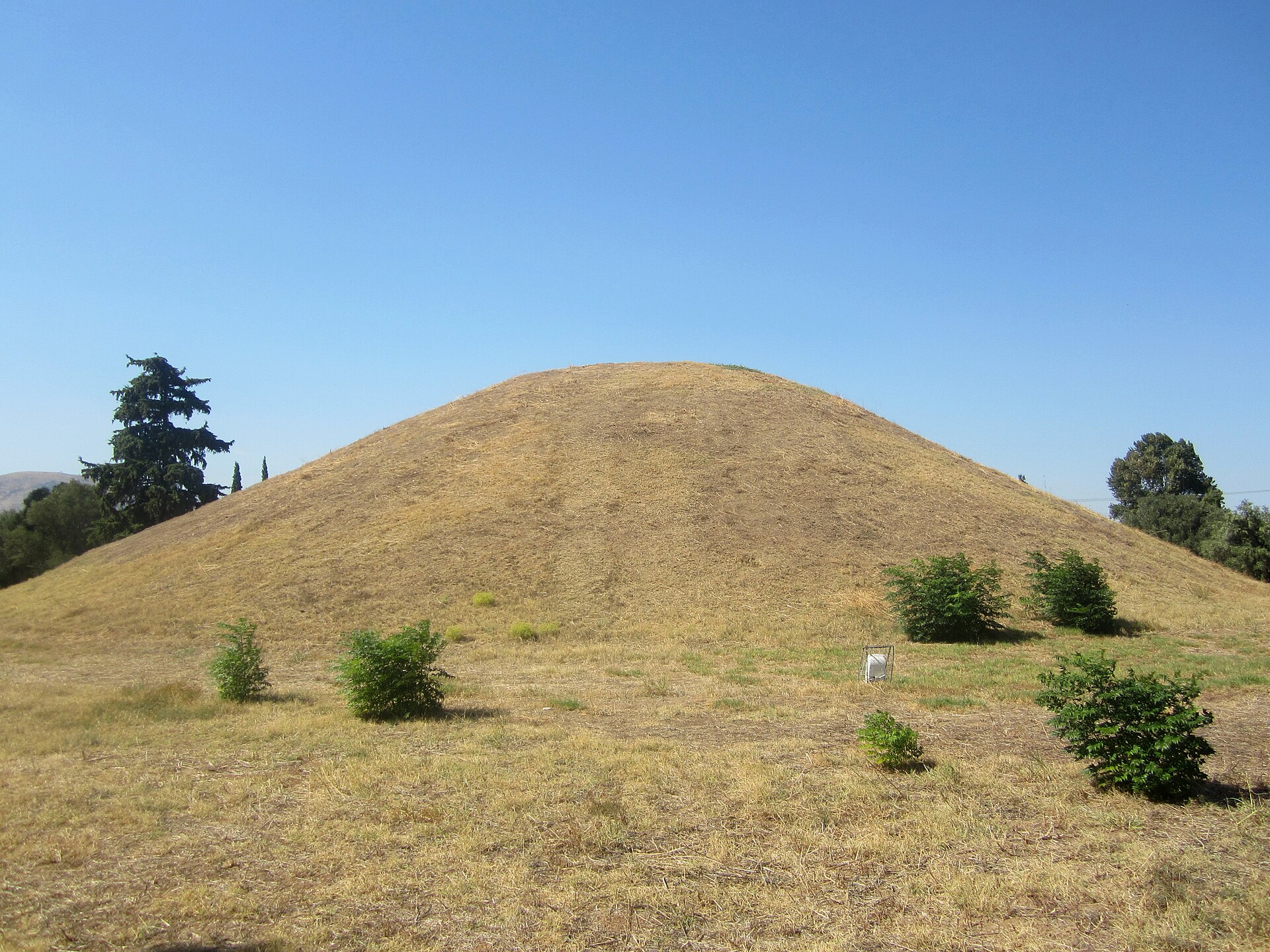
The 9-metre-high circular earth mound marks the communal grave of the 192 Athenian hoplites who died in the Battle of Marathon. Built immediately after the battle in 490 BC, the tumulus has been continuously preserved for 2,500+ years. Walk to the top for the view across the battlefield plain. Free entry, always open. Address: 2 km south of Marathon town on the main coast road.
2. Marathon Archaeological Museum
Small but excellent museum 2 km north of the Tumulus, with finds from the battle and from earlier Marathon-area settlements. Highlights: the original bronze helmet of Miltiades (the Athenian general who commanded at Marathon), pottery fragments, the famous 5th-century-BC Marathon Boy statue, and a detailed model of the battlefield. €6 entry; reduced €3. Open Tuesday-Sunday 8:30 AM-3:30 PM; closed Mondays.
3. The Battlefield Plain
The flat coastal plain where the battle was fought is now mostly farmland. Information markers at strategic points explain the battle’s tactical sequence: the Persian disembarkation at Schinias Bay, the Athenian initial position 1.5 km inland on the higher ground, the famous “double envelopment” charge by Miltiades, and the rout of the Persians back to their ships.
4. The Tomb of the Plataeans
A second smaller burial mound nearby holds the remains of the Plataean hoplites who died fighting alongside the Athenians. Free, on the same road as the Tumulus.
5. Schinias Beach
The 4-kilometre stretch of golden sand at Schinias is backed by the largest stone-pine forest on the Attica coast, making it the only Athens-area beach with proper natural shade. The Schinias-Marathon National Park surrounds the beach. The 2004 Olympic rowing centre is at the south end of the beach. Free entry; sun-bed rental €5-10. Swimming, watersports, and the surrounding pine forest walking trails.
6. Schinias-Marathon National Park
One of the most important wetlands in southeast Europe, with 175+ bird species recorded. The wooden boardwalks through the pine forest and reed beds are excellent for birdwatching at any time of year. Free entry.
Suggested Marathon Day Itinerary
9:00 AM: Depart Athens by rental car or KTEL bus.
10:00 AM: Arrive Marathon. Visit the Tumulus of the Athenians (30 minutes).
10:30 AM: Marathon Archaeological Museum (60 minutes).
11:30 AM: Drive 5 minutes to Schinias Beach.
12:00 PM: Beach time, swimming, lunch at a seaside taverna (2-3 hours).
3:00 PM: Drive to the Battlefield Plain and the Tomb of the Plataeans (45 minutes).
4:00 PM: Coffee in Marathon town.
5:00 PM: Return to Athens.
6:30 PM: Arrive central Athens.
Total cost: €30-50 per person independent including bus + entries + lunch.
The History of the Battle
In 490 BC the Persian king Darius I sent a fleet across the Aegean to punish Athens and Eretria for supporting the Ionian Revolt. The Persians landed at Marathon Bay with around 25,000 troops. The Athenians and their Plataean allies (10,000 men total) marched to meet them. After several days of standoff, the Athenian general Miltiades launched a famous “double envelopment” charge that broke the Persian wings and routed the army back to its ships. 192 Athenians and 11 Plataeans died; estimates of Persian casualties range from 6,400 to 12,000. The Athenian victory ended the First Persian Invasion of Greece.
The messenger Pheidippides was famously dispatched to run the 42 km back to Athens to announce the victory; he reportedly delivered the news (“Nenikēkamen! – We have won!”) and collapsed dead in the agora. The modern marathon foot race traces its origin to this run; the international standard 26.2-mile marathon distance was officially set in 1908 to match the route from Marathon to Athens. The annual Athens Authentic Marathon (every November) still runs the historical route.
Where to Eat in Marathon
Schinias Beach tavernas: several beachfront tavernas serve excellent grilled fresh fish and traditional Greek summer food. €25-40 per person. Vergina: traditional taverna in Marathon town with excellent meze and grilled meats. €20-30. Akrogiali: harbour-front fish taverna in Nea Makri (10 km south). €30-40 per person.
Best Time of Year for Marathon
April-June and September-October: ideal weather. July-August: hot but perfect for Schinias Beach combination. November: the historic Athens Marathon race day (early November); spectators line the entire route from Marathon to Athens.
Frequently Asked Questions
How far is Marathon from Athens?
43 km northeast of Athens, 45 minutes by car via the National Road 83. KTEL bus takes 60-75 minutes.
How much does a Marathon day trip cost?
Independent: €30-50 per person including bus + entries + lunch. Guided tour: €60-100 per person. Rental car: €70-90 per couple.
What is the Tumulus of the Athenians?
A 9-metre circular earth mound marking the communal grave of the 192 Athenians who died at the Battle of Marathon in 490 BC. Built immediately after the battle and preserved for 2,500+ years. Free entry, always open.
Is Marathon worth visiting?
Yes, particularly for visitors interested in classical Greek history or running. The combination of the battlefield, the tumulus, the small museum, and the beautiful Schinias Beach makes for a perfect half-day trip from Athens.
Can you swim at Marathon?
Yes. Schinias Beach (3 km from the battlefield) is one of the best beaches near Athens, with 4 km of golden sand backed by the largest pine forest on the Attica coast. Free entry; sun beds €5-10.
When is the Athens Marathon race?
Early November every year. The Athens Authentic Marathon runs the original historical route from Marathon to the Panathenaic Stadium in central Athens, with around 60,000 international participants.
Is the Marathon Museum worth it?
Yes. Small but excellent, with the original bronze helmet of the Athenian general Miltiades, a battlefield model, and significant finds from earlier Marathon-area settlements. €6 entry; 60 minutes is sufficient.
The Battle of Marathon: What Actually Happened in 490 BC
The Battle of Marathon was the decisive engagement of the First Persian Invasion of Greece. King Darius I of Persia sent a punitive expedition of approximately 25,000 soldiers and 600 ships against Athens and Eretria — the two Greek city-states that had supported the Ionian Revolt against Persian rule (499-493 BC). The Persian fleet landed at Marathon Bay in August/September 490 BC, choosing the location because the wide coastal plain was suitable for the Persian cavalry to operate effectively.
The Athenian army of approximately 10,000 hoplites (heavily armed citizen-soldiers), reinforced by 1,000 Plataeans, marched the 42 kilometres from Athens to meet the Persians. The Athenian generals were divided on strategy. The senior commander Callimachus and the strategist Miltiades — who had previously served in the Persian military and understood Persian tactics — argued for an immediate attack before the Persian cavalry could be brought into action. After several days of standoff, Miltiades attacked on a morning when the Persian cavalry was apparently being re-embarked for a planned amphibious assault on Athens itself.
The Athenian formation was unusual: deliberately thinned in the centre and reinforced on the wings. When battle began, the thinner Athenian centre was pushed back as expected, but the strengthened wings broke through the Persian lines and then wheeled inward to attack the Persian centre from the rear. The result was a devastating Persian defeat — Herodotus records 6,400 Persian dead against 192 Athenian fallen. The 192 Athenian war dead are buried in the Soros (the burial mound) which remains visible at the site today, one of the most-evocative archaeological sites in Greece because it marks the actual graves of named historical individuals.
The Marathon Run: Pheidippides and the Modern Race
The famous “Marathon Run” story combines two separate historical events. The first: Pheidippides, an Athenian professional long-distance runner (a “hemerodromos”), was sent before the battle to Sparta — a distance of approximately 240 kilometres — to request Spartan military aid. He ran the distance in approximately two days. The Spartans, however, were observing a religious festival and refused to march before the full moon, arriving too late for the battle.
The second event — the basis for the modern Marathon race — is the (probably legendary) run from the Marathon battlefield to Athens to announce the victory. According to Plutarch (writing 500 years after the battle), a soldier named Thersippus ran the 42 kilometres in heavy armour, announced “Νενικήκαμεν!” (Nenikēkamen — “We have won!”), and collapsed dead. Modern historians believe this story is a later embellishment; the more reliable account is that the entire Athenian army marched back to Athens immediately after the battle to defend the city against the Persian fleet sailing around Cape Sounion.
The modern marathon race was created for the 1896 Athens Olympics as a deliberate revival of the Pheidippides legend. The Athens 1896 marathon was run from the Marathon battlefield to the Panathenaic Stadium — the same route still used today by the Athens Authentic Marathon every November. The official distance was standardised at 42.195 km at the 1908 London Olympics (the distance from Windsor Castle to the royal box at the White City Stadium).
The Athens Authentic Marathon (November)
The Athens Authentic Marathon is held every November on the original Marathon-to-Athens route. The 2026 edition will be held on Sunday November 8th. The race attracts 20,000+ international runners; the finish line is in the Panathenaic Stadium (the marble stadium of the 1896 Olympics). The route passes through Marathon village, Nea Makri, Rafina, Pikermi, and into Athens via Vasilissis Sofias Avenue.
Participating as a runner: registration opens in February at athensauthenticmarathon.gr; entry fee €80-120. The race includes the full marathon (42.195 km), a 10 km race, and a 5 km race for non-marathoners. Spectator advice: the Panathenaic Stadium finish (1-4 PM) is the most-atmospheric viewing point; the Marathon-area start (9 AM) is also popular. Athens hotels book up months in advance for the marathon weekend.
Schinias National Park & Beach
Two kilometres east of the Marathon battlefield, Schinias National Park is one of the most-beautiful natural areas in Attica. The park encompasses a 3.5-kilometre Aleppo-pine forest growing directly behind a wide sandy beach — the only such pine-forest-and-beach combination in Greater Athens. The park was designated in 2000, partly to protect the 2004 Olympics Rowing Centre that hosted the rowing and canoe-kayak events.
The beach is 2.5 kilometres of fine white sand with calm shallow water — ideal for families and beginner swimmers. Free public sections dominate; several small €5-10 organised areas offer sun loungers. The pine forest provides natural shade — invaluable in July-August when other Athens beaches have no shade. The forest also has marked walking trails (1-3 km loops) and a small bird-watching observatory (the wetlands host migratory birds in spring and autumn).
Several tavernas operate at the Schinias end of the road; the most-popular are the simple fish tavernas near the beach parking. €25-40 per person for fresh grilled fish; €15-25 for casual meze and souvlaki. Most tavernas open April-October.
Rafina Port: The Underrated Alternative
Combined with a Marathon day trip, the small port town of Rafina (10 kilometres south of Marathon) offers an excellent lunch or dinner option. Rafina is the second-largest Athens port (after Piraeus); it operates ferry connections to Andros, Tinos, Mykonos, and other Cyclades islands. The waterfront has a dozen seafood tavernas serving fish bought directly from the local fishing fleet that morning — significantly fresher (and often cheaper) than central Athens equivalents.
Recommended Rafina tavernas: Limanaki (the historic harbour fish taverna; €35-60 per person), Ouzeri Lefkos (casual meze; €20-35), and Bobonas (modern Mediterranean; €40-70). The Rafina-to-Athens drive is 35-45 minutes; the bus is 50-75 minutes (€2.40 each way).
How to Visit Marathon: Detailed Logistics
By rental car (recommended): the 42 km drive from central Athens takes 60-90 minutes via the Athens-Marathon Avenue (Marathonos Avenue). Rental car €30-50/day. Park free at the Marathon Archaeological Museum, the Marathon Tomb (Soros), and at Schinias beach.
By KTEL Attica bus: from the Pedion tou Areos bus terminal in central Athens to Marathon village. €5-7 each way; 90-120 minutes. From Marathon village you’ll need a taxi (€10-15) to reach the Soros, the museum, and Schinias.
By organised tour: several Athens operators run half-day Marathon + Schinias day trips. €40-80 per person; includes transport, guide, and Marathon Tomb entry.
The Marathon Archaeological Museum
The small but excellent Archaeological Museum of Marathon (€6 entry; closed Tuesdays) displays artefacts from the Marathon battlefield and the wider Northeast Attica region. The highlights: pottery and weapons from the Marathon battle, the Soros excavation finds, Egyptian-influenced artefacts from the Roman estate of Herodes Atticus (the Roman senator who built the Odeon on the Acropolis south slope), and a small but interesting collection of prehistoric Attic artefacts.
The museum is 2 km from the Marathon Tomb (Soros). Combined visit including the Tomb takes 90-120 minutes. Audio guides available in English; the curators are knowledgeable and speak English well.
Ramnous: The Lesser-Known Archaeological Site
10 km north of Marathon, the small archaeological site of Ramnous (Ραμνούς) is one of the most-atmospheric and least-visited ancient sites in Attica. The 5th-century-BC fortified deme included a Temple of Nemesis (the goddess of divine retribution; appropriate given the Persian defeat at nearby Marathon). The site’s dramatic clifftop location overlooking the Euboean Strait, combined with the near-total absence of other visitors, makes Ramnous one of the best “secret” archaeological visits from Athens. €4 entry; allow 60-90 minutes. Combine with Marathon for a complete Northeast Attica day.
Lake Marathon & the Reservoir
The Marathon Dam, completed in 1929, was the engineering achievement that brought reliable water supply to Athens for the first time. The dam created Lake Marathon (Limni Marathona), a man-made reservoir still supplying part of Athens’s drinking water. The dam face is built of Pentelic marble (the same marble as the Parthenon) — one of the most-distinctive dams in the world. The lake itself is closed to swimming and boating (protected drinking water source), but the dam area and the small museum (free) make for an interesting 30-minute stop on the Marathon day trip.
Plan the Rest of Your Athens Trip
For more day trips, see our pillar guide to Day Trips from Athens, our Cape Sounion guide, our Delphi guide, our Athens beaches guide, our Panathenaic Stadium guide, and our top 25 attractions.
Photo Credits
- The Tomb of the Athenians at Marathon: Marathon Tomb of the Athenians 2 by Tomisti, CC BY-SA 4.0, via Wikimedia Commons.