This article contains advertising. Some of the hotel, tour, activity, flight and transfer links in it are paid links: if you book through one, we get a commission from the booking company, and your price is the same either way. It never affects what we recommend. Affiliate disclosure
Athens is the open-air museum of the Western world. Every street corner in the city centre seems to brush up against 2,500 years of history, and the top attractions in Athens, Greece range from the world’s most recognisable ancient temple to humming neighbourhood markets, hilltop sunset spots, and modern cultural complexes that rival anything in Europe. With so much packed into a compact, walkable centre, the challenge isn’t finding things to see, it’s deciding what makes the cut.
This guide ranks 25 must-visit attractions that every first-time visitor to Athens should put on the itinerary, plus a few that even seasoned travellers tend to miss. Each entry includes practical visiting information, ticket prices, opening hours for 2026, the best time of day to go, and how it fits into a sensible walking route through the city. Whether you have 48 hours or a full week, this list will help you build a trip that goes beyond the postcards.
How to Use This List
The 25 attractions are loosely grouped from most-essential to off-the-beaten-path. Numbers 1 through 10 are the headline sights almost every visitor will want to tick off; 11 through 20 round out a deeper week-long stay; and 21 through 25 are the local favourites that turn a good trip into a great one. Most are reachable on foot or with a single metro ride from Syntagma or Monastiraki. For broader context on planning your visit, see our complete things to do in Athens guide.
1. The Acropolis & the Parthenon
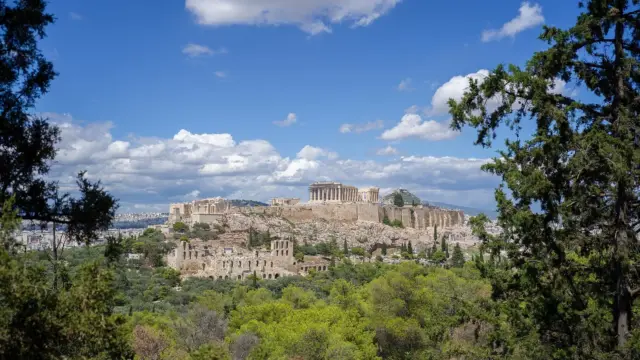
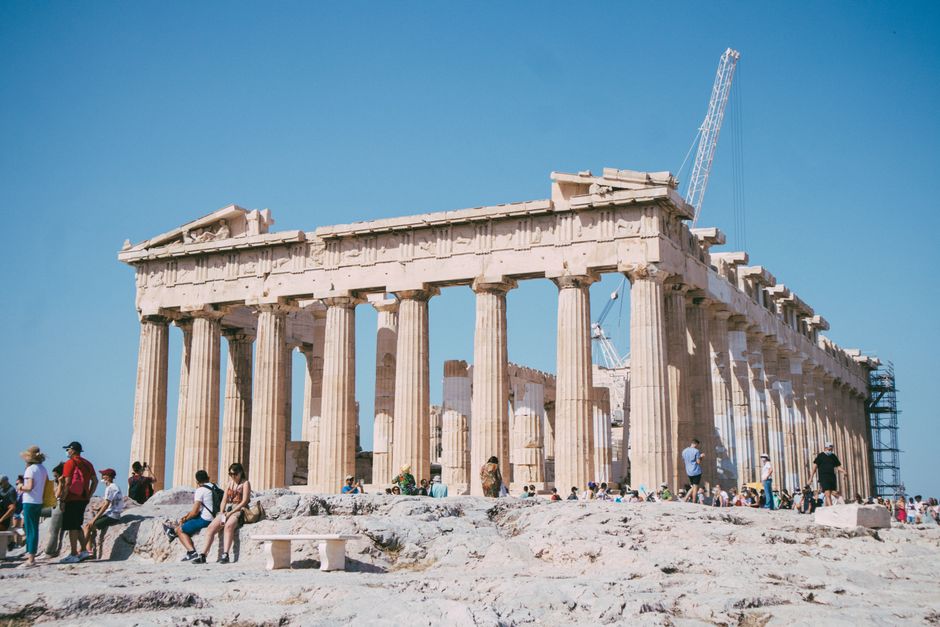
Nothing else in Athens comes close. The Acropolis is the limestone citadel that has crowned the city since the Bronze Age, and the 5th-century-BC Parthenon, dedicated to the goddess Athena, is the temple that has defined classical architecture for two and a half millennia. Walking the Sacred Way past the monumental Propylaea gateway is the single most memorable hour any visitor will spend in Greece.
2026 essentials: The site opens at 8:00 AM all year. It closes at 8:00 PM from April to August, then earlier through the autumn: 7:30 PM on 1-15 September, 7:00 PM on 16-30 September, 6:30 PM on 1-15 October and 6:00 PM on 16-31 October. From November to March the hours are 8:00 AM to 5:00 PM. Last admission is 20 minutes before closing. Adult entry is €30 (reduced €15), and a timed-entry reservation is required; book on the official ticketing portal at tickets.hh.gr. The combined site pass that also covered six other archaeological sites is no longer sold. For a calmer visit, take the first slot at 8:00 AM or come in the late afternoon, checking that day’s closing time. Avoid midday in summer when the rock genuinely roasts.
2. Acropolis Museum
You cannot fully appreciate the Acropolis without the museum that contextualises it. Bernard Tschumi’s glass-and-concrete building stands about 300 metres southeast of the Parthenon, and its top-floor Parthenon Gallery shares the temple’s orientation, so the frieze blocks run in their original sequence, though at a lower height than on the building itself. Glass floors reveal an excavated ancient neighbourhood beneath your feet.
2026 essentials: €20 (reduced €10), the same all year. From April to October it closes at 8:00 PM Tuesday to Thursday and at weekends, 5:00 PM on Mondays and 10:00 PM on Fridays; from November to March it closes at 5:00 PM Monday to Thursday, 10:00 PM on Fridays and 8:00 PM at weekends. The late Friday opening makes it the perfect after-Acropolis stop. Check the museum’s website for its free-entry days.

3. The Ancient Agora & Temple of Hephaestus
If the Acropolis was the spiritual heart of Athens, the Agora was its civic and commercial soul. This was the centre of Athenian civic life, the place associated with Socrates and his philosophical discussions, and where the city’s daily business actually happened. The fully intact 5th-century-BC Temple of Hephaestus is, paradoxically, in better shape than the Parthenon and gives a far truer picture of what an ancient Greek temple looked like.
2026 essentials: €20, reduced €10. The reconstructed Stoa of Attalos houses an excellent on-site museum. Allow 90 minutes minimum.
4. Plaka Neighbourhood
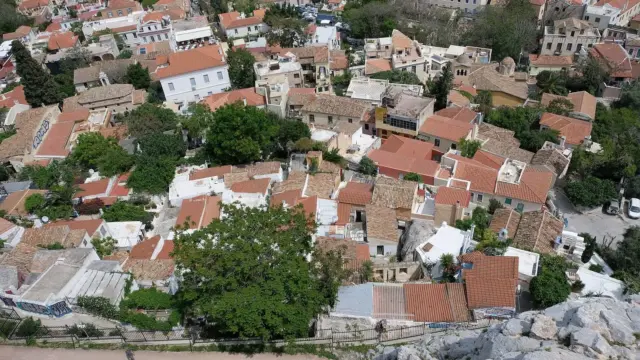
Plaka is the historic neighbourhood spread across the slopes beneath the Acropolis. Whitewashed houses, bougainvillaea-draped lanes, neoclassical mansions and tavernas spilling onto cobbled streets give it the feel of a Cycladic island village dropped into the middle of a capital city. The micro-neighbourhood of Anafiotika, climbing the rock itself, is the best place in Athens for a slow, aimless wander.
Tip: Plaka’s central streets get tour-bus busy by 11:00 AM. Go before 9:00 AM for empty alleyways and golden light, or after 8:00 PM when the dinner crowd softens it.
5. Monastiraki Square & Flea Market
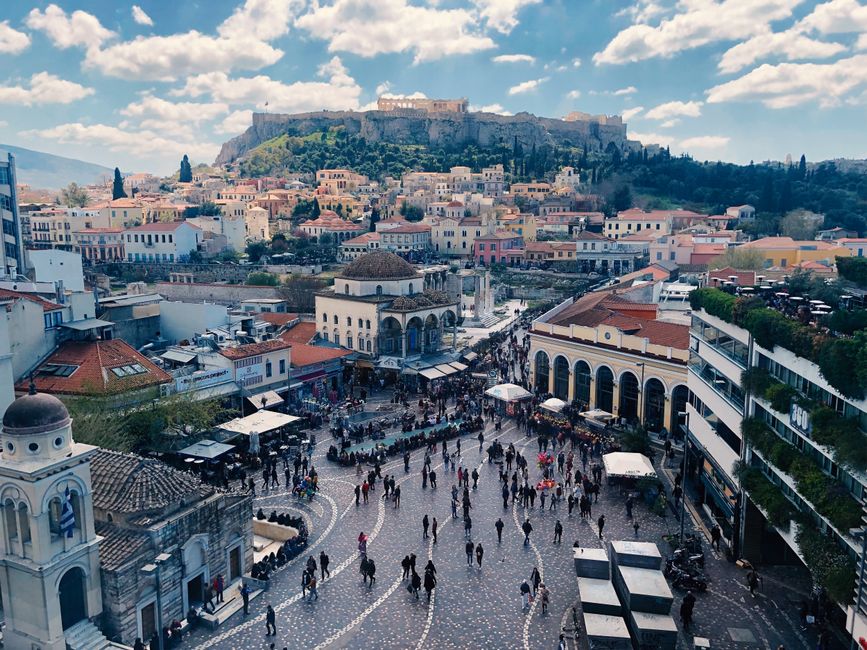
Monastiraki is the messy, glorious crossroads of central Athens. The square frames a perfect Acropolis view; the surrounding streets are lined with shops, and on Sundays the area south of the square turns into an open-air second-hand bazaar that stretches towards Thissio. Pause at Avissinias Square for the antique dealers and at Ifaistou Street for leather sandals and souvenirs.
6. Changing of the Guard at Syntagma Square
Every hour, on the hour, two Evzones in pleated fustanella skirts and pom-pom shoes perform a slow, hypnotically stylised ceremony in front of the Tomb of the Unknown Soldier outside the Greek Parliament. The full ceremonial changing happens every Sunday at 11:00 AM, when the entire Presidential Guard marches to the Tomb accompanied by a military band. It is one of the most photographed Athens experiences and it is completely free.
7. National Archaeological Museum
Greece’s flagship museum and one of the great archaeological collections on Earth. The Mycenaean gold from Heinrich Schliemann’s excavations, the bronze Antikythera Youth, the Jockey of Artemision, and the eerily beautiful Cycladic figurines are reason enough to come; the Thera frescoes from Akrotiri seal it. Allow at minimum three hours, ideally a full half day. €20 entry; from 4 May to 15 November 2026 it is open 8:00 AM to 8:00 PM Wednesday to Monday and 1:00 PM to 8:00 PM on Tuesdays.
8. Temple of Olympian Zeus & Hadrian’s Arch
One of the largest temples of antiquity, the Olympieion was begun around 515 BC and finally finished by the emperor Hadrian in 131-132 AD, roughly 650 years later. Only 15 of the original 104 colossal Corinthian columns still stand, but their sheer scale is awe-inspiring. The Roman triumphal arch right next to it marks the symbolic boundary between the old Greek city and Hadrian’s new Roman quarter.

9. Panathenaic Stadium (Kallimarmaro)
The only stadium in the world built entirely of marble. Originally laid out in 330 BC, rebuilt in marble in the 2nd century AD, and excavated and restored in time to host the very first modern Olympic Games in 1896. Entry includes a small but interesting museum on the history of the modern Olympics and the right to run a victory lap on the same track Greek athletes used over two millennia ago. €12 entry (reduced €6); opening hours change with the season and around events.
10. Lycabettus Hill
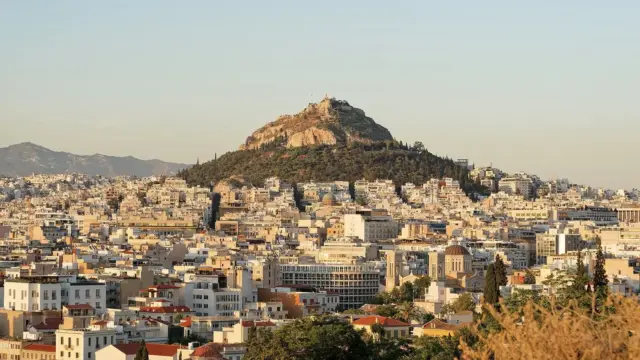
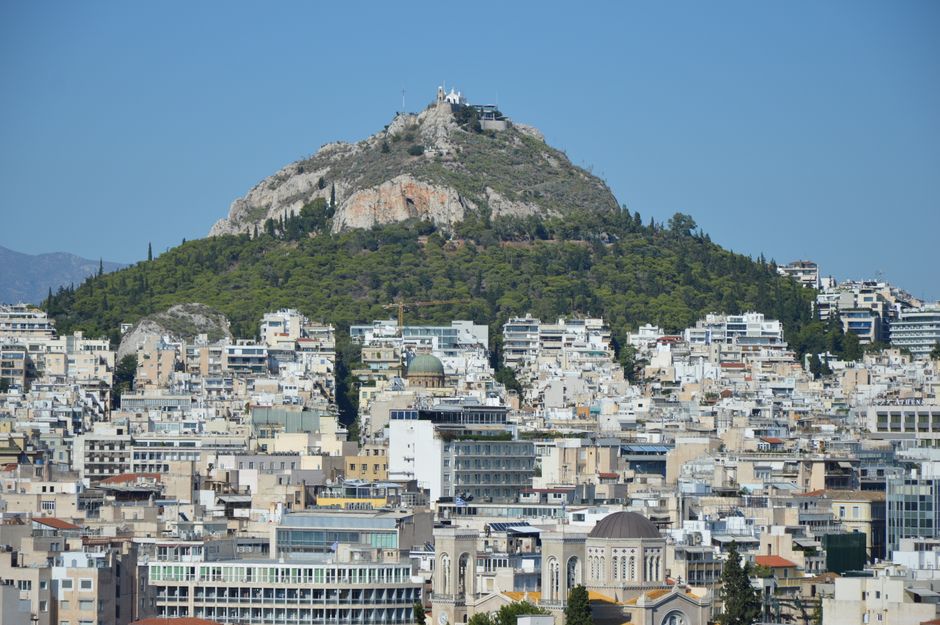
At 277 metres, Lycabettus is the highest natural point in central Athens and the place every visitor should be at least once at sunset. The panoramic view takes in the Acropolis and the whole city sprawl. Walk up through the pines from Kolonaki, or take the funicular from Aristippou Street if you want to save your legs. The little white chapel of Agios Georgios at the summit is delightful.
11. Roman Agora & Tower of the Winds
The Roman-era successor to the Ancient Agora, built in the 1st century BC under Caesar and Augustus. Its showstopper is the Tower of the Winds, a 12-metre octagonal marble structure, completed by about 50 BC at the latest, that combined sundials, a water clock, and a weather vane. €10, reduced €5.
12. Hadrian’s Library
Right beside the more famous Roman Agora, the library complex inaugurated by Hadrian around 132 AD once contained reading rooms, lecture halls, and an inner courtyard with a pool. The surviving facade with its Corinthian columns is striking, and the on-site ruins of three later Christian basilicas add layers of history. €10, reduced €5.
13. Kerameikos Cemetery
The ancient cemetery of Athens, in use from the 9th century BC, sits on the western edge of the centre near the Thissio metro station. Wandering the burial grounds with their evocative funerary stelai, the foundations of the Sacred Gate, and the on-site Oberlaender Museum is one of the city’s most underrated experiences. You will often have the place almost to yourself.
14. Benaki Museum of Greek Culture
The private collection of Antonis Benakis traces Greek culture from antiquity to the 20th century in a beautifully curated neoclassical mansion on Kolonaki’s Vassilissis Sofias Avenue. The Byzantine icons, traditional Greek costumes, and recreated Macedonian salons are highlights. Entry is €12, and the permanent exhibition is free on Thursdays from 6:00 PM to midnight (not for organised or guided groups). The museum’s separate Museum of Islamic Art in Thissio is equally worthwhile.
15. Museum of Cycladic Art
Devoted to the minimalist marble figurines of the Cycladic civilisation that flourished 5,000 years ago in the islands of the central Aegean, this small, elegant museum is a particular favourite of design lovers. Picasso, Modigliani, and Brâncuși were all openly influenced by these slender, abstract forms. Entry is €12.
16. Stavros Niarchos Foundation Cultural Center
Designed by Renzo Piano Building Workshop, this cultural complex in the southern suburb of Kallithea houses the National Library of Greece and the Greek National Opera under a sloping green roof topped with a 10,000 m² photovoltaic canopy. The surrounding 21-hectare park has a canal for kayaking, a running track, and a dome for events and performances. Entry is free; concerts and tours are bookable online.
17. Anafiotika
This tiny island village inside Plaka was built by craftsmen from Anafi who came to Athens in the 1860s and recreated their home in miniature on the rocks. Whitewashed houses, flowers in clay and tin planters, narrow stairways, and constant glimpses of the Acropolis above make this the most magical 15 minutes you can spend in central Athens. People live here, so wander the lanes on foot and keep your voice down.
18. Mount Lycabettus Theatre & Pine Forest
The pine-clad slopes of Lycabettus are an underrated walking destination, with shaded paths winding up from Dexameni Square that locals use for morning runs. The open-air Lycabettus Theatre, carved into a former quarry near the summit, hosts major international concerts every summer; past performers include Radiohead, Patti Smith, and the Athens Festival’s classical productions.
19. Filopappou Hill
Across the valley from the Acropolis, Filopappou Hill (also called the Hill of the Muses) gives the single best Acropolis photograph anywhere. The pine-forested slopes contain the prison of Socrates carved into the rock, the church of Agios Dimitrios Loumbardiaris, and the 2nd-century-AD Filopappou Monument at the summit. Sunset here is more local, less crowded, and arguably more atmospheric than Lycabettus.
20. Varvakeios Central Market
Athens’ main covered food market, opened in the late nineteenth century, sells meat, fish, olives, herbs, and Greek cheeses six days a week. The atmosphere is loud, theatrical, and entirely authentic. Diporto, a basement taverna at 9 Sokratous, has been serving simple meals since 1887 and is one of the oldest basement tavernas in the city; its speciality is a hearty chickpea soup.
21. Kotzia Square & the Old City Hall
One of the most beautiful squares in central Athens and one of the least visited by tourists. The 19th-century City Hall faces the National Bank, an excavated stretch of the ancient road to Acharnes is preserved at the centre, and the surrounding streets are full of grand neoclassical façades. A short detour from Omonia metro.
22. The First Cemetery of Athens
Athens’ Père-Lachaise. This is where the city’s poets, prime ministers, archaeologists, and shipping magnates have been buried since 1837, in marble tombs designed by some of the country’s leading sculptors. The Sleeping Maiden by Yannoulis Chalepas is the masterpiece. Quiet, leafy, and intensely atmospheric. Free entry.
23. Gazi & the Technopolis
The gasworks complex that once supplied Athens with town gas, whose first buildings went up between 1862 and 1887, became Technopolis, the City of Athens’ multipurpose cultural centre, in 1999. The surrounding Gazi neighbourhood has reinvented itself as one of the city’s most vibrant nightlife districts. Easy access from Kerameikos metro station.
24. National Garden & Zappeion
A 15.8-hectare green oasis right behind Parliament, commissioned by Queen Amalia in 1838 as the royal garden and completed in 1840. Shaded paths, a small zoo, ponds, ancient column fragments, and a botanical museum make it the best way to escape Athens heat. The neoclassical Zappeion Hall at its southern edge is a fine 19th-century exhibition building, and its on-site café has a lovely garden terrace.
25. Pnyx & the Areopagus
Two rocky outcrops west of the Acropolis with enormous historical weight. The Pnyx is where the Athenian Assembly met; the Areopagus is the rock where, according to Acts 17, the apostle Paul addressed the Athenians. (Socrates, for the record, was condemned by a citizen jury in 399 BC, not by the Areopagus.) The Pnyx is free to enter, and both give you the Acropolis from a different angle.
How Many Attractions Can You See in Athens in One Trip?
Most visitors find that 48 hours is enough for the headline sights (numbers 1 through 10 above) at a brisk pace; three full days lets you add the Roman Agora, Hadrian’s Library, Kerameikos, and at least one major museum without rushing. A week makes it possible to combine all 25 attractions on this list with a half-day Cape Sounion run, a beach day on the Athens Riviera, and a full day trip out of Athens to Delphi or Hydra. The best advice we give is to pace yourself; ancient sites and museums tire visitors faster than they expect, and Athens rewards slow walking and long meals.
Best Order to Visit the Top Athens Attractions
For a logical first-day route, start at the Acropolis at the 8:00 AM opening, descend the south slope to the Acropolis Museum for early lunch, then walk through Plaka to the Roman Agora, Hadrian’s Library, and into Monastiraki for shopping and people-watching. Day two should pair the Ancient Agora with a long afternoon at the National Archaeological Museum and finish at sunset on Lycabettus or Filopappou Hill. This sequence keeps you near the metro at all times and lets you adjust the pace as the heat or your stamina dictates.
Tickets, Passes & Money-Saving Tips
The old combined ticket for seven sites (Acropolis, Ancient Agora, Roman Agora, Hadrian’s Library, Kerameikos, Olympieion, and Aristotle’s Lyceum) is no longer sold, so each now sells its own ticket: €30 for the Acropolis, €20 each for the Ancient Agora and the Olympieion, €10 each for the Roman Agora, Hadrian’s Library and Kerameikos, and €5 for the Lyceum. Major museums each price separately. The Acropolis and the other state sites and museums are free on March 6, April 18, May 18, the last weekend of September, and October 28, and also on the first and third Sundays of each month from November to March. EU citizens up to the age of 25 get free entry with an identity card or passport; a student card alone does not qualify older visitors.
Best Time of Year to Visit These Attractions
April, May, late September and October are the sweet spot. Archaeological sites are open later than in winter, and the major attractions are free of the brutal July and August heat. Winter (November to March) has shorter site hours but dramatically fewer crowds and softer light for photography. Avoid the first two weeks of August if possible, when both the heat and the cruise-ship volume peak together.
Frequently Asked Questions
What is the number-one attraction in Athens?
The Acropolis is the unquestionable number-one attraction in Athens. The 5th-century-BC complex of temples on the city’s central limestone hill, crowned by the Parthenon, recorded about 4.6 million visits in 2025 and is a UNESCO World Heritage site. No trip to Athens is complete without it.
How many days do you need to see the top attractions in Athens?
Two full days is enough to visit the top ten attractions on this list at a comfortable pace. Three days lets you add the major museums and archaeological sites without feeling rushed; a week is ideal if you want to combine the city with day trips to Delphi, Cape Sounion, or the nearby Saronic islands.
Do I need to book Acropolis tickets in advance?
Yes. As of 2026, the Acropolis requires a timed-entry reservation year-round. Book through the official portal tickets.hh.gr at least a week in advance during summer, ideally a month ahead for July and August dates. Early-morning slots sell out fastest because they are the coolest and quietest.
What is the best free attraction in Athens?
The changing-of-the-guard ceremony at Syntagma Square is the most spectacular free experience in Athens. For something quieter, the walk up Filopappou Hill at sunset, the Anafiotika neighbourhood, and the Pnyx are all free and offer some of the city’s best Acropolis views.
Are Athens attractions accessible for people with mobility issues?
The Acropolis has a wheelchair lift on its north slope and a paved path on the rock itself, but the surface is uneven in places. The Acropolis Museum, National Archaeological Museum, Stavros Niarchos Foundation Cultural Center, and most state museums are fully accessible. Plaka and the Ancient Agora are partially accessible; Anafiotika and the Pnyx involve uneven ground and stairs.
What attractions are open on Mondays in Athens?
The Acropolis, Ancient Agora, Roman Agora, Olympieion, Hadrian’s Library, and the Acropolis Museum are all open on Mondays in 2026. The National Archaeological Museum opens late on Tuesdays (1:00 PM to 8:00 PM); from 4 May to 15 November 2026 it opens at 8:00 AM on the other days, Mondays included. Always double-check on the official sites because hours change for public holidays.
Can I see the top Athens attractions on a budget?
Yes. The Acropolis costs €30 and the other major archaeological sites €5-20 each, since the old combined pass is no longer sold; the National Archaeological Museum and the Acropolis Museum cost €20 each, and other museums price separately. Free attractions including Plaka, Monastiraki, the changing of the guard, Anafiotika, Filopappou Hill, the National Garden, the Pnyx, and most churches make it possible to spend a full day in central Athens for under €10 once you factor in metro and a Greek coffee.
Plan the Rest of Your Athens Trip
The 25 attractions in this guide are the foundation of any Athens itinerary. To go deeper, see our pillar guide to things to do in Athens, our complete historical sites and museums guide, our neighbourhood-by-neighbourhood breakdown, and our transport guide for navigating between sites efficiently. If you are travelling with children, our Athens with kids guide highlights the most family-friendly attractions on this list.