This article contains advertising. Some of the hotel, tour, activity, flight and transfer links in it are paid links: if you book through one, we get a commission from the booking company, and your price is the same either way. It never affects what we recommend. Affiliate disclosure
Piraeus is the largest passenger port in Europe and the gateway from Athens to the Greek islands. The port authority counts about 20 million passenger movements a year, about eight million of them on the short Salamis-Perama crossing, with ferries to the Aegean islands and Crete plus international cruise traffic. The gates are spread across a wide area, so check which one is on your ticket before you set off. This is the complete Piraeus port guide for ferries from Athens in 2026, with how the gates work, the free shuttle bus, transport from central Athens, and clear advice on which gate serves which destination. It is not the only option, though: our guide to Athens’ ferry ports and island flights explains when Rafina, the short way to Andros, Tinos and Mykonos, or Lavrio, the port for Kea and Kythnos, is the better start.
Piraeus Port at a Glance
Around 10 km southwest of central Athens. Departures leave from numbered gates (E1, E2 and so on). A free port bus runs between gates E1 and E5. Multiple cafés, kiosks, ATMs, and waiting areas. Accessible facilities throughout.
For broader context, see our Getting Around Athens pillar, our Athens to Greek islands ferry guide, and our airport transport guide.
The Piraeus Gate System (Critical to Get Right)
Gates and What They Serve
- E2: Crete ferries
- E6, E7: Blue Star’s Mykonos ferries; other Cyclades sailings vary, so check the gate on your ticket
Important: Always Check Your Ticket for the Specific Gate
The gate number is printed on your ferry ticket and may change occasionally. Confirm the gate at the Piraeus port information desk on arrival or check the digital displays at the gate area.
Free Shuttle Bus Within the Port
A free port bus runs between gates E1 and E5; check the electronic signs at the stops for the next arrival. It is the easiest way to cover the distance between gates at that end of the port, including the walk from the metro towards Gate E2 for Crete ferries. Use only if you’re a ferry passenger.
How to Get to Piraeus from Athens
From the Athens Airport
Metro Line 3 (blue, direct): about 55-60 minutes; €9 single. Direct service no transfer. Arrives at Piraeus station, opposite the main terminal gates. Best option for travellers heading directly from a flight to a Cyclades ferry.
X96 24-hour Express Bus: about 90 minutes, depending on traffic; €5.50. Runs around the clock between the airport and Piraeus port; check OASA’s X96 page for the current stops. Best if you’re arriving outside metro hours.
Suburban Rail (Proastiakos): less frequent than the metro but a viable alternative; Hellenic Train publishes the current fares and timetable on hellenictrain.gr.
Taxi: runs on the meter rather than a flat fare, so the cost depends on traffic and the time of day. Most expensive but door-to-door.
From Central Athens
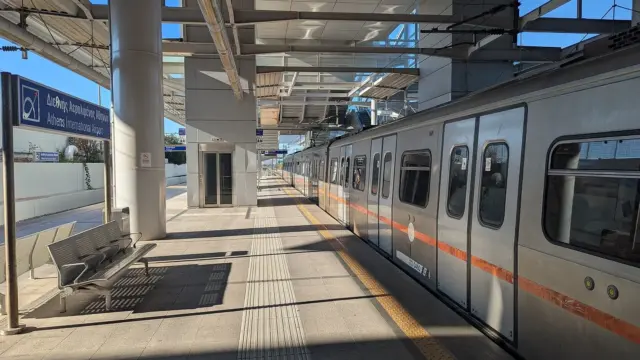
Metro Line 1 (green): 25-30 minutes from Monastiraki; €1.20. Ends at Piraeus station, opposite the main terminal gates.
Metro Line 3 (blue): about 20 minutes from Syntagma; €1.20. Calls at Piraeus station, one stop before its Dimotiko Theatro terminus.
Bus 040: runs from Syntagma; €1.20. Direct bus alternative.
X80 Express Bus: a seasonal link (May to October) between the Piraeus cruise terminals, the Acropolis and Syntagma, every 35-40 minutes from 07:00 to 21:15. The €1.20 ticket is not valid on it; use the €4.10 24-hour ticket or the €20 3-day tourist ticket.
Taxi: around €25 from central Athens, more in heavy traffic.
Pre-Ferry Practical Tips
Arrive 60-90 minutes early. The port is large, and how long it takes to reach your gate from the metro depends on which gate it is, so check it on your ticket and give yourself a margin. Add time for security and boarding.
Have your ticket on your phone. Most ferries now use e-tickets with QR codes; print as backup if your phone battery is unreliable.
Bring cash for snacks and water. The port cafés and kiosks accept cards but cash is sometimes faster.
Check your gate again before you leave. The gate number can change, so look at your ticket and the port’s departure boards.
Pack a portable charger. Long overnight ferries to Crete or Rhodes will deplete your phone battery; bring backup power.
Where to Eat & Drink at Piraeus
Several cafés and small restaurants near each gate. For a proper meal, head into Piraeus town or to Mikrolimano, the small yacht harbour where fish tavernas line the water.
Where to Stay Near Piraeus
If you have an early-morning ferry, staying near Piraeus cuts out the morning ride from central Athens (Line 3 alone takes about 20 minutes from Syntagma, before the walk to your gate). Recommended hotels: Piraeus Theoxenia (5-star, close to the main port), Phidias Piraeus (free shuttle to the port gates), Triton Hotel (3-star, at the port). Check each hotel’s rates and transfer arrangements for your dates. Central Athens hotels remain the better choice for longer Athens stays; only stay at Piraeus for the night before an early ferry.
Cruise Ship Arrivals at Piraeus
Major international cruise lines (Royal Caribbean, MSC, Princess, Norwegian, Holland America, Celebrity) all stop at Piraeus as part of eastern Mediterranean itineraries. Most lines arrange shuttle buses to central Athens for shore excursions. For independent travel, Metro Line 3 runs from Piraeus to Syntagma in about 20 minutes for €1.20.
Common Piraeus Mistakes to Avoid
Showing up at the wrong gate (check it on your ticket, as the walk between gates can be long). Staying on a Line 3 train past Piraeus: Line 1 ends there, but Line 3 continues one stop to Dimotiko Theatro, so get off at Piraeus and look for the exit towards your gate. Underestimating the size of the port (allow 60+ minutes from metro arrival to ferry boarding). Trying to walk between distant gates (the free port bus covers gates E1 to E5). Missing the e-ticket QR code at boarding (have it ready on your phone with screen brightness up).
Wheelchair Accessibility at Piraeus
The port is fully wheelchair-accessible with ramps at all major gates and lifts at the metro stations. There are accessible toilets at the Akti Vasileiadi, Agios Dionysios and Akti Tzelepi terminals. Most ferries have wheelchair access; book in advance to confirm specific accommodations.
Frequently Asked Questions
How big is the Piraeus port?
Piraeus is the largest passenger port in Europe, with numbered departure gates spread along a long waterfront, so check which one is on your ticket. It handles about 20 million passenger movements a year, a figure that includes the busy Salamis-Perama crossing.
Which Piraeus gate goes to Santorini?
Blue Star’s Mykonos ferries use gates E6 and E7, but the gate for Santorini depends on the operator and the sailing. Always check your specific ticket for the gate number, which can change.
Which Piraeus gate goes to Crete?
Gates E2 and E3 serve Crete ferries (Heraklion, Chania, Sitia). The free port bus between gates E1 and E5 saves you the walk from the metro.
How do I get to Piraeus from central Athens?
Metro Line 1 (green) from Monastiraki, or Line 3 (blue) from Syntagma in about 20 minutes; €1.20. Line 1 ends at Piraeus station, while Line 3 calls there and continues one stop to Dimotiko Theatro. The station sits opposite the main terminal gates.
How early should I arrive at Piraeus?
60-90 minutes before departure. Gates are spread out, and the time it takes to reach yours depends on the gate and where you start, so confirm it on your ticket. Add time for security and boarding.
Is there a shuttle bus at Piraeus port?
Yes. A free port bus runs between gates E1 and E5 for ferry passengers, and electronic signs at the stops show when the next one is due. It saves the long walk between distant gates.
Where should I stay if I have an early Piraeus ferry?
If your ferry departs before 8 AM, staying near Piraeus (Piraeus Theoxenia, Phidias Piraeus, or Triton Hotel) saves the early ride across town. Otherwise, central Athens hotels work fine; allow 75 minutes from hotel to ferry boarding.
Piraeus: From Ancient War Port to Modern Mega-Port
Piraeus has been Athens’s port for 2,500+ years. Themistocles began fortifying Piraeus in 493 BC, turning the natural harbours of Kantharos, Zea, and Munichia into an important Athenian naval base. The 5th-century-BC Long Walls connected Athens to Piraeus, allowing the city to survive sieges by maintaining sea-supply lines. Sulla destroyed Piraeus in 86 BC, and a long decline followed, with only intermittent use of the harbour; permanent settlement resumed in 1829, and the modern municipality was founded in 1835.
Today Piraeus is the largest passenger port in Europe, with about 20 million passenger movements a year including Salamis-Perama traffic, and a major European container port. It is run by the Piraeus Port Authority, majority-owned by COSCO Shipping, the Chinese state-owned company that bought a 51% stake in the authority in 2016 (controversial but transformative for port investment); COSCO’s container-terminal lease dates from 2009.
Piraeus Port Terminals: The Geography
Piraeus has multiple departure gates (Pyle / Pyles), numbered from E1 upwards. Knowing your gate is essential: the gates are spread along the waterfront, and the wrong one can mean a long walk.
Always verify your gate on the e-ticket or with the operator. Information desks at the port help; ask early if uncertain.
Getting to Piraeus from Central Athens
Metro Line 1 (Green; ISAP)
€1.20; runs straight from central Athens to the port. From Syntagma, Line 3 is the direct route and takes about 20 minutes; taking Line 2 to Omonia and changing to Line 1 is the alternative. From the Piraeus Metro station, the walk to the ferry gates depends on which gate you need; a taxi is an option, with the fare depending on the route and traffic.
Metro Line 3 (Blue)
€1.20; about 20 minutes from Syntagma. The Line 3 extension to Piraeus opened 2022. Direct from Syntagma without transfer. Often less crowded than Line 1.
X96 Express Bus
€5.50; about 90 minutes from the airport, traffic permitting. The 24-hour direct bus from Athens International Airport to Piraeus port.
Taxi
Roughly €25 from central Athens; the journey time depends on traffic. The most-convenient with luggage. The driver can drop you at your gate, which saves the walk inside the port.
Suburban Railway (Proastiakos)
Used by airport-Piraeus direct travellers. Avoids the Athens Metro change.
Piraeus Pre-Ferry Logistics
Arrive 45-60 minutes before departure (60-90 for car ferries).
Find your gate: use the port’s electronic departure boards or ask at information.
Pick up tickets if not already e-ticket: the operator’s ticket office at the gate.
Board: boarding times vary by operator and vessel, so check your booking or ask at the ticket office, and make sure you are on board before departure.
Find a seat: deck class is unreserved; arrive early for better seating choice on popular routes.
Where to Eat at Piraeus
The port area has dozens of small tavernas and cafes. The most-respected:
Mikrolimano Harbour
A small harbour with a waterfront promenade of tavernas, their shady terraces lined up one after another. The pick of them:
Margaro: fish restaurant known for its shrimp and red mullet.
Pasalimani & Zea Marina (east of the main harbour)
The Zea marina has upmarket restaurants and a different atmosphere from the main port:
Varoulko Seaside: chef Lefteris Lazarou’s seafood restaurant, listed in the Michelin Guide.
The Hellenic Maritime Museum
The Hellenic Maritime Museum has 1,700 square metres of exhibition space and more than 2,500 items; check the current ticket price on hmmuseum.gr. Located adjacent to Zea Marina. Excellent for visitors with 2-3 hours before a ferry. The exhibitions trace Greek seafaring from prehistoric times to the present, from ancient triremes through the modern shipping industry. Allow 90 minutes minimum.
The Piraeus Archaeological Museum
Lesser-visited but excellent (€10, reduced €5). The collection includes the famous bronze statues found in Piraeus in 1959: the Piraeus Apollo, which the museum calls the oldest surviving cast statue in Greece, and the Piraeus Artemis. An easy ten-minute walk from the passenger port.
The Athens-Piraeus Long Walls
Sections of the ancient Long Walls connecting Athens to Piraeus survive along Athens-Piraeus Avenue. The most-impressive surviving section is at the Eleftherios Venizelos Avenue near the Athens-Piraeus Avenue. Free; visible from the road; small interpretive signage. A 30-minute history detour for transport history enthusiasts.
Cruise Ship Terminal
The dedicated cruise ship terminal handled 863 cruise calls in 2025. Major lines: Royal Caribbean, Norwegian, Princess, Celebrity, Holland America, MSC, Costa, Carnival. The terminal has shore-excursion buses, official Athens taxi rank, and direct Metro connection.
Cruise visitors with limited time should focus on: Acropolis + Acropolis Museum (4-5 hours total), brief Plaka walk (1-2 hours), and a quick lunch. Half-day and full-day Athens tours from Piraeus are also sold; compare what each includes before booking.
Piraeus Hotels for Early-Morning Ferries
For travellers with an early-morning ferry (check the departure time on your booking), a Piraeus hotel saves a pre-dawn taxi from central Athens:
Hotel Piraeus Theoxenia: 5-star boutique hotel near the main port; see its own booking system for rates on your dates. Walk to ferry gates.
Hotel Triton: 3-star hotel at the port; ask for a quote for your dates.
Piraeus Pickpocketing & Safety
The Piraeus port area is generally safe but has typical port-area pickpocketing risk. Be alert in the crowded ferry boarding queues. Use front pockets and crossbody bags. The Piraeus Metro station evening crowds can be hectic; secure your luggage and bag.
The Piraeus areas outside the immediate port (Mikrolimano harbour, Zea Marina, the Piraeus residential streets) are very safe day and night. The areas around the main port can feel rough at 5-6 AM with the early-ferry crowds; nothing actually dangerous but practical to be alert.
Piraeus History Walking Tour
For a half-day Piraeus exploration combining ferry preparation with sightseeing:
10 AM: Metro from central Athens.
10:30 AM: Hellenic Maritime Museum (90 minutes).
12 PM: Walk to Mikrolimano for lunch at one of the waterfront tavernas.
1:30 PM: Walk back through Zea Marina; visit the Piraeus Archaeological Museum.
3 PM: Walk back to port for afternoon ferry departure.
Common Piraeus Mistakes
Arriving at the wrong gate (verify it well in advance), missing the ticket collection deadline (Blue Star asks passengers collecting from Greek port agents to do so at least two hours before departure), parking in unauthorised areas, eating at the first taverna near the port instead of walking to Mikrolimano, arriving with insufficient time for ferry boarding.
The Pirate Past: Piraeus Folklore
Piraeus has a colourful 19th-20th-century history as a refugee centre and smuggling hub, and it was an important centre of rebetiko music (the underground Greek genre that refugees arriving after the 1922 Asia Minor Catastrophe and the 1923 population exchange helped to shape). The Piraeus rebetiko scene survives today at several specialty rebetiko clubs in the Piraeus residential neighbourhoods. See our rebetiko venues guide.
Cruise Ship Day in Athens: The Complete Strategy
Piraeus handles more than a million cruise passenger movements a year, and an Athens day ashore needs careful planning around your own ship’s arrival and all-aboard times. The optimal cruise-day Athens itinerary:
7-8 AM: Arrive at Piraeus; immediate Metro Line 3 to Syntagma or pre-booked tour bus.
8:30 AM: Pre-booked Acropolis ticket (book the first slot of the day).
9-11:30 AM: Acropolis visit.
11:30 AM-1 PM: Acropolis Museum.
1 PM: Quick Plaka lunch (souvlaki or taverna).
2 PM: Brief Plaka and Monastiraki walk.
3:30 PM: Metro back to Piraeus.
4:30 PM: Back on ship in time for 5 PM departure.
This itinerary covers the Athens essentials but requires hustling. For a more-relaxed pace, skip the Acropolis Museum or focus only on the highlight Parthenon Gallery.
Piraeus Port Wi-Fi & Charging
Download your e-ticket and your ferry company’s app before you reach the port, and bring a charged power bank.
Long-Distance Ferry Boarding Tips
For the multi-hour ferry journeys (Crete overnight, Cyclades day):
Reserve a cabin if travelling overnight: the price depends on the operator, route and cabin type; massively more-comfortable than airline-style seats.
Bring earplugs: ferry engines are loud; conversations carry.
Take seasickness medication preemptively: dose 30 minutes before boarding for rough-water routes.
Identify the duty-free shop: ferries to non-EU destinations have duty-free; some Greek-island routes have shipboard shops with reasonable prices.
Pre-charge devices: charging stations are limited.
Plan the Rest of Your Athens Trip
For more transport content, see our pillar guide to Getting Around Athens, our Athens to Greek islands ferry guide, our airport transport guide, our Metro guide, our Aegina day trip guide, and our things to do guide.