The Panathenaic Stadium, known to Greeks as the Kallimarmaro (“beautifully marbled”), is the only stadium in the world built entirely of white marble. Originally constructed in the 4th century BC, rebuilt in marble by the Roman senator Herodes Atticus in 144 AD, and excavated and restored just in time to host the very first modern Olympic Games in 1896, it remains the spiritual home of the Olympic movement and the start/finish line of the annual Athens Authentic Marathon. Few sights in central Athens combine 2,500 years of continuous athletic history into a single visit so directly. This is the complete Panathenaic Stadium Athens guide for 2026 with tickets, opening hours, what to see, and the famous victory-lap option that even most visitors do not know about.

What Is the Panathenaic Stadium?
The Panathenaic Stadium (Παναθηναϊκό Στάδιο in Greek, also known as the Kallimarmaro) is a U-shaped multi-purpose stadium in central Athens. It was originally built around 330 BC by the orator Lycurgus for the Panathenaic Games. The structure was completely rebuilt in white marble by the Roman senator Herodes Atticus in 144 AD, with a capacity of around 50,000 spectators. After centuries of disuse, it was excavated and restored using the wealth of the Greek diaspora benefactor Evangelos Zappas for the 1896 first modern Olympic Games. Today it remains the only fully-marble stadium in the world and the symbolic home of the modern Olympic movement.
For broader context, see our Athens Historical Sites pillar, our top attractions guide, and our things to do guide.
Panathenaic Stadium 2026 Tickets & Prices
€10 standard adult ticket. €5 reduced for students with valid ID and seniors over 65. Free for children under 6 and groups of schoolchildren with their escorts. Includes free entry to the on-site Olympic Posters and Torches Museum and an audio guide in 11 languages.
The Panathenaic Stadium is NOT included in the €36 combined Athens archaeological ticket; tickets must be purchased separately at the entrance or through the official site.
Opening Hours for 2026
March-October: 8:00 AM to 7:00 PM daily. Last ticket sold at 7:00 PM. November-February: 8:00 AM to 5:00 PM daily. Last ticket sold at 5:00 PM.
The stadium remains open on most Greek public holidays but closes on January 1, Orthodox Easter Sunday, May 1, and December 25.
How to Get There
By metro: Akropoli station (red line 2), 12-minute walk via Hadrian’s Arch and the National Garden. By foot: 15 minutes from Syntagma Square, 12 minutes from Plaka, 10 minutes from the Temple of Olympian Zeus. By bus: Multiple routes stop on Vasileos Konstantinou Avenue immediately outside. By taxi: €6-10 from any central Athens hotel. Address: Vasileos Konstantinou Avenue.
What to See
1. The Marble Track and Stands
The U-shaped 192-metre marble track and the tiered marble seating with capacity for 50,000 spectators. The track is the same length and surface as used in the 1896 first modern Olympics. Walking the track itself, particularly the long straight, is a uniquely tactile experience: this is the actual marble surface that Spyridon Louis ran across when he won the marathon in the 1896 Games.
2. The Athletes’ Tunnel
The original Roman-era tunnel that brought ancient athletes from the changing rooms into the stadium. Still preserved with its original arched ceiling; this is the same tunnel used by the modern Greek athletes in 1896 and at the 2004 Athens Olympics (when the Panathenaic Stadium hosted the archery and the marathon finish).
3. The Bronze Olympic Stelai
At the southern (open) end of the stadium, bronze plaques list every modern Olympic Games host city from 1896 forward. A second set of plaques records the Greek Olympic champions.
4. The On-Site Museum (Olympic Posters & Torches)
Tucked into the marble stands at the eastern end, the small but excellent museum displays the original Olympic posters from every modern Games (1896 to the present), the official Olympic torches from each Games, and historical photographs of the 1896 opening ceremony. Allow 30 minutes; included in your stadium ticket.
5. The Sphendone (Curve)
The curved northern end of the stadium where the original 4th-century-BC starting line was located. Stand on this end to feel the curve’s geometry as an ancient runner would have felt it before the start of the dolichos (long race) or the dromos (sprint).
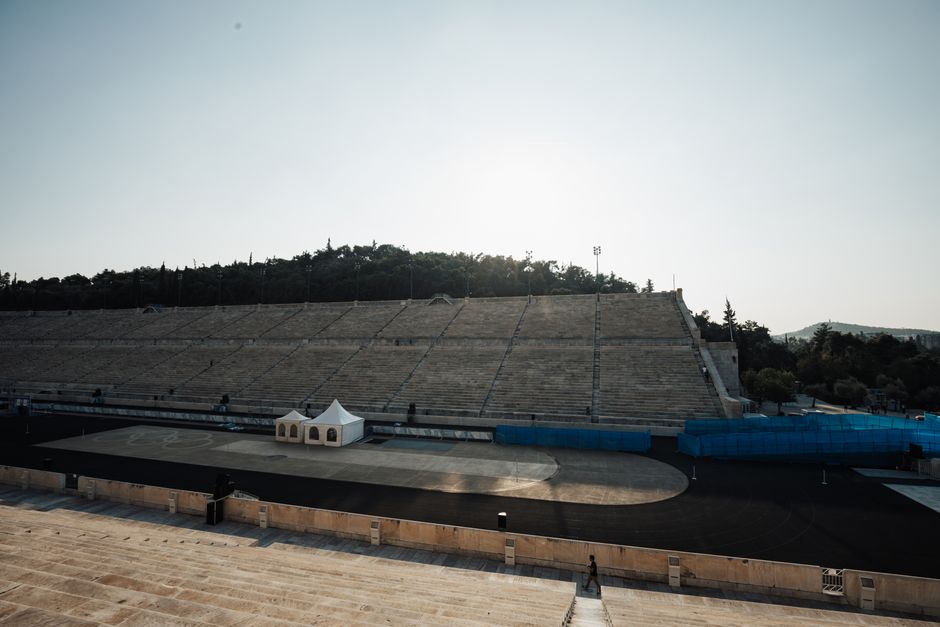
Running Your Own Victory Lap
The Panathenaic Stadium is the only Olympic-history stadium in the world that allows everyday visitors to run on the original marble track. Show up between opening time (8:00 AM) and closing, present your ID at the ticket office, pay the €10 stadium entry, and you have full access to the 192-metre marble straight and the U-shaped track for as many laps as you can manage. Wear proper running shoes; the marble is genuinely slippery, particularly in spots polished smooth by 130 years of athletic and tourist use.
The dawn jog hour (8:00-9:00 AM) is the quietest time. Many Athenian residents have a long tradition of running here as a daily exercise routine; you may share the track with a few locals but rarely more than 5-10 other runners during opening hour.
The Olympic and Athletic History
The Ancient Panathenaic Games
The Panathenaic Games, held every four years in honour of Athena, were one of the four major athletic festivals of the ancient Greek world (along with the Olympics, Pythian, and Isthmian Games). The stadium was the primary venue. Foot races, wrestling, pankration (no-rules martial art), chariot racing, and musical contests were all held during the festival, which lasted 8 days. Winners received amphorae of olive oil from sacred trees, with the largest awards going to the chariot-race champions.
The 1896 First Modern Olympics
When Pierre de Coubertin’s International Olympic Committee chose Athens as the host of the first modern Olympic Games, the Panathenaic Stadium was the obvious venue but had been derelict since the 4th century AD. Greek benefactor Evangelos Zappas funded the initial 1869 excavation; his cousin Konstantinos Zappas continued the work; the final reconstruction in white Pentelic marble was funded by Athenian Greek diaspora businessman George Averoff. The 1896 opening ceremony on April 6, 1896 drew over 80,000 spectators. Spyridon Louis, a Greek water carrier, won the marathon (the new Olympic event invented for the 1896 Games) and entered the stadium to one of the most-celebrated finish moments in sporting history.
The 2004 Olympics & the Marathon Finish Line
At the 2004 Athens Olympics, the Panathenaic Stadium hosted the archery competition and was the finish line of the marathon (with the marathon route running the same path as the 1896 original). The annual modern Athens Authentic Marathon, held every November, still finishes here.
Best Time to Visit
Early morning (8:00-10:00 AM) is the best time for both temperature and atmosphere. The white marble reflects intense heat in summer afternoons; the stadium feels like an oven from 11 AM to 4 PM in July-August. Late afternoon (5-7 PM) is the second-best window. Spring (March-May) and autumn (October-November) are the most pleasant overall seasons.
How Long to Spend
Allow 60-90 minutes for a thorough visit including the museum. A focused “see and run a lap” visit takes 30-45 minutes. The stadium combines well with the National Garden (5 minutes’ walk west) and the Temple of Olympian Zeus (10 minutes’ walk northwest) for a perfect 3-hour central Athens morning.
Photography Tips
Best angles: the panoramic shot from the upper rows of the U-shaped marble seating; the long straight shot running south down the track; the perspective from the open southern end looking up at the curved sphendone; and the tunnel-arch shot from inside the athletes’ tunnel. The white marble works best with the long shadows of early morning or late afternoon. Hand-held photography permitted everywhere; tripods technically prohibited but rarely enforced.
Combining with Other Athens Sites
The Panathenaic Stadium pairs perfectly with: the National Garden (5 minutes’ walk west), the Zappeion (10 minutes’ walk west), the Temple of Olympian Zeus (10 minutes’ walk northwest), and the First Cemetery of Athens (10 minutes’ walk south). A perfect morning route: 8 AM Panathenaic Stadium (90 minutes), 10 AM Temple of Olympian Zeus (45 minutes), 11 AM National Garden walk (45 minutes), 12 PM lunch at the Zappeion garden café. Total cost: €18 entry + €15-25 lunch.
Practical Tips
Wear sunscreen and a hat; the marble reflects intense UV in summer. Bring water; there are water fountains at the entrance but no shaded rest areas inside. The on-site café-bar by the entrance has cold drinks and basic snacks. Wheelchair accessibility is partial; the main entrance is wheelchair-accessible but the marble seating is not. Audio guides are included in the ticket price (11 languages available).
Frequently Asked Questions
What is the Panathenaic Stadium?
The Panathenaic Stadium (Kallimarmaro, “beautifully marbled”) is a multi-purpose stadium in central Athens, the only stadium in the world built entirely of white marble. Originally constructed in the 4th century BC, rebuilt in marble in 144 AD, restored for the 1896 first modern Olympic Games.
How much does it cost to visit the Panathenaic Stadium?
€10 standard adult ticket; €5 reduced for students and seniors. Free for children under 6 and school groups. Includes audio guide and entry to the on-site Olympic Posters and Torches Museum.
What are the Panathenaic Stadium opening hours?
March-October: 8 AM to 7 PM daily. November-February: 8 AM to 5 PM daily. Closed Greek public holidays.
Can I run on the Panathenaic Stadium track?
Yes. With a valid stadium ticket, visitors can run as many laps as they like on the 192-metre marble track during opening hours. Bring proper running shoes; the marble is slippery, especially when polished smooth.
Was the Panathenaic Stadium used in the 1896 Olympics?
Yes. The 1896 first modern Olympic Games opened in the Panathenaic Stadium on April 6, 1896 with over 80,000 spectators. The stadium hosted track and field events, and was the famous finish line of the marathon won by Greek runner Spyridon Louis.
How long does the Panathenaic Stadium visit take?
Allow 60-90 minutes including the on-site museum. A focused visit takes 30-45 minutes; an unhurried visit with the museum and a lap of the track takes 90 minutes to 2 hours.
What is in the Panathenaic Stadium museum?
The on-site Olympic Posters and Torches Museum displays the official posters from every modern Olympic Games (1896 to present), the official Olympic torches from each Games, and historical photographs of the 1896 opening ceremony. Free with stadium admission.
Is the Panathenaic Stadium walkable from the Acropolis?
Yes, 20 minutes’ walk via the Temple of Olympian Zeus and Hadrian’s Arch. The stadium pairs naturally with the Acropolis-and-Olympieion morning for a full classical Athens day.
Plan the Rest of Your Athens Trip
For more historical sites, see our pillar guide to Athens historical sites and museums, our Acropolis guide, our Temple of Olympian Zeus guide, our Ancient Agora guide, our top 25 attractions, and our unique Athens experiences guide.